

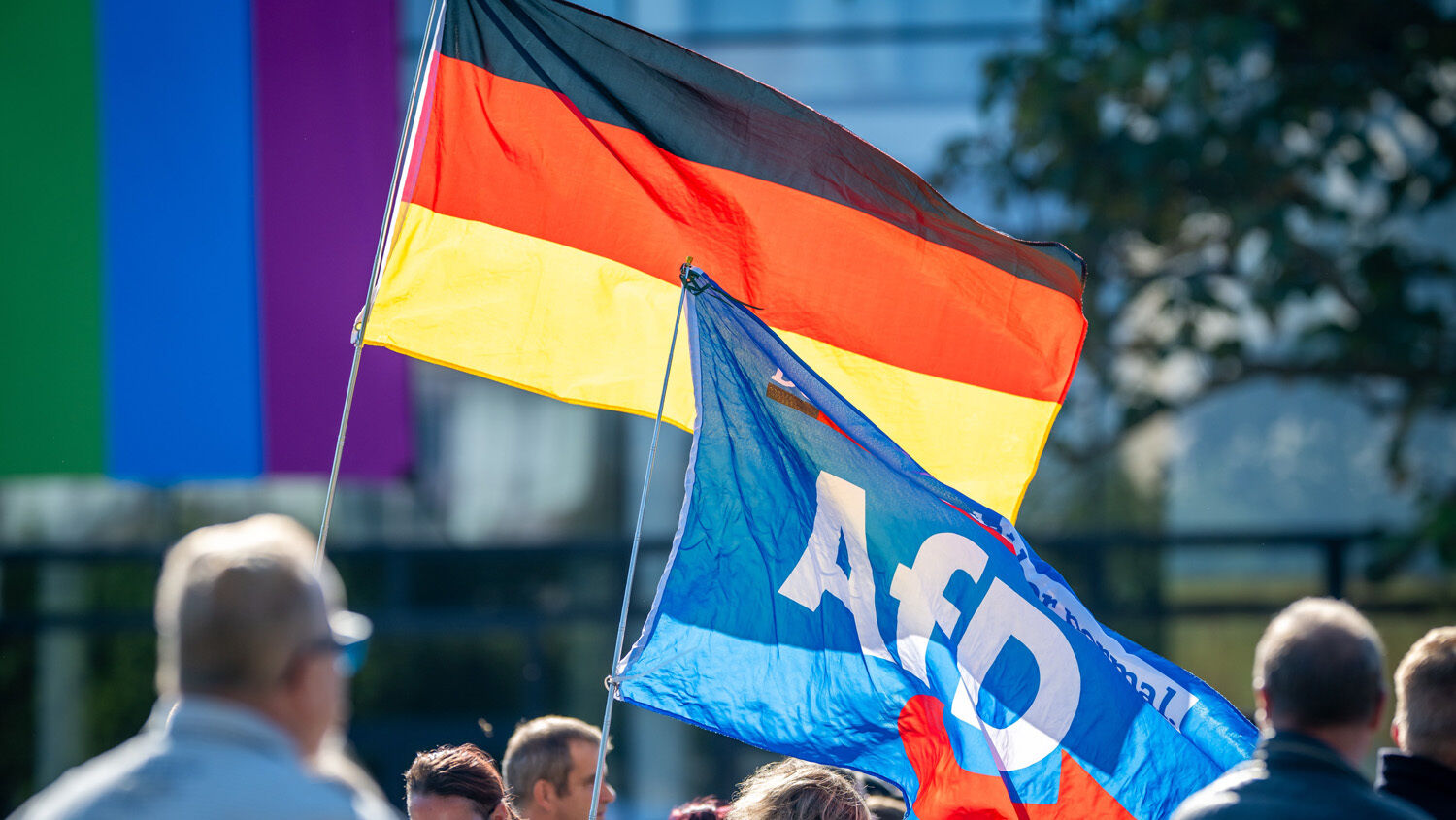
Guttenberg Sparks Controversial AfD Debate
Former German Defense Minister Karl-Theodor zu Guttenberg, along with politicians from his sister party, sparked a significant controversy yesterday regarding how to deal with the far-right Alternative für Deutschland (AfD) party.
The Christian Democratic Union (cdu) and Guttenberg’s party, the Christian Social Union (csu), have refused to work with the AfD due to the neo-Nazi views of some of its leaders. But as Stern reported, some prominent leaders now demand a change. Stern wrote:
Former Secretary General [Peter] Tauber declared the previous course of action in dealing with the AfD a failure and called for the Union to open up to substantive political cooperation with the AfD: “We should therefore consider a new policy of red lines, which would then also allow decisions to be made that the AfD agrees with.” The AfD would not be weakened if the public impression were “everyone against the AfD.”
The same article quoted Guttenberg saying, “Disenchantment cannot be achieved through boycott.” He meant that the mainstream parties’ boycott of the AfD will not cause its supporters to become disenchanted with the party. This and another statement led some to believe that Guttenberg, like Tauber, was demanding some cooperation with the AfD. This caused a media stir and a broader debate. Bild wrote:
With their call for cooperation with the AfD, prominent Union party figures Peter Tauber and Karl-Theodor zu Guttenberg have reignited the debate within the party about establishing a firewall.
It’s remarkable what a stir Guttenberg can cause with just a few words.
However, Guttenberg clearly stated in the same Stern interview that he continues to insist on no cooperation with the AfD. He noted:
For me, no party of the so-called center is electable if it flirts with a coalition partner that tolerates neo-Nazis, extremists and enemies of the constitution in its ranks. As long as the AfD gives such people a home, this incompatibility resolution must remain in place.
At its national conference in 2018, the cdu introduced the “AfD firewall,” officially called the “incompatibility resolution.” It states: “The cdu in Germany rejects coalitions and similar forms of cooperation with both the Left Party and the Alternative for Germany.”
On LinkedIn, Guttenberg stressed that he continues to support the firewall that bans cooperation with the AfD:
Some media outlets are claiming today that I am calling for a “normalization in dealing with the AfD” or a “softening of the firewall” with some former Union politicians.
This statement is fundamentally incorrect. A report in Stern magazine about an interview I gave to the magazine has apparently been grossly distorted by some media outlets. I am merely calling for a tough confrontation with the AfD on the issues.
While Guttenberg did call for a different approach to the AfD, he did not explicitly call for a coalition or even for an informal cooperation. He did say, however, that the political parties should confront the AfD openly—e.g. in debates. This in itself is controversial, as it provides an additional stage for the AfD. But ignoring the AfD has not worked; Guttenberg hopes such open confrontation might.
“There is a need for substantive confrontation, and in my opinion, that doesn’t happen enough,” he said. “What are we afraid of?” He noted that some AfD leaders are “intellectually shallow-rooted people.”
This is no different from what Guttenberg told Spiegel in May when he said he believes that a firewall in terms of “participation, voting and the like is correct.” However, he said they should attempt to reach the AfD voters to ensure that the voters themselves are not left behind the firewall.
Yet another statement of his raised even more questions. When asked, “Is a minority government with changing majorities conceivable for you?”, he stated:
That is never desirable. But if you don’t think this scenario through to the end, you run the risk of falling into a trap. If there is no stable option, you should be prepared with a Plan B for a state premier election. Whether anyone is already working on that plan—I have my doubts.
This scenario may become reality in some states in Eastern Germany. Polls indicate that the AfD could achieve 40 percent of the vote in Saxony-Anhalt; this means the cdu would have to form a coalition with three other parties to form a government that excluded the AfD. Two of these three parties are far left. While this is the most extreme example, it shows what a nightmare coalition negotiation could become.
The other option is a minority government with changing majorities. In theory, the AfD could still be excluded from any cooperation. In practice, however, this will become increasingly difficult. Many fear that a minority government will lead to cooperation with the AfD.
Concerning Guttenberg’s statement, cdu Member of Parliament Saskia Ludwig told Bild: “Of course, a minority government is an option in a democracy—even if decisions can only be made with the votes of the AfD.”
Thus, even though Guttenberg formally calls for noncooperation with the AfD, such cooperation may become necessary.
On the national level, we could see something similar by the next federal election in 2029 or in an earlier snap election. In his May interview with Spiegel, Guttenberg was asked if future cooperation with the AfD was conceivable. He answered:
I don’t think it can be ruled out. The AfD could reach 35 percent because it won’t be possible to tackle the monstrosity of tasks now facing this new government within two years in such a way as to regain the trust of the population. And because of this 35 percent possibility, which I hope will never occur, exclusion in 2029 cannot be ruled out, given the actions or inactions of the protagonists at that time. … They may end as junior partner, hopefully no one will ever do that. So I hope that none of this will happen.
So although Guttenberg hopes no one will cooperate with the AfD, he believes it could happen. And he indicates he would tolerate such cooperation and remain a member of the party.
Given Guttenberg’s continued rejection of the AfD, Stern asked him about cooperation with the Left. He replied that this firewall was already history given that “cdu/csu and the Left Party talk to each other when it comes to agendas or constitutional amendments.”
Guttenberg himself cohosts a popular podcast with left-wing icon Gregor Gysi, a former member of East Germany’s ruling Socialist Unity Party. In his podcast, Guttenberg often discusses the possibility of pushing through constitutional amendments with the help of the Left to avoid cooperation with the AfD. Many conservative politicians still reject such cooperation with the Left; some even favor cooperation with the AfD.
There are indications that Guttenberg is not entirely against cooperation with the AfD under certain circumstances.
In January, Germany’s parliament narrowly passed a resolution to tighten migration and asylum laws with support from the AfD. Chancellor Friedrich Merz was the opposition leader at the time and initiated the vote. “We will introduce [the proposals] independently of who approves them,” Merz said at the time. “If the AfD agrees, they agree. If they don’t, let them abstain. There are no conversations, no negotiations, no joint government between us.”
This was very controversial at the time, but Guttenberg defended the action.
The controversy was so great that Jewish journalist Michel Friedman took the drastic step of leaving the cdu after 43 years of membership. Friedman called the action “a catastrophic turning point for democracy in the Federal Republic” and an “inexcusable power play.”
On September 5, Guttenberg appeared on the ndr Talk Show together with Friedman and was asked to respond to Friedman’s warning.
Guttenberg asked if it wouldn’t have been better if a “great mind” like Friedman had stayed in the cdu to help shape the party. Friedman had protested when former German Chancellor Helmut Kohl bowed before SS graves in Bitburg but had stayed in the party. But now he thinks the cdu has fundamentally changed. Friedman then issued an emotional appeal and a warning of where Germany is headed. The moderators wanted to move on to lighter topics, but he insisted on sounding the alarm.
Friedman was vice chairman of the Central Council of Jews in Germany from 2000 to 2003. Much of his family was murdered during the Nazi era, and he fears history is repeating itself.
The brief dialogue was revealing. While Guttenberg publicly condemns the AfD, he may tolerate it. What’s more, his ideas about Germany’s future are very different from Friedman’s.
Where is Germany heading? Is it returning to its Nazi roots? “The rise of this extreme party is just one sign of a German society in trouble,” wrote Trumpet editor in chief Gerald Flurry last year in “Nazism Rises Again in Germany.” He showed that in Revelation 17 the Bible prophesies of Germany’s dark past reemerging. The same prophecy indicates that a strongman in the tradition of Charlemagne and Adolf Hitler will rise in this climate to lead Germany to its prophetic destiny. He noted:
Daniel 8:23 warns that “a king of fierce countenance, and understanding dark sentences, shall stand up.” This is referring to the coming leader of Germany. We can know this by putting this prophecy together with others. The prophecy in Daniel 11:40-45 says “the king of the north” shall rise “at the time of the end.” This is about a German-led European superpower. Isaiah 10:5-19 give a similar prophecy, adding that this leader shall be “the king of Assyria.” The modern Germans are the descendants of ancient Assyria. (For proof, read “The Remarkable Identity of the German People.”)
Daniel 8:23 supplies some key details about this soon-coming strongman. The Theological Wordbook of the Old Testament explains that “dark sentences” means riddles, difficult or dark speeches, sayings, questions or parables. It is used “at a higher social level.” Gesenius’ Hebrew-Chaldee Lexicon defines “dark sentences” as “twisted, involved, subtlety, fraud, enigma.” This strongman grasps things that are obscure, things you can’t understand without explanation or interpretation.
This is revealing insight. The prophesied strongman operates on a high social level. He is capable of understanding and solving complex issues and questions. He is brilliant and sophisticated, and he has intellectual depth and power. The context shows he enjoys notoriety and fame for it. …
The rise of the Nazi spirit in Europe is sobering. It certainly shows how the climate is ripe for the rise of this strongman.
Guttenberg is not known for socializing with AfD leaders, some of whom he considers to be “intellectually shallow-rooted people.” However, the party’s rise demands complex solutions, which he may be able to provide.
The future of the AfD in this prophesied empire is uncertain. But we do know that the extremist views of many of its members will be incorporated. There are also strong indications that Guttenberg himself will be the strongman leading this rising European empire. To learn more, read Mr. Flurry’s article “Watch This Man Closely.”


