

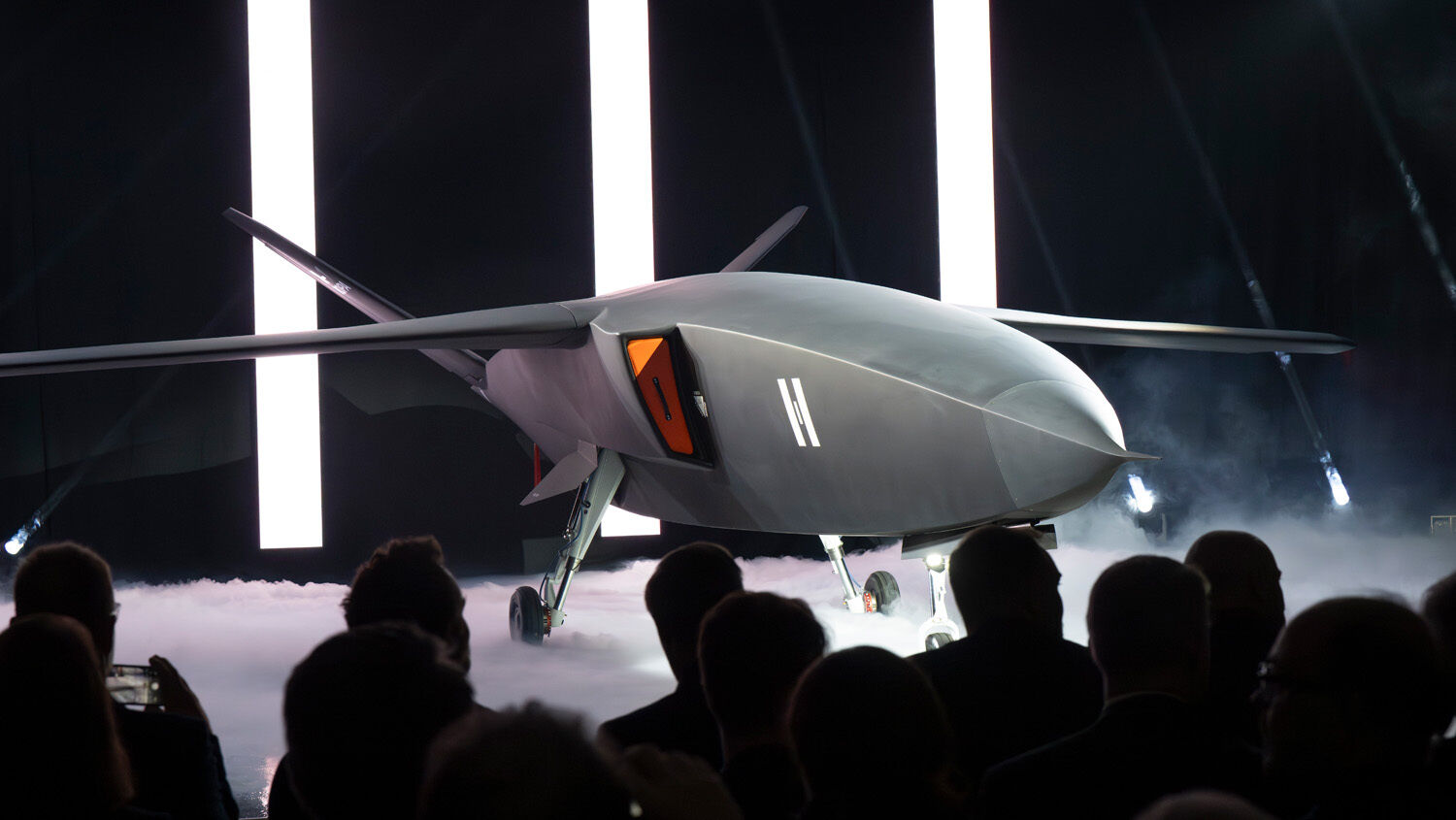
Helsing Races to Build Europe’s First Unmanned AI Fighter Jet
On September 25, Helsing presented the unmanned fighter jet, the CA-1 Europa, in the Bavarian town of Tussenhausen. It will be controlled by artificial intelligence and able to operate in a swarm of more than a hundred.
Helsing plans to mass-produce the jet within five years. The first test flights are planned for 2027. So far, only the United States and China have similar projects.
The machine is designed for reconnaissance flights, armed combat missions and electronic warfare. While most of its capabilities are secret, a few details are known:
- It is 11 meters (36 feet) long, with a 10-meter (33-foot) wingspan.
- It can carry up to four tons of configurable payload.
- It is capable of high-supersonic performance.
- It can conduct solo, wingman or swarm operations.
To advance the jet project, Helsing acquired the aircraft company Grob this year. Series production could begin in 2029.
We are thinking of swarms of several hundred aircraft.
—Torsten Reil, founder of Helsing
The wars of the future could look very different. The Times wrote:
Somewhere in the skies over the western Russian city of Pskov, four combat jets circle warily into a dogfight.
The two aircraft on the red team, steered by professional fighter pilots at the controls of a pair of simulators, twist and turn at hairpin angles in an effort to elude their blue pursuers.
One contrives to dodge an air-to-air missile and squeeze off a retaliatory shot. Yet they are fighting a losing battle—in the space of five minutes, one screen fills with flames as the jet is struck, and then the other is too.
The victor is an artificial intelligence (AI) algorithm that has picked up an entire career’s worth of aerial combat training in a matter of hours, according to its developers.
Now Helsing, a German-British start-up that is emerging as a prodigy of the European defense technology sector, is wiring the system into what it hopes will become the Western world’s first AI-guided and uncrewed fighter jet.
The article quoted Thomas Enders, the former head of Airbus and a board member of Helsing: “We’ve seen the results: If you feed this thing with data for a weekend, you can produce a pilot with [the equivalent of] a lifetime’s experience, or more. It’s a true revolution.”
Europe’s rapid military buildup is prompting a boom in military start-ups and attracting lucrative partnerships for unmanned combat aircraft. AeroTime wrote:
Several U.S.-developed platforms are moving across the Atlantic through industrial partnerships. General Atomics is adapting its yfq-42a collaborative combat aircraft for Europe with assembly in Germany. Rheinmetall and Anduril are working together to offer a European version of the yfq-44 Fury, while Airbus has teamed with Kratos to bring the xq-58a Valkyrie into German service from 2029. All three are designed to provide nato with affordable, networked combat drones before sixth-generation fighters arrive.
Led by Germany, Europe is becoming a military superpower. However, when facing Russia, China or the U.S., it may lag in experience and the number of trained combat personnel. AI systems could shrink this gap. A small cadre of skilled pilots might command hundreds of AI-driven fighter jets and drone swarms, executing complex, highly coordinated missions.
The Bible indicates what the future of warfare could look like.
“A prophecy in Revelation 9 describes the military equipment used in this warfare as swarms of locusts. Could these locusts be swarms of various aircraft coordinating their flight patterns through AI?” Trumpet editor in chief Gerald Flurry asked in “The Unknown Future of Artificial Intelligence.”
Lange’s Commentary states: “In antithesis to natural locusts, which desolate vegetation, these locusts leave unharmed all green things, attacking solely those men who have not the seal of God.”
Revelation 9:7-10 read: “And the shapes of the locusts were like unto horses prepared unto battle; and on their heads were as it were crowns like gold, and their faces were as the faces of men. And they had hair as the hair of women, and their teeth were as the teeth of lions. And they had breastplates, as it were breastplates of iron; and the sound of their wings was as the sound of chariots of many horses running to battle. And they had tails like unto scorpions, and there were stings in their tails: and their power was to hurt men five months.”
Lesson 32 of the Herbert W. Armstrong College Bible Correspondence Course reads:
John used the symbolic term locusts to describe the terrifying war machines that would be invented by scientists and used by the military in this final world conflict! Notice that these symbolic locusts, or grasshoppers, are driven by men and are able to fly (verses 7, 9). They will make a tremendous noise and are protected by armor plating.
These superweapons of destruction and world conquest were completely unfamiliar to the Apostle John. He could only describe them in the language of his day. These terrifying weapons of war probably now exist in design in our modern military arsenals. At the time of the fifth trumpet and the first woe, it will be plainly evident just what these weapons are and how they will be used.
A combination of manned sixth-generation fighters and swarms of autonomous fighter jets and drones would give the impression of swarms of iron locusts driven by men.
Mankind is getting closer to the fulfillment of these prophecies. “Watch ye therefore, and pray always, that ye may be accounted worthy to escape all these things that shall come to pass, and to stand before the Son of man,” Jesus Christ warned in Luke 21:36.
The Bible reveals that this war will become so devastating that Jesus Christ has to intervene to prevent total destruction.
To understand what the Bible prophesies about our day, enroll in the free Herbert W. Armstrong College Bible Correspondence Course.


