

Mystery of the Holy Roman Empire
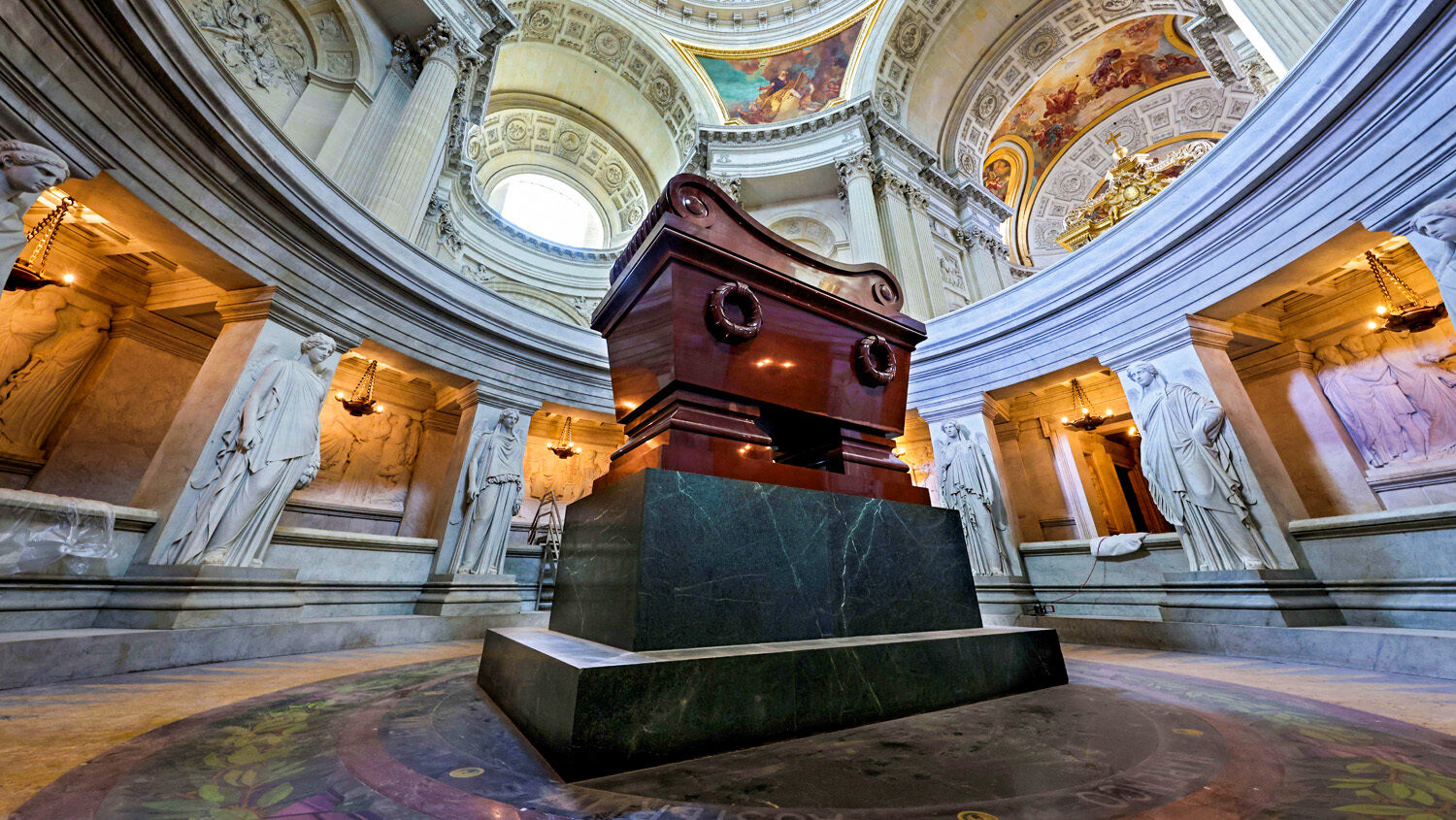
Surrounded by gleaming marble and under a brilliantly painted baroque ceiling lies Napoleon Bonaparte—or rather, what’s left of him. A magnificent set of coffins carrying the emperor’s ashes sit in a former church. Today, this church built under France’s kings is a secular tomb for the House of Bonaparte—modern France’s “founding family.”
The tomb is only one component of Les Invalides, France’s national military museum in Paris. The main building hosts galleries detailing France’s wars from centuries past. One highlight is the galleries describing France’s modern wars, from the Franco-Prussian War of 1870 to the end of World War ii. They showcase everything from the microphone Charles de Gaulle used to implore his countrymen not to surrender to the Nazis to a captured Nazi standard from the liberation of Corsica.
Les Invalides is considered Europe’s greatest military museum. But when I visited last week, I couldn’t help but notice a dichotomy. Half of the museum celebrated a man who tried to conquer all of Europe. The other half celebrated Europe’s liberation from another man who tried to do the same.
Habsburg Emperor Francis ii dissolved the Holy Roman Empire, the supranational union over much of Central Europe, before Napoleon could claim the title as emperor. But Napoleon built his empire from the legacy of the Holy Roman Empire. His second wife Marie Louise was a Habsburg. His son, buried close by him, held the title “king of Rome.” He brought the pope to coronate him in Notre Dame Cathedral, as the popes coronated the medieval emperors.
Adolf Hitler was also inspired by the Holy Roman Empire in building his realm. He chose the city of Nuremberg as his movement’s “spiritual capital” because it was one of the Holy Roman Empire’s historic capitals. He called his empire the “Third Reich” in homage to the Holy Roman Empire, the “First Reich.”
Seeing this dichotomy reminded me of a quote from Otto von Habsburg, the late heir of the Habsburg dynasty, on his views of modern Europe: “”The [European] Community is living largely by the heritage of the Holy Roman Empire, though the great majority of the people who live by it don’t know by what heritage they live.”
I wouldn’t put Napoleon Bonaparte quite in the same league as Adolf Hitler. Napoleon wasn’t quite the deranged psychopath Hitler was. But both were megalomaniacs who devoted their lives to bloody conquest and subjugating other nations. Their empires came in the spirit of the Holy Roman Empire.
Biblically, these resurrections of the Holy Roman Empire fulfill a prophecy in Revelation 17 of “a scarlet coloured beast, full of names of blasphemy, having seven heads and ten horns” (verse 3). Combining this chapter with prophecies in places like Revelation 13 and Daniel 7 show this to be a prophetic metaphor for the Holy Roman Empire. (Request a free copy of Herbert W. Armstrong’s Who or What Is the Prophetic Beast? for more information.) Verses 9-10 of Revelation 17 specify the “seven heads” represent seven consecutive incarnations of this empire.
Napoleon led the fifth incarnation of this empire. (Curiously enough, his remains are entombed in five coffins.) Hitler led the sixth. But the prophecy says there would be seven. That means there is one more to come.
The Trumpet expects this last resurrection to come from Europe’s ongoing unification project. This is the European Community, predecessor of the European Union, von Habsburg referred to. Europe’s leaders often mention the Holy Roman Empire as an inspiration in their efforts. But this is an irony. The EU’s “founding fathers” wanted to unify Europe with Hitler’s empire in hindsight. They wanted to create a solution to the problems that stemmed from Hitler. They thought uniting Europe through diplomacy would keep this empire dead and buried.
There is a missing dimension to the Holy Roman Empire that Europe’s unifiers then and today do not understand: Satan the devil.
The book of Revelation describes Satan as a dragon (e.g. Revelation 12:9). Revelation 13:2 reads of this Roman beast: “The dragon gave him his power, his throne, and great authority” (New King James Version). Verse 4 reads: “And they worshipped the dragon which gave power unto the beast: and they worshipped the beast, saying Who is like unto the beast? who is able to make war with him?” Revelation 12:3 says that this dragon has seven heads and ten horns. The Holy Roman Empire is made in Satan’s image.
Perhaps not every one of the human leaders of this empire had the same degree of evil. But they all came in the same spirit. According to the Bible, to one degree or another, they were all led by the devil.
Why was the devil leading them? To oppose God’s plan: “And it was given unto him [the beast] to make war with the saints, and to overcome them …” (Revelation 13:7). Perhaps the rule of some of these leaders did physically improve the lives of some people. Hitler healed Germany’s gutted economy. But that doesn’t make them righteous empires in God’s eyes. That should be the only opinion that matters.
The Holy Roman Empire is a mystery to this world. It is a legacy many would-be unifiers of Europe look to as a panacea for the Continent’s ills. But the great majority of Europeans don’t know what heritage they are trying to bring back. The great majority don’t know what evil spirit is also looking to rebuild Europe.
Without this spiritual perspective, one can look at Napoleon and Hitler and see two different legacies. It’s not only the French who do so. Winston Churchill saw Napoleon as a role model and decorated his estate with Napoleonic memorabilia. Britain’s esteemed historian Andrew Roberts titled his Napoleon biography Napoleon the Great. The United States Capitol Building hangs prestigious portraits of Napoleon and Justinian, another leader of that empire, as noble lawmakers worthy of emulation.
The Holy Roman Empire has been one of Western civilization’s most influential governments. It is easy to think of Hitler and his empire as the bad guys while the other incarnations were civilization’s zenith. It is easy to look at Hitler’s empire as an aberration of civilization, while the other heads of the beast were in a state of enlightenment. In Western historiography, the Dark Ages are called “dark” because “the light of Rome was extinguished”—saved only as it was kept alive by the Holy Roman Empire and the Roman Catholic Church.
Without the spiritual perspective, you can look the Holy Roman Empire right in the eye and not recognize it. You can look at the tomb of Napoleon and not realize Hitler’s empire came in the same spirit. You can look at Hitler and not realize his “god” was the same one that spawned the First French Empire. You can look at these historical empires and not realize the European Union is stemming from the same source.
Therefore, you can look at attempts to revive the Holy Roman Empire in Europe as good. People can even be persuaded to support the project as righting Hitler’s wrongs. But reviving this beast is not good. God prophesies this last resurrection will be bloodier than all others combined.
Revelation 17:8 reads: “And those who dwell on the earth will marvel … when they see the beast that was, and is not, and yet is.” People will be shocked when they see this vicious beast resurface one more time and bring destruction to the world. Perhaps part of the reason is because they didn’t know what to look for. Perhaps it’s because they didn’t know what it really meant for Europe to revive the heritage of the Holy Roman Empire. Ultimately, it’s because they don’t have—or refuse to have—God’s perspective.
To learn more, request a free copy of our book The Holy Roman Empire in Prophecy.


