
Is TRIPP a Trap?
Is TRIPP a Trap?

With the stroke of a pen, United States President Donald Trump attempted to solve a conflict that has festered since the 1980s. On August 8, he hosted Azerbaijani President Ilham Aliyev and Armenian Prime Minister Nikol Pashinyan in Washington to sign a joint peace declaration. It was the first diplomatic breakthrough between the two former Soviet countries in decades. If successful, it will change the geopolitics of the region and the world.
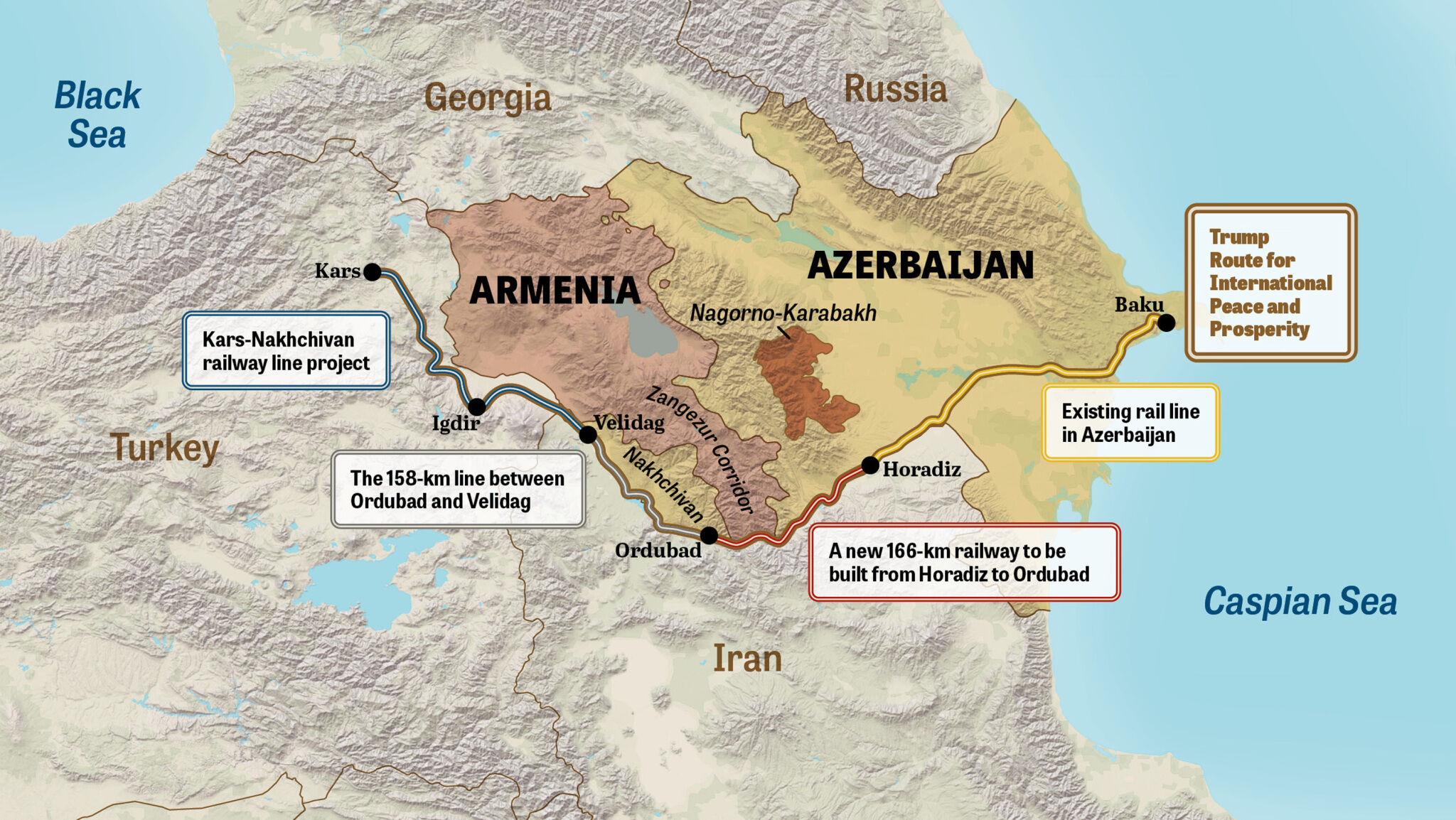
Each side declared acceptance of the other’s territorial integrity, committed to opening its borders with each other and with neighboring countries, and its willingness to sign a formal peace treaty. Armenia and Azerbaijan also agreed to the establishment of the Trump Route for International Peace and Prosperity (tripp), an economic supply chain connecting Azerbaijan with Turkey and the rest of Europe through southern Armenia.
Azerbaijan’s economy relies heavily on fossil fuel exports, but currently these and other goods must pass through Iran, Russia or Russia-influenced Georgia. tripp would fix this.
Armenia is also influenced by Russia and technically has a security alliance with it, but when Armenia activated that alliance during its last major skirmish against Azerbaijan, Russia gave little support. So the Armenians want to find a new security partner, and the Americans are interested in the Armenians.
The declaration is a nonbinding statement of intent, but if implemented, the U.S. will oversee the process and enable private American contractors to develop the corridor. This could include armed military and nonmilitary U.S. personnel.
The Caucasus has been an important area since Noah disembarked from the ark in this general vicinity. This temperate, mountainous region connects Europe and Asia, and passing through it are travelers and goods from the Black Sea, Caspian Sea, Russia, Turkey, Iran and points beyond. For thousands of years, peoples, nations and empires have warred over control of its warm-water ports, mountain passes, railways and, today, pipelines.
The U.S. drastically boosting its interest and its stake in the Caucasus would be a major move. But in such an important and complex region, it would need help.
Context
The roots of the Armenia-Azerbaijan conflict go back about 100 years. As dictator Joseph Stalin drew the boundaries of the Soviet Union’s socialist republics, he left Armenians in Azerbaijan and divided Azerbaijan in two, split by Armenia. Stalin and the Soviets tightly controlled both states, so these unnatural divisions made little difference until 1988, when Soviet rule was collapsing. At that point, the Armenian-majority territory of Nagorno-Karabakh voted to leave Azerbaijan and join Armenia, and the two sides erupted into war. A 1994 ceasefire put Nagorno-Karabakh under Armenian control, and the conflict remained frozen until 2020, when the Azerbaijanis launched a lightning military offensive. Since then, Azerbaijan has conquered Nagorno-Karabakh and even parts of Armenia proper.
President Trump is trying to create an entry point for a direct American presence in this small territory. Not only would this create opportunities for surveillance and projecting power, it would also diminish Russia’s and Iran’s economic leverage as Azerbaijan does business directly with Turkey and Europe. China, which is expanding its own trade networks to Europe, would also lose out in this region. The U.S. would gain a geopolitical advantage it has never had before, at minimal financial and diplomatic cost.
But there is one complicating factor: Turkey.
Self-serving Sultan
The complicated history and politics of the Caucasus force those who want to do business between Europe and Asia to pass through countries influenced by Russia or Iran, or through actual Russian or Iranian territory. tripp would offer an attractive way to bypass them by routing transit through Azerbaijan’s western exclave of Nakhchivan and its small border with Turkey.
Turkey is interested, to say the least. Though Armenia has yet to implement tripp, Turkey has already started constructing a significant rail line on its side of the border that would serve the plan. The Turkish government wants unimpeded access to Azerbaijan, especially its ports on the Caspian Sea; trade with Kazakhstan and its uranium; trade with Turkmenistan and its huge natural gas reserves; and trade with the rest of Central Asia, which has strong connections to Turkish history, culture and language.
However, there is a catch.

Since becoming Turkey’s leader in 2003, President Recep Tayyip Erdoğan has pushed to restore Turkey’s strength as one of Eurasia’s great powers. To this end, he has cracked down on dissent at home, helped oust the Assad regime in Syria, propped up governments in places like Libya, and sponsored terror groups like Hamas and the Muslim Brotherhood. Analysts call his vision for Turkey “neo-Ottoman,” because it attempts to restore the power Turkey had in the Ottoman Empire, which controlled much of the Middle East, Eastern Europe and North Africa from the 16th to the 20th century.
The Turks and the Ottomans lost control of the Caucasus well over a century ago, and it has never controlled Central Asia. tripp has the potential to help Erdoğan build a partially revived, partially brand-new economic empire out of what used to be Russia’s empire.
For all that the U.S. would gain from staking a new interest in the Caucusus, it would also become heavily dependent on Turkey. If Armenia and Azerbaijan descend into war again or other powers cause problems there, the U.S. would likely rely on Turkey, a nato ally, to help it project power, or, if the worst should happen, to shelter Americans as they evacuate.
But is Turkey a true friend of America and the West?
Erdoğan and his regime have clashed with Trump over a few issues, arbitrarily detained domestic and foreign journalists, and provided major resources to Hamas, even temporarily allowing the terrorist group to set up offices in Istanbul.
U.S. diplomats might dismiss these warning signs as insignificant, but should they?
Fatal Flaw in Peace Deals
The Armenia-Azerbaijan breakthrough brought reactions similar to those from the 2020 Abraham Accords between Israel and the United Arab Emirates. In both cases, the development was unexpected, likely wouldn’t have happened without President Trump’s efforts, and offered new potential in a troubled region.
Many were excited about President Trump’s Israel-U.A.E. deal, but Trumpet editor in chief Gerald Flurry wrote: “We all want peace. But sadly, these peace pacts have a deadly flaw. Biblical prophecy gives us deep insight into these recent agreements. It actually foretells that moderate Arabs will unite, somewhat like we are now seeing. But they are prophesied not to cooperate with the United States or Israel! A prophecy in Psalm 83 exposes a hidden reality behind these peace deals. We are already in the beginning stages of its fulfillment” (“Deadly Flaw in Mideast Peace Deals”).
Psalm 83:1-4 read, “Keep not thou silence, O God: hold not thy peace, and be not still, O God. For, lo, thine enemies make a tumult: and they that hate thee have lifted up the head. They have taken crafty counsel against thy people, and consulted against thy hidden ones. They have said, Come, and let us cut them off from being a nation; that the name of Israel may be no more in remembrance.”
The Jewish nation in the Middle East is called the State of Israel today. But the Jews come from the tribe of Judah, which was only one of the 12 tribes of ancient Israel. Judah and Israel were actually separate and even warring kingdoms for most of their biblical history. So when the Bible prophesies about “the name of Israel,” this actually includes other modern nations that descended from the other 11 ancient tribes, principally the United States and Britain. (Request your free copy of The United States and Britain in Prophecy, by Herbert W. Armstrong; article, page 23.)
Verses 6-8 list these enemies of Israel: “The tabernacles of Edom, and the Ishmaelites; of Moab, and the Hagarenes; Gebal, and Ammon, and Amalek; the Philistines with the inhabitants of Tyre; Assur also is joined with them ….” Neither biblical nor secular history records such an alliance, either in composition or purpose. Therefore Psalm 83 is a prophecy for our day. But what does this list of archaic, seemingly random peoples mean for us today?
“The key to unlocking this prophecy,” Mr. Flurry wrote, “is to know the modern descendants of these peoples. And God in this end time has supplied this key. Based on biblical and historical research and with God’s inspiration, Herbert W. Armstrong gave a good general idea of which nations these peoples correspond to today, equating the Ishmaelites with Saudi Arabia and the Gulf states, the Hagarenes with Syria, the Philistines with the Palestinians, Gebal and Tyre with Lebanon, Moab and Ammon with Jordan, and Edom and Amalek with Turkey. … Notice too that Assur, or Assyria, is on this list. This refers to modern-day Germany” (ibid).
“While it seems that these nations are moving away from radicalism and violence,” Mr. Flurry wrote, “we must look beneath the surface. After all, this prophecy reveals that they will take ‘crafty counsel’—subtle and shrewd dealing. This sure prophecy shows that these nations will ally to try to blot out the name of Israel forever! That is intense hatred!”
The prophecy lists Turkey as part of this alliance. Another prophecy forecasts in greater detail what the modern Turks will do.
Concerning Edom
Millenniums ago, God promised Abraham that his descendants would become great nations, nations that would change the course of human history (see Genesis 12, 15, 17, 26-28 and 35). This line of descendants went through Abraham’s son Isaac, and Isaac’s son Jacob, whose name God changed to Israel. It bypassed Jacob’s older brother, Esau, father of the Edomites.
The book of Obadiah is a prophecy “concerning Edom” (verse 1). It states that the descendants of Esau still have bitterness toward the descendants of Israel and will perpetrate a stunning betrayal against them!
“For thy violence against thy brother Jacob,” God thunders to Edom, “shame shall cover thee, and thou shalt be cut off for ever. In the day that thou stoodest on the other side, in the day that the strangers carried away captive his forces, and foreigners entered into his gates, and cast lots upon Jerusalem, even thou wast as one of them” (verses 10-11).
This connects to other prophecies that forecast the nations of Israel coming under attack by German-led Europe and the nations of the Psalm 83 alliance. The Turks will join this war, and notice what God tells them: “Neither shouldest thou have stood in the crossway, to cut off those of his that did escape; neither shouldest thou have delivered up those of his that did remain in the day of distress” (verse 14).
What does this passage mean?
The Trumpet explained in 1997: “These panic-stricken Israelitish refugees, by running to Turkey, will think they are entering friendly territory. … [T]o find favor with this terrifying European power, Turkey will betray the peoples of the very nations it is allied with today—ancestrally its own twin brother!” (December 1997).
Watch for this deal to ultimately empower Turkey most of all—and for Turkey to betray America! (article, page 12).
What else does Obadiah’s prophecy reveal? It reveals that these massive, consequential, dire world events are leading to an even greater world event!
“But upon mount Zion shall be deliverance, and there shall be holiness; and the house of Jacob shall possess their possessions. And the house of Jacob shall be a fire, and the house of Joseph a flame, and the house of Esau for stubble, and they shall kindle in them, and devour them …. And saviours shall come up on mount Zion to judge the mount of Esau; and the kingdom shall be the Lord’s” (verses 17-18, 21).
The events of Bible prophecy, which could only be known in advance by God, are leading to God’s direct intervention and the reestablishment of His government on Earth!
“God is sending saviors,” Mr. Flurry writes in Obadiah: The Most Terrifying Message in the Bible. “This is the good news. If God’s Laodiceans and the world heed our message, it will save them physically and spiritually. …
“This world’s greatest need is for saviors! … Strife on our weary planet is about to end forever! Jesus Christ is about to rule this Earth. We must not overlook the greatest Savior of all pictured in this book. ‘[T]he kingdom shall be the Lord’s’—forever!”
The terrifying prophecies recorded in Psalms, Obadiah, the Gospels and throughout the Old Testament and New Testament are unfolding now. The fulfillment of these prophecies is ultimately good news! If the Bible accurately, intricately recorded the rise of the nations of Israel, as well as their imminent fall, you can trust that it is accurate in its record of the next great world event—Jesus Christ’s return and the establishment of the literal Kingdom of God over Armenia, Azerbaijan, Russia, Iran, Turkey, Israel, the United States and all nations.


