

Why European Leaders Bow to Trump
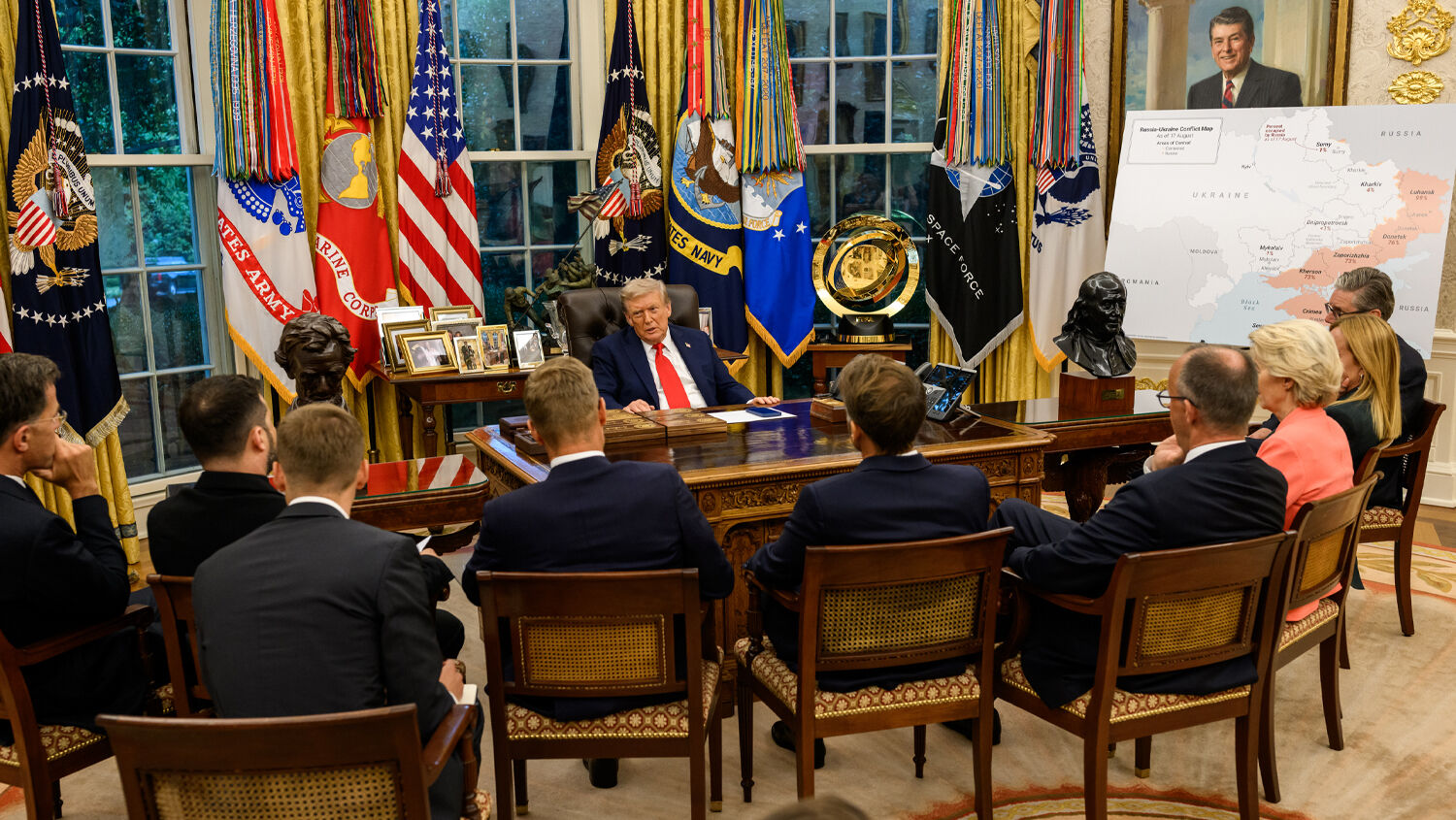
An iconic photograph went viral on Monday that captured European leaders gathered around United States President Donald Trump’s desk, listening intently. Social media commentators compared the scene—taken during recent Ukraine peace talks—to schoolchildren surrounding their teacher. With a president embodying America’s dominant global influence, European leaders appeared to be reduced to adolescents at most.
But the show of respect is part of their strategy.
Europe will never forget the meeting between Trump and Ukrainian President Volodymyr Zelenskyy on February 28. Tensions boiled over when Vice President JD Vance suggested that the war should be settled through “diplomacy.” Zelenskyy shot back that Russia had been advancing into Ukraine since 2014 and that years of diplomatic efforts and peace agreements had failed to halt President Vladimir Putin’s aggression. The exchange quickly escalated into a shouting match. A furious Donald Trump ultimately ordered Zelenskyy out of the White House.
Ever since, European leaders have implemented a new strategy: flattery.
Italian Prime Minister Giorgia Meloni led the way in April with a plan to “sweet-talk Trump on tariffs” as Politico put it.
German Chancellor Friedrich Merz followed suit. Although on election night, February 23, he spoke of Europe’s need for military independence from an unpredictable U.S. administration, his first meeting with Trump on June 5 was entirely free of drama. He presented Trump with a framed copy of his German grandfather’s birth certificate and expressed gratitude for ongoing German-U.S. cooperation.
Prior to the meeting, Carlo Masala, professor of international politics and director of the Institute for Strategy and Forecasting at the University of the Federal Armed Forces in Munich, revealed the strategy:
[Merz] must be assertive, but at the same time, of course, he must pursue the strategy that the Europeans have been pursuing for the past six months, or rather since Trump took office: constantly giving Trump the feeling that he is a great statesman with a clear vision. So I believe that this flattery combined with European self-confidence is the appropriate strategy, although there is no guarantee that it will ultimately be successful.
Many, particularly in the German language, have articulated this strategy: Flatter Donald Trump, give him the “feeling that he is a great statesman,” but continue to despise him.
During a nato summit at the end of June, member states bowed to Trump’s long-standing demand to drastically increase military spending. At the same summit, nato Secretary General Mark Rutte called Trump “Daddy,” honoring the U.S.’s authority in the alliance. For some, Rutte’s flattery went a step too far. But former German Defense Minister Karl-Theodor zu Guttenberg defended it on his July 1 podcast:
I mean, the connotation of “Daddy” is actually hardly appropriate for the seriousness of this alliance and everything, and yet a serious result has come out of it. So that’s why I think you have to look at what happened there through a slightly different lens, and the only task Mark Rutte really has now, even if he wants to continue to see nato as a defense alliance, is to keep the strongest military partner on board. And in particular … to avoid sending a signal of weakness to the outside world, of disunity, which we certainly had for years.
That’s the context of the recent meeting when the British prime minister, the French president, the German chancellor, the Italian prime minister, the Finnish president, the European commission president and the nato secretary general figuratively bowed before Trump. It was not out of deep reverence for the person or his country, but rather a goal-oriented show. These leaders flatter Trump and appeal to his vanity to get what they want in the long run.
The strategy appears to be working. While the U.S. has imposed tariffs on the European Union, the rates are far from the catastrophic levels once feared. American troops and nuclear weapons remain stationed in Europe, and Trump continues to affirm his commitment to nato.
Still, the appearance of unity is deceiving. The cracks are visible in the frequent criticisms of Trump, the underlying disagreements and, most importantly, in Bible prophecy.
While most people ignore the Bible as the source of understanding world events, it is the only accurate tool to foretell the future. Besides general instructions to not trust the deceitful hearts of men (Jeremiah 17:5-9), it also has many prophecies for our time today.
One of these prophecies is found in Jeremiah 4:30: “Though thou clothest thyself with crimson, though thou deckest thee with ornaments of gold, though thou rentest thy face with painting, in vain shalt thou make thyself fair; thy lovers will despise thee, they will seek thy life.”
Don’t be deceived by the humble looks of European leaders: They despise America and all it stands for. As Trumpet editor in chief Gerald Flurry wrote in “Germany’s Astonishing Military Rise”:
Notice: Our “lovers will despise” us! Look at the rhetoric of German leaders today and you see a lot of hatred toward America. Yet we have a romantic idea of Europe and view Germany as our lovers. What a contrast! Could the Bible have expressed it more to the point?
Ezekiel 23 warns against trusting Germany: “And they shall recompense your lewdness upon you, and ye shall bear the sins of your idols: and ye shall know that I am the Lord God” (verse 49).
If we paid any attention to these warnings, we certainly would not give the Germans our nuclear bombs!
It is true that Europe does not yet have the unity, power or leadership to act against the U.S. in a meaningful way. It is also true that Trump has negotiated more favorable deals than prior presidents. But soon the simmering hatred will lead to a horrific betrayal, as explained in Mr. Flurry’s article “America’s Naive Trust in Germany.”
Our world likes to cling to any sign of peace and unity. However, Jesus Christ warned that “nation shall rise against nation” and that “great tribulation” will engulf this world before He intervenes (Matthew 24:7, 21). Are we willing to believe God’s Word or do we trust the deceitful words of men?


