
Rheinmetall’s Infiltration of Britain
Rheinmetall’s Infiltration of Britain
For 16 years, Rheinmetall has steadily wedded itself to the United Kingdom’s defense industry. What began as a modest presence has expanded into a major national security vulnerability. This risk is now amplified by Rheinmetall’s rapid ascent in the European defense industry, raising urgent questions about Britain’s military autonomy.
This is a complete reversal of the reality Germany faced following its World War ii defeat. British Prime Minister Winston Churchill agreed in 1945 that Germany should undergo a “complete disarmament and demilitarization … and the elimination or control of all German industry that could be used for military production.”
Rheinmetall was one company that was to be dismantled. But by the 1950s, its military branch was revived.
In 2009, Rheinmetall Defense UK Ltd. was established with the goal to “enhance the capabilities of the UK’s armed forces.” Since then, Rheinmetall has become a critical provider of UK weapons systems. In 2019, British defense company bae Systems sold a 55 percent controlling share of its Land UK division to Rheinmetall.
Defense News wrote at the time that “the latest joint venture deal effectively puts control of Britain’s entire mainstream armored-vehicle design and manufacturing capabilities in foreign hands, with Rheinmetall joining General Dynamics and Lockheed Martin as the key primes in the British sector” (July 22, 2019).
Consider this lunacy: The British government broke up bae’s hold on the market and invited in a World War ii enemy that now dominates the European market. Since 2022, Rheinmetall’s share price has increased 20-fold.
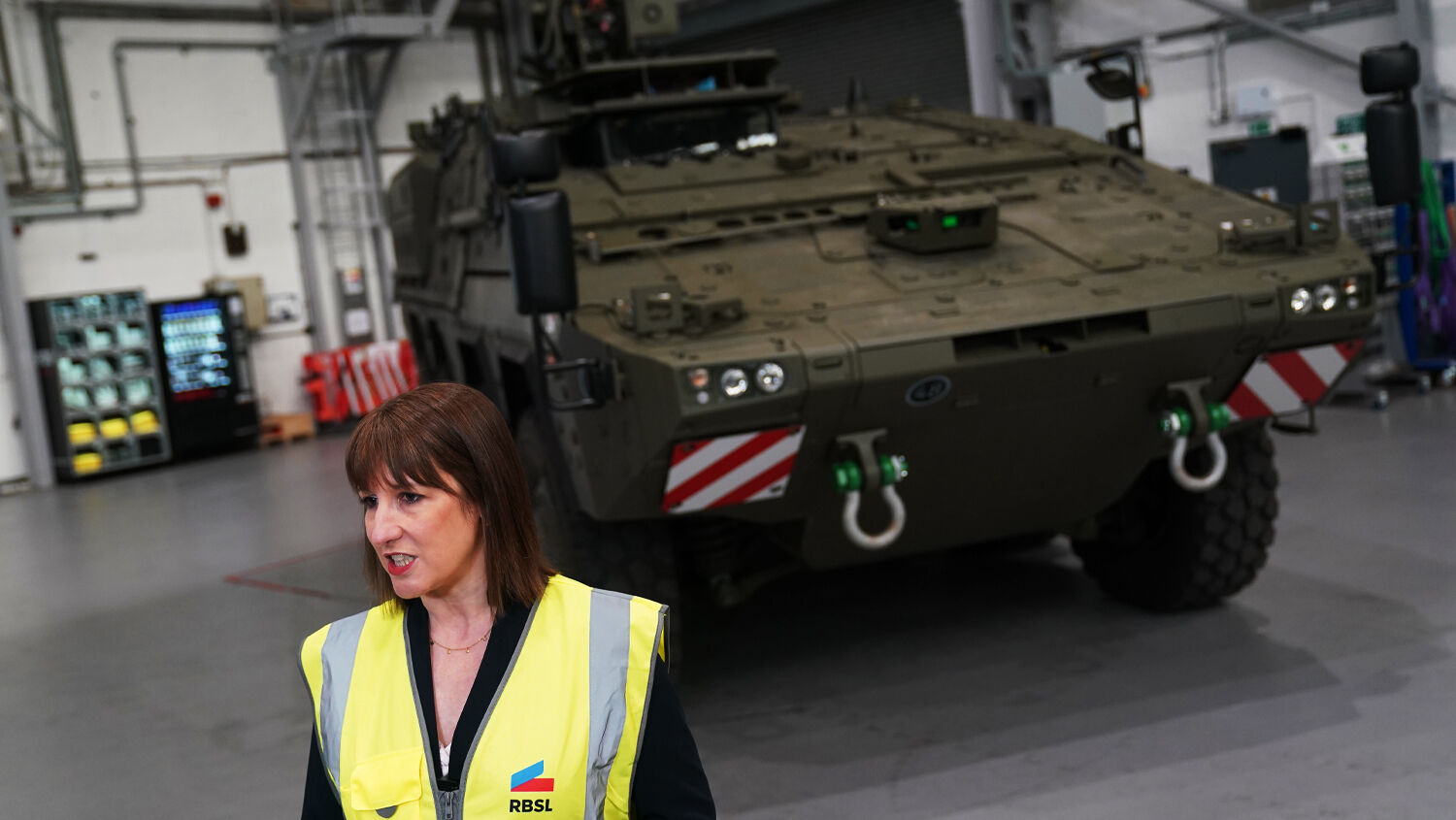
Rheinmetall partners with bae to deliver Boxer trucks and Challenger 3 tanks to the British Army. This gives it responsibility for Britain’s defense systems against a ground invasion and insight into some of Britain’s most vital weapons systems.
After the UK Defense Ministry announced its plan to buy more Boxer armored vehicles on June 7, 2021, Rheinmetall ceo Armin Papperger said, “We are proud to now be taking responsibility for one of the UK’s most significant army armament programs at this cradle of British combat vehicle manufacturing.”
In March 2024, Rheinmetall opened its first divisional headquarters outside of Germany: Rheinmetall House in Bristol, England. The new headquarters includes a collaboration and innovation center, coordinating with other Rheinmetall offices that have since opened in London, Telford, Newcastle, Bovington and the Isle of Wight.
Step by step, Rheinmetall is becoming integral to British defense.
On Oct. 23, 2024, Britain and Germany signed the landmark Trinity House Agreement that paved the way for a new Rheinmetall artillery gun barrel factory in the UK. The British government noted it marked the first time in a decade that artillery gun barrels were manufactured in Britain.
In May, it was announced that Rheinmetall had chosen Telford as the location for the factory. The facility “will directly support the Army’s future force structure and readiness for modern conflict,” Rheinmetall’s website states. The press release concludes: “This is more than a facility. It is a foundation for the future of British defense.” Nobody appears concerned with the UK entrusting Rheinmetall with its national security.
You could say that since Brits are still driving the tanks, the national security risk is minimal. That’s a short-sighted view, and in some cases, Brits are not even driving the tanks.
In cooperation with Rheinmetall, Britain’s Defense Ministry is experimenting with unmanned vehicles. In 2022, the British Army ordered four Rheinmetall Mission Master SP designed for surveillance purposes and three designed to transport cargo. Previously the UK procured eight Mission Masters developed by Rheinmetall Canada.
These vehicles are designed to operate in a “wolf pack” concept “working together to accomplish missions ranging from surveillance to target position transfer and slew-to-cue. The units communicate with each other using their advanced artificial intelligence capabilities to maintain rich situational awareness,” states Rheinmetall’s website.
But the one controlling the AI of this wolf pack is the same company that swore revenge on Britain when defeat drew near in World War ii. Mr. Flurry explained, “Toward the end of World War ii, Nazi leaders and industrialists got together to prepare for an inevitable military loss. A French spy attended one of these meetings and leaked the details to the Allies. The meeting was held on Aug. 10, 1944, in the Hotel Rotes Haus in Strasbourg, France. Among the industrial leaders present was a representative of Rheinmetall.”
This report was classified until 1996, by which time most of the world didn’t care. The Daily Mail said at the time, “U.S. Military Intelligence report EW-Pa 128 is as chilling now as the day it was written in November 1944.” Mr. Flurry commented, “Chilling indeed! And it is even more so if you understand that these secret plans have been meticulously carried out and are about to affect our whole world! Why don’t the media report on it?”
The day after Germany surrendered in World War ii, Herbert W. Armstrong warned: “We don’t understand German thoroughness. From the very start of World War ii, they have considered the possibility of losing this second round, as they did the first—and they have carefully, methodically planned, in such eventuality, the third round—World War iii!”
If Britain faced the truth, it would see it has opened the door to a treacherous enemy.


