

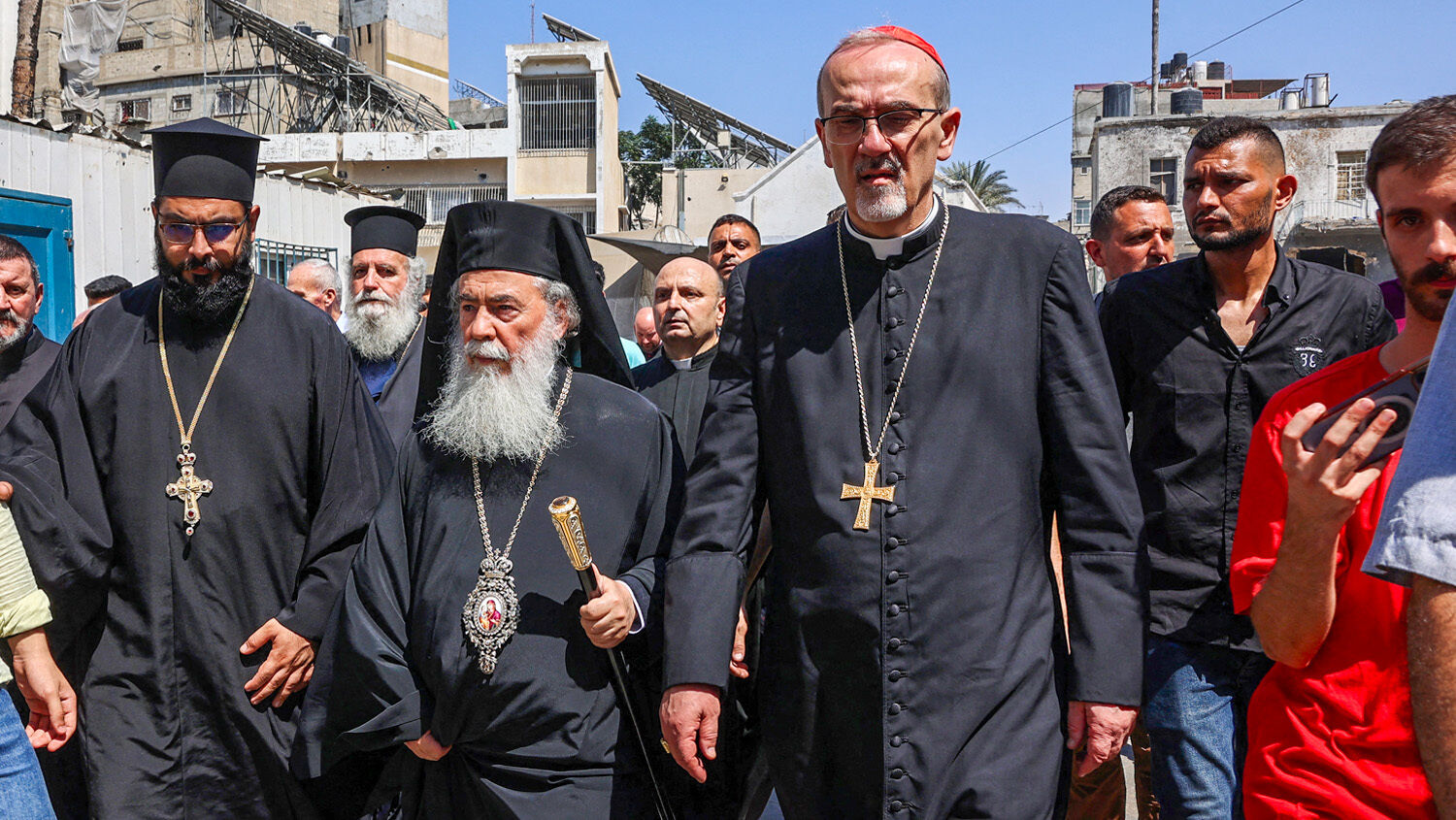
Patriarch of Jerusalem Accuses Israel of Massacring Catholics
The Israel Defense Forces (idf) struck the Holy Family Church, the only Roman Catholic church in the Gaza Strip, on July 17. The strike killed three people and injured nine others. Gabriel Romanelli, the parish priest, was lightly injured. The idf states the strike was accidental.
Israel’s Foreign Ministry released a statement saying: “The idf is examining this incident, the circumstances of which are still unclear, and the results of the investigation will be published transparently.”
The Catholic Church doesn’t accept the Israeli version of events. Latin Patriarch of Jerusalem Pierbattista Pizzaballa has jurisdiction over Gaza’s Catholics. He told Vatican News: “What we know for sure is that a tank, the idf says by mistake, but we are not sure about this, they hit the church directly.” A statement from the Latin patriarchate of Jerusalem “strongly condemns this tragedy and this targeting of innocent civilians and of a sacred place.”
Pope Leo xiv phoned Pizzaballa to express solidarity with Gaza’s Catholics. Pizzaballa told Vatican News the pope said that “it is time to stop this slaughter, that what has happened is unjustifiable, and that we must ensure there are no more victims.”
Such strong words could be expected when a region’s only Catholic community is hit like this. But there is more to these statements than may meet the eye.
Pizzaballa is essentially claiming the idf went out of its way to deliberately kill Catholics.
That is a grave allegation. What rationale is he using for this?
Casus Belli
Days before the church strike, there was alleged violence between Israeli settlers and Palestinian Christians in the West Bank community of Taybeh. Israeli settlers were accused of setting fire to the archaeological site of a ruined church. (This is despite evidence suggesting the Israelis were trying to put out the flames.) A priest reportedly phoned the Israeli authorities to intervene, but nobody did.
Pizzaballa visited Taybeh on July 14. He condemned the incidents and questioned the Israeli police’s nonresponse.
The Catholic Church believes the two events are connected. The Catholic magazine Pillar, citing “sources close to the patriarchate,” claimed “that internally church authorities were considering the possibility that the tank attack [on July 17] was a direct response” to the Taybeh visit.
That outlandish accusation is uncorroborated by hard facts. The idf is fighting a defensive war against Hamas. There is no reason to suspect the Catholic Church in Gaza would attract the idf’s attention. Every soldier in the idf knows the international community scrutinizes their every move. Why would a soldier go out of his way for bad press like this?
These are not Pizzaballa’s first accusations. In April 2023, he accused Israeli Prime Minister Benjamin Netanyahu’s “far-right government” of being involved in attacks on Christians in the Holy Land. “The frequency of these attacks,” he told the Associated Press, “the aggressions, has become something new.” He claimed Israelis “feel they are protected … that the cultural and political atmosphere now can justify, or tolerate, actions against Christians.”
Pizzaballa may genuinely believe some in Israel’s government want genocide against Christians. This is an outrageous lie lacking evidence. Even many of Israel’s biggest critics wouldn’t accept this charge.
Gaza’s Catholics number less than 200. There are worse crises hitting areas with much bigger Catholic populations. Israel has tens of thousands more Catholics than Gaza—people who are also feeling the effects of explosives raining down on them from Iran, a country that openly speaks of genocide against Israel. Yet it is the plight of Gaza’s Catholics that attracts the most attention from the Vatican. Romanelli had nightly phone calls with the late Pope Francis for most of the current war. The Vatican hasn’t given similar attention to the millions of Catholics in Ukraine, Lebanon and elsewhere.
Why the fixation with Gaza? It has to do with what Gaza represents.
Persona Non Grata
In 2014, Pope Francis made his first visit to Israel. But he didn’t travel to Israel directly; he visited Jordan first. He traveled to Israel via motorcade through the West Bank. Francis made an impromptu stop near Bethlehem at a section of Israeli security wall separating the West Bank. This particular section of the wall had graffiti comparing Israel’s treatment of the Palestinians to the Nazis’ Warsaw Ghetto in World War ii. Near graffiti stating “Free Palestine,” with news cameras poised, he started praying.
Trumpet editor in chief Gerald Flurry wrote the following after Francis’s photo op:
The pope knows how to use symbolism, and this is the symbol he created to show the world. It did not happen by accident! He created a photo op at that place for all it symbolized—a “symbol of division,” the Guardian calls it. That implies that it is a symbol of the Nazi spirit, with the Jews as Nazis.
The fact is, the pope wanted the world to see this image. Forget about what happened in World War ii, he is saying. Isn’t he implying that the Jews are the Nazis today? Many people will think so. Look around Europe: Many Europeans are starting to believe that about the Jews!
In his 2024 autobiography, Francis claimed: “According to some experts, what is happening in Gaza has the characteristics of a genocide. It should be carefully investigated to determine whether it fits into the technical definition formulated by jurists and international bodies.”
This is a ludicrous charge. But it shows the Vatican’s real opinion of Israel.
Francis seemed sincere in his beliefs. Pizzaballa was a Francis appointee both as patriarch of Jerusalem and as a cardinal. One would think Francis would appoint someone who matched his sentiments to be bishop over the Holy Land.
It’s not only the Catholic Church believing these sentiments. The Eastern Orthodox Church is echoing them.
E Pluribus Unum
When Pizzaballa visited the West Bank on July 14, he was joined by Eastern Orthodox Patriarch of Jerusalem Theophilos iii. His statement was a joint statement with the Orthodox patriarch. On July 18, the two patriarchs made another joint visit—to Gaza.
Pizzaballa and Theophilos surveyed the damaged church and met with local Christians. The Latin patriarchate stated their entourage included “hundreds of tons of food supplies as well as first aid kits and urgently needed medical equipment. In addition, the patriarchate ensured the evacuation of individuals injured in the attack to medical institutions outside Gaza where they will receive care.” Pope Leo spoke with both Pizzaballa and Theophilos once they entered Gaza.
The Orthodox patriarchate called Pizzaballa Theophilos’s “brother in Christ” and called the visit “a powerful expression of ecclesial unity and fraternal solidarity in the face of the deepening human suffering in the [Gaza] Strip.”
This marked a rare occurrence of Israel allowing foreign officials to visit Gaza.
Such cooperation between the Catholic and Orthodox patriarchs would have been very controversial decades back. The two churches haven’t been in communion with each other for almost 1,000 years. Officially, the two denominations still see each other as heretics.
The Trumpet and its predecessor magazine the Plain Truth have expected a Catholic-Orthodox reconciliation for decades. (See here for more information.) It seems one of the main catalysts bringing the two churches together is a shared support of the Palestinians.
There is an ulterior motive to the Catholic Church’s viewpoint.
Veni, Vidi, Vici
The Vatican’s relationship with the State of Israel has always been complicated. After World War i, the Vatican protested the planned creation of a Jewish state. After World War ii, when the international community was planning on dividing the Holy Land between Jewish and Arab states, the Vatican wanted international oversight with Catholic influence over Jerusalem. The Vatican only established formal diplomatic relations with Israel in 1993. This was after Israel’s former enemy Egypt did in 1980 and after the anti-Zionist Soviet Union did in 1991.
The Catholic Church has always seen Jerusalem and the region’s holy sites as its territory. For centuries, the Catholic Church has always had a presence in the land and used its presence to further its ambitions.
Could the Catholic Church today have similar designs on the Holy Land as it did in centuries past?
Revelation 17 speaks of a woman, a biblical symbol of a church. This woman rides a “beast” (verse 3), a biblical symbol for an empire (see Daniel 7). Combining with other relevant prophecies like in Revelation 13, this “beast” is revealed to be the Holy Roman Empire, a church-state combine that has repeatedly wreaked havoc around the world. Secular history demonstrates six resurrections so far of this empire. (Request a free copy of The Holy Roman Empire in Prophecy for more detail.)
Revelation 17:9-10 show there are to be seven consecutive resurrections of this empire. That means there is one more to come. The Trumpet expects this final resurrection to form in Europe in the near future. And the Trumpet expects the Catholic Church to play a pivotal role in building this empire.
As part of this, the Trumpet expects the Catholic Church to take an increasing interest in the Middle East, especially Jerusalem. Daniel 11:40-45 is a parallel passage showing what this coming empire, under the name “the king of the north,” will accomplish. (Our editor in chief Gerald Flurry’s free book The King of the South explains further.)
Daniel 11:45 reads: “And he [the leader of this coming empire] shall plant the tabernacles of his palace between the seas in the glorious holy mountain,” or Jerusalem.
Plain Truth editor in chief Herbert W. Armstrong wrote in 1951: “[T]he capital of this revived Roman Empire, along with the Vatican, will make a lightning move to Palestine—probably Jerusalem! That shall be the last abomination to be set up there! Notice, in Daniel 11:45, ‘tabernacle’ is a place of worship, and ‘palace’ the residence of a king.”
If the Catholic Church genuinely feels Israel is committing genocide against Christians, one must expect it to push itself more into the Middle East. Expect the Vatican to summon entire armies to fulfill its purposes.
To learn more, read “The Dark Side of the Pope’s Visit to Jerusalem.”


