
Canada, Australia, Britain—Brothers Charging In Opposite Directions

Canada, Australia, Britain—Brothers Charging In Opposite Directions
Canada, Australia and Britain share an imperial history, a language, a legal system, a government under King Charles and much more. In biblical prophecy, all are modern descendants of Ephraim. But in elections this past week, they couldn’t have had more divergent results.

Just one week ago, it looked like Canada and Australia might get right-wing governments, while Britain seemed wedded to the left. But the opposite happened. We reported on Canada’s stunning win for the left last Tuesday, and on Britain’s conservative swing on Friday—though this morning we’ll look at how it is even bigger than first thought. We begin, though with Australia’s election from Saturday:
An embarrassment for Australia’s right: Most polls had predicted a tight race or a hung Parliament. Instead, the center-left Labor Party, led by Prime Minister Anthony Albanese, wiped the floor with the conservative Liberal-National Coalition, led by Peter Dutton.
- Labor secured a second term with a strengthened majority, projected to win at least 81 to 87 seats in the 150-seat House of Representatives, up from 77 before the election.
- Meanwhile, Dutton lost his own seat to Labor, a rare event for an opposition leader.
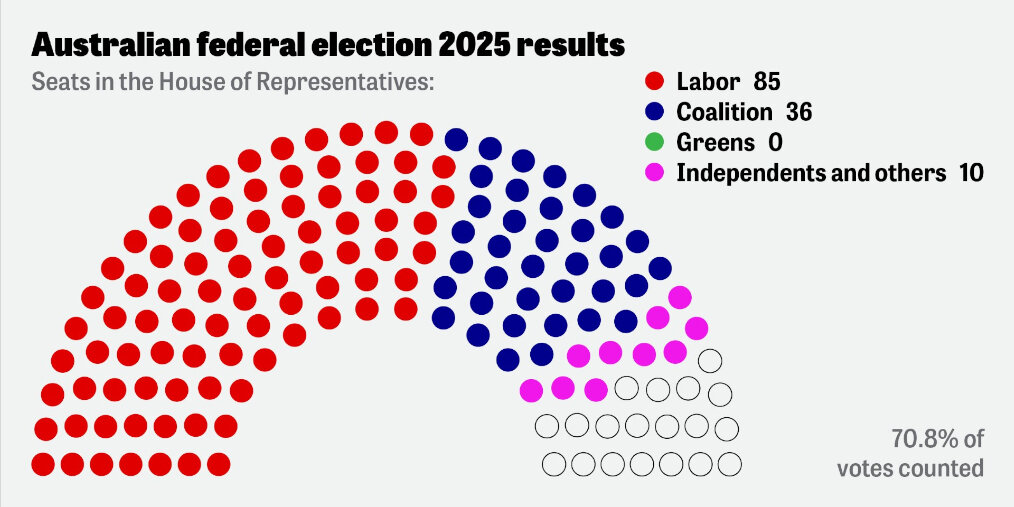
As in Canada, Donald Trump and tariffs are being blamed. Dutton had embraced rhetoric and policies reminiscent of Trump, including support for controversial immigration policies, public sector cuts, nuclear energy, and a doge-like initiative to improve government efficiency. So the narrative is that Dutton and the right were too much like Trump, and voters rejected the Coalition’s alignment with maga politics.
It’s not that far-left policies received a clear mandate, though. Labor campaigned on stability and center-left priorities like housing affordability, health care and renewable energy. The Greens, a more overtly left-wing party, performed poorly. Independents and minor parties captured about a third of primary votes, but didn’t significantly shift the outcome toward a broader left-wing coalition.
So while not as stunning, the result does mirror the anti-conservative shift in Canada. And Labor’s victory was decidedly different from what happened back in what was once called “the mother country”:
Reform victory was even bigger than we thought: This is a generational shift in British politics. Throughout the country, 23 county councils were up for grabs. Before the vote, people said it would be a big deal if Nigel Farage’s Reform party managed to win control of just one council. It won 10. The Conservatives and Labour won zero. Liberal Democrats won three. In the remaining 10, no one won an overall majority, but Reform was generally the largest party. If Reform performed like this in a national election, it would have a comfortable majority in Parliament, and Farage would be prime minister.
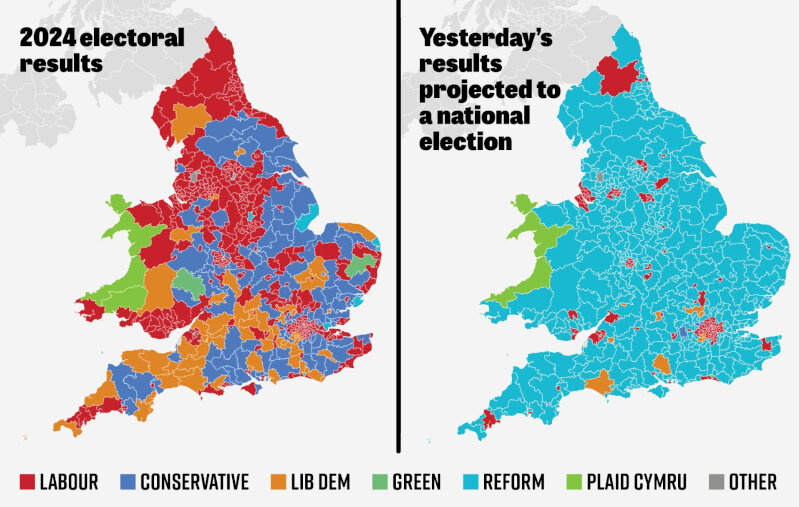
Farage has shown that Reform is a real contender. Now he must show they can govern. He has promised to set up a UK version of doge to cut costs in the local governments he now controls. He has pledged to cancel wasteful environmental programs and has told dei and environmental staff they can expect to lose their jobs.
The question is essentially the same as the one confronting Donald Trump: Can Farage deliver without getting tripped up by activist courts and judges?
It seems virtually every major political movement in the world is experiencing a “Trump effect,” positive or negative. It is driving countries into not only reactionary politics but also economic realignment and urgent militarization.
Meanwhile, this divergence in political outcomes for America and Britain, versus the other nations of Ephraim, will be interesting to watch play out. Even as other prophesied national alliances coalesce—especially in Europe and Asia, and between those two—and as the world moves deeper into the prophesied “times of the Gentiles,” these nations of modern-day Israel are growing more politically alienated from each other.
What happened to Israel’s missile defense? Yesterday, Yemen’s Houthi terror group launched a ballistic missile at Israel that hit the perimeter of Tel Aviv’s Ben Gurion Airport. About eight people were injured, none seriously. But flights were canceled for the day. The Houthis have been launching projectiles at Israel every Friday. Israel’s missile defense systems are considered world class, but technical failures enabled this missile to get through.
This is not the first time a Houthi missile has evaded Israel’s defense systems. In December, one hit a playground near Tel Aviv. Vulnerability to attacks from places as far away as Yemen is concerning. Our editor in chief Gerald Flurry wrote in “Is the Red Sea Crisis About to Fulfill Bible Prophecy?” why events in Yemen could soon capture the attention of the whole world.
IN OTHER NEWS
How to succeed in European politics: Our feature story today, by Josué Michels, examines Italian Prime Minister Giorgia Meloni’s secret to success: good relations with the Catholic Church.
Romania also shifts right: The far-right presidential candidate won the first round of elections in Romania on Sunday, our In Brief reports. The runoff will be held in two weeks.
U.S.-Japan relations took another hit on April 30, Peter van Halteren reports, with the indictment of a U.S. marine of rape and battery charges.
Clearing out Hezbollah: The Lebanese Army has dismantled over 90 percent of Hezbollah’s infrastructure near the border with Israel, our In Brief reports. This was part of the stipulations in November’s peace deal with Israel.
The end of an era: 94-year-old Warren Buffett announced he will retire as ceo of Berkshire Hathaway at the end of this year. In 1942 at age 11, he started using money from his paper route to buy stocks. Eighty-three years later he is retiring with a net worth of $168 billion. (He could have easily been the richest man in human history if he had not given $58 billion to charity.) His final warning to America is that the budget deficit is unsustainable and doge is important. Buffett once said, “I could end the deficit in five minutes. You just pass a law that says that anytime there is a deficit of more than 3 percent of gdp, all sitting members of Congress are ineligible for reelection.”


