

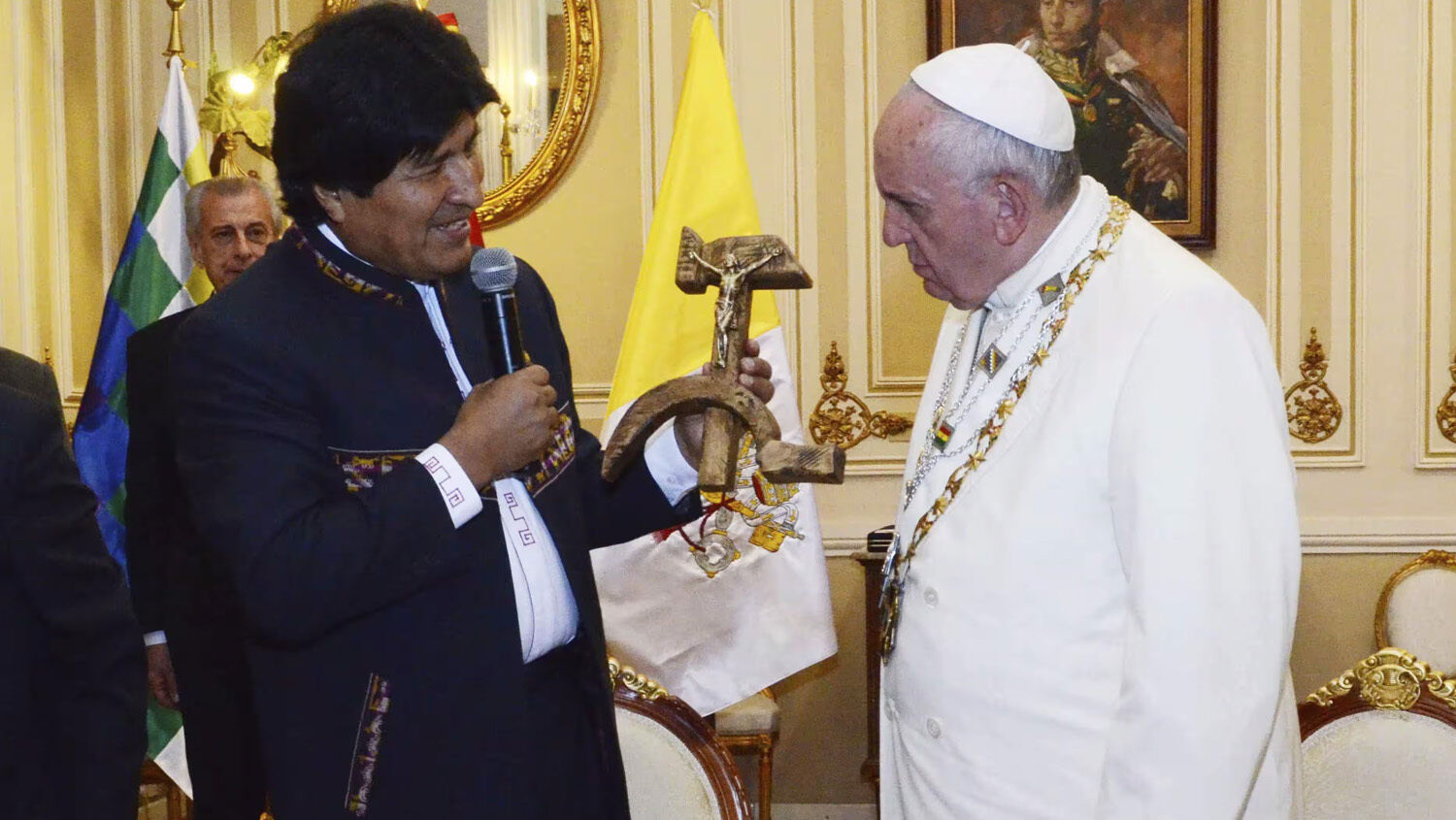
The Real Legacy of Pope Francis
Jorge Mario Bergoglio’s election as pope in March 13, 2013, caught many people by surprise. He seemed like a quiet, unpretentious Argentine more interested in the poor than in politics. In many ways, he was the antithesis of the ultratraditionalist that many assumed would replace Benedict xvi. Instead of warning about the twin dangers of secularism and Islam, the newly crowned Pope Francis went to great lengths to appease atheists, homosexuals, Muslims and transgenders. When challenged by conservative Catholics, he spoke of a calling “to not raise walls, but bridges.”
Now, Francis’s papacy has ended. He reigned for 12 years, the ninth-longest papacy since the 1800s, before he succumbed to double pneumonia this morning at 7:35. Within 15 to 20 days, elector cardinals from all over the world will gather for a conclave in Vatican City where they will debate Francis’s legacy and pick his successor.
In some ways, Francis’s pontificate was a failure. His efforts to reach out to immigrants and sexual deviants did not reenergize the Catholic Church the way he thought they would. In fact, the share of people identifying as Catholic in both Europe and the Americas is shrinking despite Francis’s evangelization efforts. The only regions where Catholicism is growing are in Africa and Asia, where the bishops are more socially conservative than they are in Western nations.
The cardinals who will gather for a conclave next month understand this reality and will likely elect someone more conservative than Jorge Bergoglio. Yet just because Francis’s woke outreach did not make Catholicism more popular does not mean that the College of Cardinals will abandon Pope Francis’s legacy completely.
The first ecumenical that Francis penned after his election was titled Joy of the Gospel (Evangelii Gaudium). It encapsulates Francis’s vision for mankind. Though it covers a range of subjects, the exhortation is especially notable for its attack on the free-market economic system practiced in the United States.
“Some people continue to defend trickle-down theories which assume that economic growth, encouraged by a free market, will inevitably succeed in bringing about greater justice and inclusiveness in the world,” the pope wrote. But “this opinion, which has never been confirmed by the facts, expresses a crude and naive trust in the goodness of those wielding economic power and in the sacralized workings of the prevailing economic system.”
In other words, Francis did not want people to be able to manage their own wealth. He wanted powerful central authorities operating under Catholic guidance to manage people’s wealth for them so that nobody gets left out.
Francis’s economic philosophy is sometimes called state capitalism, but it used to be called corporatism. While pure socialism is direct government control of resources (and people), Catholic corporatism permits people to engage in private enterprise but manages them heavily through corporations. These corporations group people together according to their natural interests and social functions so Catholic elites can regulate their buying and selling behavior.
The basic premise of Catholic corporatism (as described by Pope Leo xiii in an 1891 encyclical) is that the goal of equality is actually a cruel illusion: People are happiest when placed in a hierarchy guided by the Roman Catholic Church. Competition is spiritually demeaning; therefore, business, labor and the state must work together in corporations that control quotas, prices, wages, individual behavior and the entire economy. And corporations are controlled by Catholic elites. Abuses of this massive concentration of power are supposed to be prevented by Catholicism itself.
This system is basically a 21st-century version of medieval feudalism, in which employees play the role of serfs, corporate elites play the role of lords, and the Roman Catholic Church plays the same role it played in the Middle Ages.
Over the past century, many nations abandoned Catholic corporatism for free-market capitalism. Francis dedicated much of his papacy to reversing this trend. After the outbreak of the covid-19 pandemic, he established the Council for Inclusive Capitalism With the Vatican. Many have said this real-life organization seems like something out of a conspiracy-theory forum. Led by the pope and Cardinal Peter Turkson, it includes numerous leaders from Fortune 500 companies that comprise 200 million employees in 163 countries and an astonishing $2.1 trillion in market capitalization.
This council is led by a core group of 27 leaders it calls the Guardians for Inclusive Capitalism, which include the chairmen and chief executives of Allianz, Bank of America, BP, Dupont, Johnson & Johnson, Mastercard, Merck and Visa. The stated goal of the council is “to build a fairer, more inclusive and sustainable economic foundation for the world” by altering government, social and political laws and regulations.
Only time will tell how influential the Council for Inclusive Capitalism With the Vatican will become, but Pope Francis’s efforts to unite the world against free-market capitalism will be part of his lasting legacy. The College of Cardinals will likely elect someone more socially conservative to replace Pope Francis, but this man will continue to push Francis’s agenda for a new world order led not by the United States but by the Catholic Church.
In his book Isaiah’s End-Time Vision, Trumpet editor in chief Gerald Flurry explains the Bible’s prophecies that the world economy will be dominated by three power blocs in the end time: Tyre, Tarshish and Kittim. Tyre, he explains, represents the commercial center of the modern-day European Union; Tarshish is modern-day Japan; Kittim is modern-day China. Isaiah 23:1-3 say that the merchants of Tarshish will mourn when Tyre is overthrown. This shows that Japan and China will be in a close economic partnership with a German-led superstate that dominates world trade.
Other passages such as Revelation 17 and 18 show that the European economy will be dominated by a church ruling from a seven-hilled city. It so happens that Pope Francis died on April 21, the 2,778th anniversary of the founding of Rome. This is interesting, considering that Rome is the seven-hilled city spoken of in the book of Revelation. It will be the Roman Catholic Church that leads a great “mart of nations” against the U.S. in the end time. Pope Francis probably did more than any pope in history to turn global sentiment against free-market capitalism and its primary proponent, the U.S.
Bible prophecy forecast thousands of years ago that the bishop of Rome would wage war against the U.S. The late pope’s crusade against free-market capitalism has rallied many nations against America. Expect Francis’s successor—even if he does end up taking a firmer stance against woke policies—to continue his predecessor’s crusade against the free market and to be instrumental in America’s demise.
To learn more, read our free book The Holy Roman Empire in Prophecy.


