The ‘Holy’ in the Holy Roman Empire
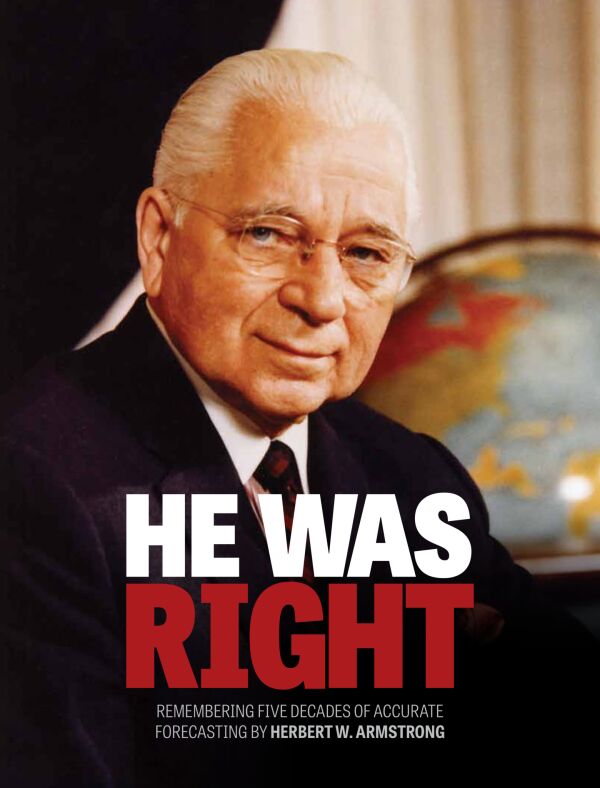
From the booklet He Was RightCopyright © 2010, 2012, 2014, 2017, 2024, 2025 Philadelphia Church of God
He was right about the revival of the Catholic Church
Many historians and analysts underestimate the role of the Roman Catholic Church in European history. Many also underestimate the extent of the Vatican’s involvement in the affairs of Europe and European countries today.
Herbert Armstrong never made this mistake.
We have seen how Mr. Armstrong for decades prophesied of the emergence in this end time of the seventh and final resurrection of the Holy Roman Empire. And though this globe-controlling “United States of Europe,” he warned, would be ruled by Germany, biblical prophecy points to the necessity of some additional power to glue the fractious nations of Europe together. After all, Daniel’s prophecy likened the final resurrection of the Holy Roman Empire to a brittle mix of iron and clay (Daniel 2:41-43). Matching Daniel 7 with Revelation 13 and 17, Mr. Armstrong understood that glue would be religion. Under God’s guidance, he linked these prophecies with history and came to see clearly that the deadly spiritual force guiding this European superstate would be the Vatican.
This Vatican is the “holy” in the term Holy Roman Empire.
“Europeans want their own united military power!” Mr. Armstrong wrote in 1978. “They know that a political union of Europe would produce a third major world power, as strong as either the United States or the ussr—possibly stronger! … But they well know there is but one possibility of union in Europe—and that is through the Vatican” (Good News, Aug. 28, 1978; emphasis added throughout).
To members and co-workers he wrote on January 23, 1980: “What Russia is doing will be the spark to bring the heads of nations in Europe together with the Vatican to form a ‘United Nations of Europe.’ The politicians cannot do this by themselves. Only with the collaboration of the pope can they do it.”
“I have been proclaiming and writing ever since 1935 that the final one of the seven eras of the Holy Roman Empire is coming in our generation—a ‘United States of Europe,’ combining 10 nations or groups of nations in Europe—with a union of church and state!” he wrote in the January 1979 issue of the Plain Truth. “The nations of Europe have been striving to become reunited. They desire a common currency, a single combined military force, a single united government. They have made a start in the Common Market. They are now working toward a common currency. Yet, on a purely political basis, they have been totally unable to unite.
“In only one way can this resurrected Holy Roman Empire be brought to fruition—by the ‘good offices’ of the Vatican, uniting church and state once again, with the Vatican astride and ruling (Revelation 17:1-5).”
Herbert Armstrong and the Plain Truth continually referenced Europe forming a church-state union under the auspices of the Vatican.
A Catholic Creation
Did you know that most of the EU’s “founding fathers” were staunch Catholics?
To men such as Jean Monnet, Robert Schuman, Alcide De Gasperi, Otto von Habsburg and Konrad Adenauer, the European project was a religious ambition as much as it was a political aspiration. The Catholic Church, to recognize their pursuit of a Catholic European empire, is in the process of canonizing both Schuman and De Gasperi. Again, these men were politicians, not priests.
Most people today have no understanding of how central the Vatican and the Catholic Church were in creating what we now know as the European Union. In 1962, Topic, a prominent British magazine at the time, wrote: “The Vatican, usually cautious over political changes not of its own inspiration, now considers the Common Market the work of divine providence. Not since the times of Spain’s Charles v has a Roman Catholic political force been so strongly welded. Not since the end of the Holy Roman Empire has the Holy See been offered a Catholic rallying point like the Common Market. If the ‘Pact of Rome,’ which created the Common Market, had been signed within the Vatican walls, it could not have favored the church more.”
In The Principality and Power of Europe, a book exposing the origins of the European Union, Adrian Hilton writes, “Europe’s leaders and the Roman Catholic Church are still working together towards the common goal of unity. Many of Europe’s political leaders … see a crucial role for the Roman Catholic Church in their efforts, providing a powerfully cohesive common religion to hold Europe together politically.” How many people today realize this—that the Vatican is one of the chief architects of European unification?
“Since World War ii, each pope has thrown his weight behind moves toward the creation of a supranational European union,” Hilton continues. “Pope John xxiii insisted that Roman Catholics should be ‘in the front ranks’ of the unification effort. In 1963, Pope Paul vi declared: ‘Everyone knows the tragic history of our century. If there is a means of preventing this from happening again, it is the construction of a peaceful, organic, united Europe.’ In 1965, he further observed: ‘A long, arduous path lies ahead. However, the Holy See hopes to see the day born when a new Europe will arise, rich with the fullness of its traditions.’”
In 1975, Pope Paul vi declared this concerning European unification: “Can it not be said that it is faith, the Christian faith, the Catholic faith that made Europe? … It is there that our mission as bishops in Europe takes on a gripping perspective. No other human force in Europe can render the service that is confided to us, promoters of the faith, to reawaken Europe’s Christian soul, where its unity is rooted.” Knowing the history and prophecy of the Holy Roman Empire, that statement is chilling!
A Force for Unity
Throughout the Soviet era, the Plain Truth encouraged its readers to “[l]ook for the Vatican to exert more influence in European affairs. … Vatican influence over European affairs is destined to grow in the months ahead” (August-September 1970).
As we have already seen, the Catholic Church played a vital role in breaking Eastern Europe out from behind the Iron Curtain and allowing it to join the European Union. But the papacy had grander ambitions.
On November 9, 1982, Pope John Paul ii, speaking on his pilgrimage to Santiago de Compostela, Spain, issued the following declaration to Europe: “I, bishop of Rome and shepherd of the universal church, from Santiago, utter to you, Europe of the ages, a cry full of love: Find yourself again. Be yourself. Discover your origins, revive your roots. Return to those authentic values which made your history a glorious one and your presence so beneficent in the other continents. Rebuild your spiritual unity. … You can still be the guiding light of civilization.”
From the mid-1990s, the Trumpet eyed the German Cardinal Joseph Ratzinger as a potential replacement for the ailing John Paul ii. In April 2005, when he took to the papal throne under the name Benedict xvi, this became reality.
His chosen name, Benedict xvi, was inspired by the life and work of Benedict of Nursia, a fifth-century monk venerated as the patron saint of Europe and the founder of the Benedictine monasteries.
During his first speech as pope in 2005, Benedict praised his namesake and explained how he laid the groundwork for European unification. “[Benedict] represents a fundamental point of reference for the unity of Europe and a strong reminder of the unrenounceable Christian roots of its culture and civilization,” he stated
On March 13, 2013, Cardinal Jorge Bergoglio was elected Benedict’s successor. The Argentinian Jesuit assumed the name Francis i, after Francis of Assisi—founder of the devout, humble and evangelistic Franciscan order of priests.
The selection of the Argentinian caught many by surprise. He was the first non-European pope in more than 1,200 years, the first-ever pope from the Americas, and the antithesis of the ultratraditionalist that many assumed would replace Benedict xvi.
Francis began reaching out to all religions, meeting with leaders from the Orthodox Church, Anglicans, Lutherans, Methodists, and also Jews, Muslims, Buddhists and Hindus. Francis decided to forgo the papal limousine and luxurious apartments in the Apostolic Palace and to instead use a regular car and live in a small guesthouse apartment.
Many people were stricken with Francis fever. “Suddenly, being a Catholic feels good,” Catholic author Cristina Odone wrote in the Telegraph on November 17, 2013. “I am so grateful to [Pope Francis] for making Catholic a word that does not automatically conjure up thoughts of homophobia, sexism and pedophilia.” Pope Francis made gentle jokes and won hearts. He delighted many with his modesty and gentleness, his seemingly inclusive overtures and his apparent desire to steer the curia away from absolutism and conservatism. He spawned a surge in Catholic Church attendance in Italy, the United Kingdom, Spain, France and all Latin American nations.
Francis had the respect of the media: Foreign Policy called his the most impressive voice in the international arena; Time named him Person of the Year for 2013.
When Pope Francis died on April 21, 2025, he was succeeded by an American who seems cast in a similar mold. How will this man advance the prophecies of the Bible?
The final iteration of the Roman Catholic Church described in Bible prophecy, and which Mr. Armstrong wrote so prolifically about, will unite Europe in the Holy Roman Empire. It seems the American Pope Leo xiv would be unable to accomplish that. This would suggest that there will be at least one more pope to follow him.
Bible prophecy says that, in the end time, the Roman Catholic Church’s leadership will appear to be gentle, sincere and “like a lamb” (Revelation 13:11). What we can be sure of is that the Vatican will continue working to win hearts, to sway European affairs, and to position itself as the “spiritual binding force” prophesied to ultimately bind Europe together. We can be sure that the “mother” church will once again serve as the cultural glue enabling the restoration of the ancient Holy Roman Empire.
Bible prophecy makes it inescapably clear.
Continue Reading: Returning to the Fold