

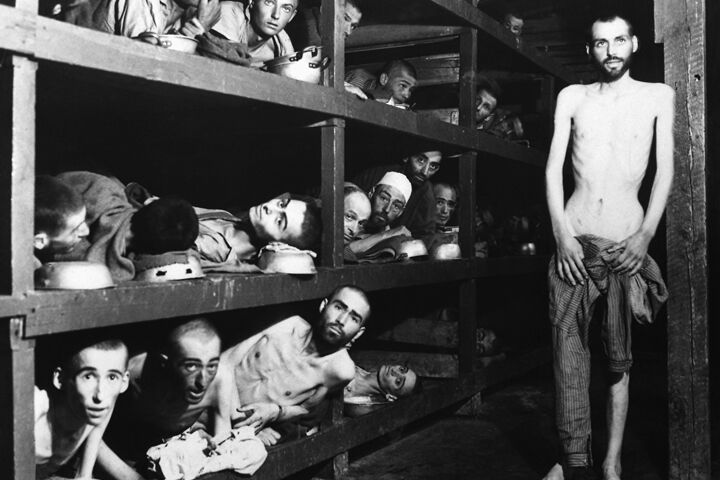
Never Again?
Earlier this week, my family and five Herbert W. Armstrong College students visited Israel’s Holocaust History Museum at Yad Vashem. Thousands of people visit the site every day, making it the second most popular tourist attraction in Israel, after the Western Wall.
The 4,200-square-meter museum was built atop the Mount of Remembrance, which overlooks the beautiful hills of Jerusalem. The museum itself, however, is mostly underground and is shaped like a massive triangular prism made of thick concrete walls. It’s as if you’re visiting an indestructible vault that was made to protect the largest collection of Holocaust documentation in the world. The museum contains over 100 million pages of evidence documenting the Holocaust, as well as 420,000 photographs and 100,000 survivor testimonials.
Each display inside the museum is organized chronologically and begins with the most significant events that led up to the Holocaust—Mein Kampf becoming a bestseller in Germany years before the emergence of Nazism, Hitler’s rise to power by democratic means, the dizzying transformation of Germany into a totalitarian state in less than one year, the establishment of the first concentration camp in 1933, Christianity’s anti-Semitic alliance with fascism, the Western media’s willful blindness, Germany’s conquest of Austria without having to fire a shot, the Anschluss, appeasement in Munich, Kristallnacht, Hitler’s vow to annihilate “the Jewish race in Europe,” the secretive Molotov-Ribbentrop alliance and then, finally, Germany’s invasion of Poland.
Hitler was appointed chancellor of Germany on Jan. 30, 1933. Within weeks, the Nazi Party began to assume unprecedented power, under the guise of protecting Germany, in its current “state of emergency,” from Communists and socialists. At the same time, new laws were being passed that barred Jews from public office, or holding medical or educational positions. Jewish book burnings and boycotts were encouraged. One year later, Hitler combined the office of chancellor and president when German President Paul von Hindenburg died, proclaiming himself Führer and Reich chancellor.
Two and a half years after becoming chancellor, Hitler instituted the Nuremberg Laws, which defined Jews as a separate race and stripped them of their basic civil rights. They were classified more as property of the state rather than as citizens.
And yet, despite these many disturbing warning signs, Western nations turned a blind eye to Germany’s “domestic” problems. None were willing to confront the madman early. World War ii wouldn’t officially begin for another four years.
Six years after that, by the time the war ended, approximately 50 million human beings had been slaughtered. Six million Jews were murdered in death camps all across Europe.
It was the deadliest, most destructive conflict in human history.
The name Yad Vashem is taken from Isaiah 56:5: “And to them will I give in my house and within my walls a memorial and a name [in Hebrew, Yad Vashem] that shall not be cut off.” The 45-acre campus is a noble memorial to ensure the lives—and names—of each of the victims are never forgotten. Whenever the Holocaust is remembered, it is remembered with the determined phrase, never again.
But as hard as it is to think about, the Bible says mankind will bring upon itself such horrors as these again.
In this end time, Jesus Christ prophesied, “For then shall be great tribulation, such as was not since the beginning of the world to this time, no, nor ever shall be” (Matthew 24:21). Jesus said this end time would be worse than anything mankind has ever experienced—including the Holocaust.
But most people—even as earthshaking military alliances form, as totalitarian regimes devour whole nations, as the spirit of hatred and racism explodes in front of us and as the protectors of freedom and democracy enter into full-scale retreat—will simply refuse to believe that anything this catastrophic could ever happen again.
Just as the people of Hitler’s day failed to fully realize the depth of horror the world would reach before it was all over, so will it be again in this end time.
This is why Christ warned, “Take heed to yourselves, lest at any time your hearts be overcharged with surfeiting, and drunkenness, and cares of this life, and so that day come upon you unawares” (Luke 21:34).
In 2008, Trumpet editor in chief Gerald Flurry wrote, “Daniel 8 speaks of a fierce German ruler [Antiochus] to come ‘in the latter time.’” It is clear from the context that this is referring to the same “end time” that Christ spoke of in Matthew 24 and Luke 21.
“Daniel 11:21 says this end-time Antiochus will ‘come in peaceably, and obtain the kingdom by flatteries,’ yet will be a vile person,” he continued.
Daniel 8:25 says, “And through his policy also he shall cause craft to prosper in his hand; and he shall magnify himself in his heart, and by peace shall destroy many ….” My father wrote, “This king comes acting like he wants peace, but he is lying! He will be a ruthless and violent man—preaching peace but practicing war!”
Pre-World War ii television footage displayed in Yad Vashem’s museum depicts a smiling Hitler surrounded by hundreds of adoring citizens. Thousands lined the streets to cheer on their leader; in tough economic times, he was hailed as the country’s savior. Is it possible the world will once again watch from the sidelines as another leader rises to power in Germany, to guide Germany and all of Europe through its current economic crisis, and it be hailed as a good thing?
The scene is set—Germany and all of Europe is reaching a crisis point. Many countries are calling on Germany to do more to take care of this economic crisis. In its quest for a savior, Europe will willingly give up its power to Germany in the interest of saving the Union. And, just as before, the world won’t fully realize what is happening until it is too late.


