

Goodbye 2011, and Good Riddance
Last year was ridiculous. In March, a monster quake triggered a tsunami that leveled parts of coastal Japan. It was just one of several record-breaking disasters to smash the globe in 2011. The year was fraught with torrential rains, freak tornados, blistering droughts and accompanying wildfires. In America, there were 12 billion-dollar disasters for the year, which surpassed the previous record of nine set in 2008. For the insurance industry worldwide, 2011 was the costliest year ever.
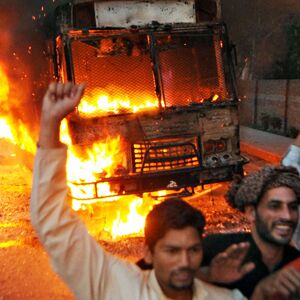
The world was also jolted by mass uprisings and revolts in 2011, as hundreds of thousands of people in cities all over the world—from Tunis to Cairo, to Rome and Manhattan—took to the streets in violent protest against various political and/or economic injustices. In the United States, the belligerent “Occupiers” who were supposed to benefit the average American worker ended up costing U.S. taxpayers tens of millions of dollars. In the UK, a small, seemingly peaceful protest quickly morphed into a barbaric rampage of widespread looting, vandalism and arson that ended with sections of London and other British cities going up in flames. In the Middle East, mass demonstrations that were supposed to remove repressive authoritarianism and usher in a new era of freedom and democracy instead cleared the way for fundamentalist Islam to expand its reach across the region.
Iran, of course, stands to benefit most from the region’s biggest upheaval in decades. With Egypt now on the fast track to becoming a radical Islamist state and America now gone from Iraq, Iran’s position as regional king has been strengthened mightily.
Germany’s conquest of Europe in 2011 is another earthshaking development the Trumpet has been following closely. Millions of lives were lost during Germany’s quest for world dominion during two world wars. Today, however, Germany has all but conquered Europe—and without ever firing a shot. That’s how historian Victor Davis Hanson summarizes the past century of German history. Der Spiegel adds that the Germanization of Europe can now be seen all over the continent. This remarkable ascendency, as numerous news outlets have reported over the past year, has many European nations trembling with fear. Within the Fatherland itself, reports German-Foreign-Policy.com, German leaders are now urging commentators to tone down their celebratory language about German domination so as to not seem too triumphant.
Germany’s rise, of course, has rapidly accelerated over the past four years because of the global financial crisis, which showed no signs of recovery in 2011. Government debt levels are still skyrocketing. Oil prices remain high. And small investors are leaving the markets. In the United States, after Washington borrowed trillions of dollars to “stimulate” the economy, gdp growth remains frustratingly slow and unemployment continues to hover around 9 percent.
Despite these grim realities, many Americans believe there are brighter days ahead in 2012. According to a recent survey, while nearly 70 percent of Americans say 2011 was a painful year they’d like to forget, 62 percent remain positively optimistic about the road ahead.
“2012 is going to be a better year. It has to be,” said one New Year’s reveler at Times Square last week. Because it was so bad in 2011, many believe, there’s surely nowhere to go but up!
One conservative commentator even promised his audience that everything would change for the better in 2012. As bad as he knows it is right now, he firmly believes we’re really close to a dramatic turnaround for America.
“2012 is going to be an incredible journey,” he said.
Humanly, it’s hard to fault someone for being optimistic about the future. God, after all, is a positive thinker. But He also says we are under a curse if we put our trust in man to solve the problems of this world (Jeremiah 17:5). And many people still believe that man’s system of democratic rule, or man’s Western-style system of education, or the traditional Christian religion, with its hundreds of divided denominations, will somehow bring widespread peace and prosperity to this troubled world—and soon!
But what does your Bible say about the days leading up to the prophesied return of Jesus Christ? Didn’t the Apostle Paul tell us that when men say “peace and safety,” sudden destruction will follow? Didn’t Jesus Himself say in Matthew 24 that the last days would be noted for worldwide fighting and unprecedented weather-related disasters?
Read Revelation 11:15-19. Why, after the kingdoms of this world become the kingdoms of our Lord, does it say the nations—plural—will be angry? It’s amazing, isn’t it, to think about how the nations of this world actually respond to the soon-coming establishment of God’s government on Earth.
Angry nations of this Earth, it says in Revelation 19:19, will assemble their armies together to make war against Jesus Christ, the Lamb of God! The Bible says this climactic battle of the ages will occur at a place called Jehoshaphat—a deep ravine that flanks the eastern border of Jerusalem.
It is here that the armies of man will fight against the armies of God for control of the entire world—Jerusalem, the future capital of the world, being the grand prize! The Bible graphically describes this nightmarish struggle—truly, the war to end all wars—in Joel 3:12-14, Zechariah 14:9-13, Revelation 14:19-20 and all of chapters 16 and 19.
The nations will be filled with white-hot rage, these passages reveal. But Jesus Christ responds to their hate-filled wrath with His own righteous display of corrective anger. Revelation 11:18 says He will “destroy them which destroy the earth.” This is what Christ must do to spare this Earth from man-made, total destruction.
Several of these biblical passages describe God’s fierce wrath as a great “winepress” that squeezes the juice from a cluster of grapes, which represents the stubborn nature of a rebellious mankind that rejected God’s government in the Garden of Eden.
It is this same government that the kings of this Earth will vainly attempt to overthrow at the return of God’s anointed. As is clearly revealed in Psalm 2, man’s problem has always been with God’s government and His rule of law. This is why the nations will fight against Christ—because they refuse to submit to God’s law, summed up by the Ten Commandments!
Now study Jeremiah 25:30-34, and keep in mind that what the prophet describes in this passage never happened during the last days of Judah’s existence, before it went into Babylonian captivity. This prophetic passage is for our time today. In it, God says He has a controversy with the nations—plural—not just Iran, or Germany, or any other one nation specifically. God, it says, is coming with a sword to plead with “all flesh.” That means all of mankind!
By this point in the affairs of men, the “rod of iron” is the only language a sinful mankind could ever understand. And the level of destruction that follows in the wake of this spectacular clash is unfathomable and immeasurable. “Thus saith the Lord of hosts, Behold, evil shall go forth from nation to nation, and a great whirlwind shall be raised up from the coasts of the earth. And the slain of the Lord shall be at that day [the time now ahead of us] from one end of the earth even unto the other end of the earth …” (verses 32-33).
It’s difficult to imagine the size and scope of this kind of devastation and ruin. But one thing this passage clearly reveals, along with the many other scriptures cited above, is that before it ever gets better on this Earth—before a peaceful and prosperous utopia can ever be established—the Bible says it will get much,much worse than it ever was in 2011.
That is the plain truth. And no amount of false hope could ever change that.
Man’s only sure and lasting hope for survival rests in the divine power of Almighty God and His merciful and forceful intervention in the affairs of mankind!


