

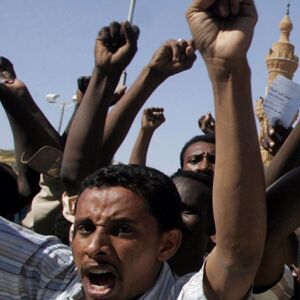
The Great Islamic Awakening
Six weeks after the Mubarak regime collapsed in early February, the New York Times wised up to what was actually happening in Egypt. Religion had emerged as the most powerful political force in Egypt, the Times wrote on March 24. This, after a youth-driven uprising that was supposedly based on “secular ideals.”
“The young people have no control of the revolution anymore,” said an Egyptian television producer, quoted in the Times. “It was evident in the last few weeks when you saw a lot of bearded people taking charge.”
In Libya, Muammar Qadhafi has been gone for just three weeks, and the liberal democracy, secular moderate disguise that covered the uprising early on has already been stripped away.
Libya could fall into the hands of Islamic extremists, said nato’s secretary general earlier this week. nato, in case you forgot, is largely responsible for ousting Qadhafi. It is Western military might that now enables Libyan rebels to draw up legislation based on sharia law.
This week, the New York Times printed a revealing article under this front-page headline: “Islamists’ Growing Sway Raises Questions for Libya.” According to the article, the most powerful military man in new Libya is Abdel Hakim Belhaj, an Islamic extremist with ties to al Qaeda. Libya’s most influential politician is an Islamic scholar named Ali Sallabi.
“It is the people’s revolution, and all the people are Muslims, Islamists,” Sallabi candidly told the Times.
Fathi Ben Issa is also featured in the Times piece. He was one of the early representatives on the Tripoli council—way, way, way back when Qadhafi was first removed from power. Mr. Ben Issa, however, has since left the council—a governing body dominated by the Muslim Brotherhood—after learning that they intended to ban the arts and issue a fatwa that would bar Libyan women from driving automobiles.
But according to the Times, “The United Statesand Libya’s new leaders say the Islamists, a well-organized group in a mostly moderate country, are sending signals that they are dedicated to democratic pluralism. They say there is no reason to doubt the Islamists’ sincerity” (emphasis added throughout).
Nothing to worry about here! says the United States and the new governing body in Tripoli—a group dominated by Islamists.
Sallabi told the Times, presumably with a straight face, that he hopes Libya will find a leader like America’s first president, George Washington.
Ben Issa, who has received death threats for cutting ties with Libya’s Islamic council, said Sallabi is only trying to mask his true intentions. “He says one thing to the bbc and another to Al Jazeera,” Ben Issa said. “If you believe him, you don’t know the Muslim Brothers.”
But to the sleeping giant in Washington, there is “no reason” at all to doubt or question Sallabi’s commitment to spreading democracy.
On that point, even the New York Times seems skeptical. “[A]s in Egypt and Tunisia, the latest upheaval of the Arab Spring deposed a dictator who had suppressed hard-core Islamists, and there are some worrisome signs about what kind of government will follow.”
Trumpet readers know exactly what kind of government will follow: one that perfectly serves the interests of Iran, the number one state sponsor of radical Islam and the prophesied king of the south (Daniel 11:40).
Ever since we identified Iran as the biblically prophesied king of the south in the mid-1990s, Iran’s enemies have either been weakened significantly or removed entirely. The Iraqi threat disappeared the moment Saddam Hussein was executed, thanks to a U.S.-led invasion in 2003. America also had a hand in weakening the Taliban—another Iranian nemesis. More recently, pro-Western governments in Lebanon, Egypt and Tunisia have all collapsed. Libya too has now given way to the Islamic tidal wave.
Israel has bogged down in two wars—fighting to a draw with Iranian proxies in 2006 and 2009. And over the last month, Israel’s worst fears about the “Arab Spring” have begun to materialize in the most sobering of ways. Israel’s ambassador has been expelled from Turkey, its citizens have been strip-searched in Istanbul and its embassy in Cairo has been ransacked by an Islamic mob—prompting Israel to evacuate embassy officials in the middle of the night.
“Rarely has the Jewish state suffered so many setbacks and blows as this month,” Spiegel Online wrote earlier this week. And we haven’t even gotten to the Palestinian bid for statehood at the United Nations. That’s set for next week.
Then there’s the precipitous decline of the American superpower, which has seen its grip over the region loosen dramatically in recent years, but not before it managed to dismantle almost every imaginable bulwark that once stood against the king of the south and helped maintain a regional balance of power.
Small wonder, then, that the Iranian-led Islamic power bloc has gained such tremendous strength over the past decade and a half!
In Western political discourse, it might be fashionable to call the latest uprisings and revolts an “Arab Spring,” but on the Arab street and in Tehran—and more importantly, in the pages of your Bible—it’s seen as a greatIslamic awakening. And it’s building toward a spectacular clash that will soon trigger World War iii!


