

Why You Should Watch September 7
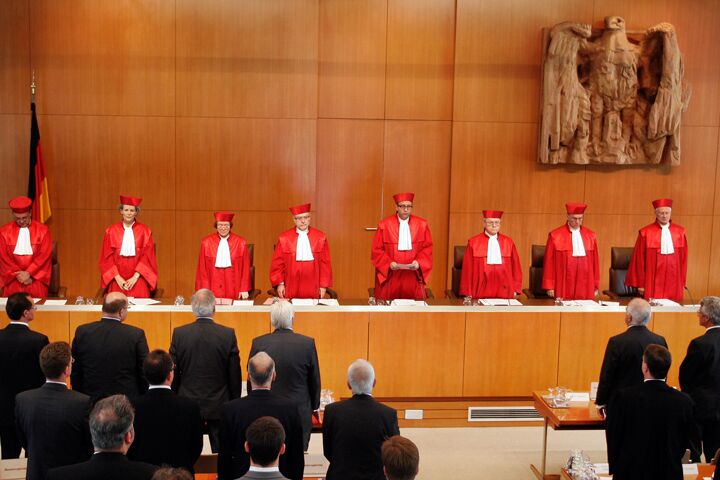
Next Wednesday, Germany’s Constitutional Court will rule on whether the eurozone’s bailouts are legal. Its decision could cause radical changes in Europe. The court case, brought by five German academics and a politician, alleges that the bailouts violate the eurozone’s no-bailout clause.
The high court could throw the eurozone into confusion by outlawing the bailouts, or imposing conditions on them. “That would really throw things into chaos!” the Trumpet’s editor in chief wrote recently. “Yet it probably will happen, and that may be the beginning of the end of Angela Merkel—and the beginning of the strongman coming on the scene to get things under control.”
Even if it does not ban the bailouts, it could rule that Germany’s parliament must have a greater say in what is done with the money.
German Chancellor Angela Merkel is so nervous about the case that she has cancelled her trip to Russia that was scheduled for the same day.
But the Constitutional Court isn’t the only threat to the bailouts. The director of the European Financial Stability Facility (efsf), Klaus Regling, said that “hysteria is sweeping Germany.”
German President Christian Wulff last week said the European Central Bank’s (ecb’s) purchase of debt was “legally questionable.” The eurozone, he warned, was going too far toward becoming a fiscal union without the consent of the people. “Decisions have to be made in parliament in a liberal democracy,” he said. “That is where legitimacy lies.”
The Bundesbank also attacked the bailouts, hinting that they may be illegal.
On the same day the high court rules, Germany’s parliament will begin its debate on the July 21 agreement extending the powers of the efsf. Angela Merkel could struggle to get it approved. She has a majority of just 19, and around 24 have said they will oppose the bailout. If she has to pass the law with the help of her opposition, the coalition could collapse.
Parliament’s vote is scheduled for September 29; it was postponed by a week so as not to conflict with the pope’s visit to Germany.
Merkel’s cabinet may have approved the deal on August 31, but it still has a ways to go before becoming law.
As the Telegraph’s international business editor Ambrose Evans-Pritchard wrote, “The next month will decide her future, Germany’s destiny, and the fate of monetary union.”
French Foreign Minister Alain Juppé gave a stark warning on August 31, saying: “The dissolution of the eurozone is not acceptable, because it would also be the dissolution of Europe. If that happens, then everything is possible. Young people seem to believe that peace is guaranteed for all time …. But if we look around in Europe there is new populism and nationalism. We cannot play with that.”
But the euro has to go through some radical changes, and they could even come this month.
In his article, “World’s Greatest Danger: Germany Domineers Over Europe Again!” Gerald Flurry wrote: “The power is already there, and Germany is directing nearly everything—though people won’t admit it. But the leadership they have now simply isn’t up to the job. The Europe project can’t really move forward until they have a strongman with the power to make it happen!” September 7 could see the next step to that strongman coming into power.


