

Siemens Poised to Spend Billions on Acquisitions
Germany’s corporate juggernaut Siemens is gearing up to spend billions of euros on takeovers and acquisitions, the Financial Times Deutschland reported on Monday. The industrial giant’s planned acquisitions will expand its automation businesses, power networks and other sectors.
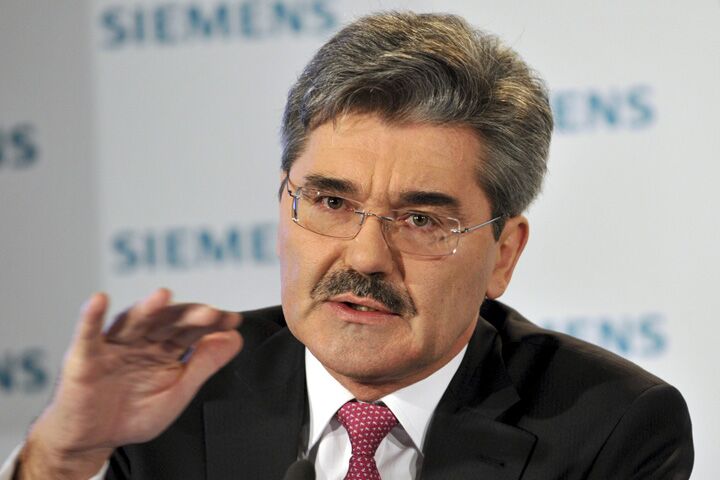
“When we talk about larger acquisitions, we mean significant sums of up to several billion euros,” Siemens Chief Financial Officer Joe Kaeser told the business daily.
Kaeser also said the company, the largest engineering firm in Europe, had achieved a degree of “management maturity” that equips it with the power to pursue substantial takeovers.
With around €15.6 billion to spend on takeovers, Siemens’s expansion will significantly enlarge the company’s power network sector and will equip it with new techniques for automation and energy efficiency.
The planned takeovers mark a stark shift in Siemens’s strategy, which over the last few years was concentrated on restructuring and internal growth.
These takeovers are an indication of a German economy that is on fire. Germany has the largest economy in Europe, and it will soon wield its mushrooming power to work toward its historical goal.
As far back as 1945, educator Herbert W. Armstrong warned that German industry was working to revive the nation’s empire. “We don’t understand German thoroughness,” he said. “From the very start of World War ii, they have considered the possibility of losing this second round, as they did the first—and they have carefully, methodically planned, in such eventuality, the third round—World War iii!”
In 1996, the U.S. government declassified a top-secret World War ii document (printed in full in our free booklet The Rising Beast) that proved Mr. Armstrong’s statement true. The document exposed agreements made between several of Germany’s largest industrial giants and top German political officials just nine months before the war’s end in Europe. According to the document, on Aug. 10, 1944, German corporate leaders representing several of the nation’s most powerful companies at the time met with German military and political personnel in Strasbourg, France. The purpose of this meeting, and a follow-up meeting the same year, was to launch the industrialists into “a postwar commercial campaign.”
This campaign was to “finance the Nazi Party, which would be forced to go underground” and to ensure that “a strong German empire [could] be created after the defeat.” These industrialists were specifically told to strengthen Germany “through their exports” and to “make contacts and alliances with foreign firms.”
The secret document released in 1996 clearly shows that German industrial giants were charged with the task of supporting the resurgence of Germany and its domineering ideologies. Though the Siemens name is above reproach in Germany today, the facts of history show that Mr. Armstrong’s forecasts about Germany’s powerful companies, like Siemens, were well-founded.
Siemens’s burgeoning power will soon be pooled with that of other German industrial giants and channeled in a perilous direction. To understand more, read our riveting free booklet He Was Right.


