

Did the Kremlin Overthrow a U.S. Ally?
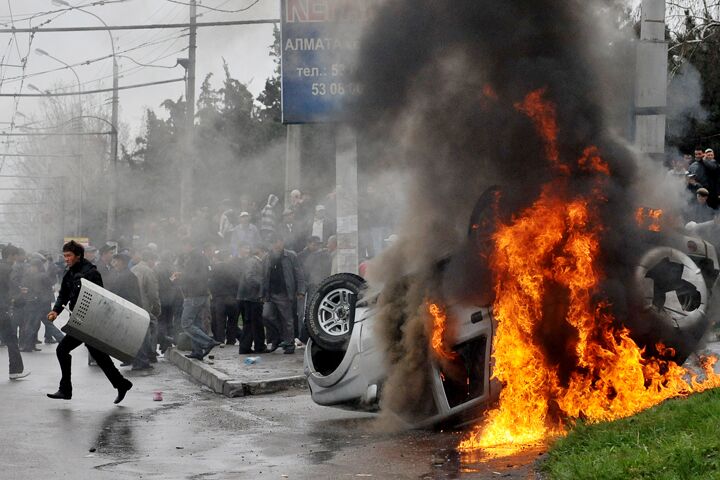
Kyrgyzstan went up in flames of revolution this week, news outlets reported. On Wednesday, Kyrgyz President Kurmanbek Bakyev was forced to flee the capital city of Bishkek after mobs of angry protestors seized government headquarters. At least 75 died in the violence between police and protesters, and hundreds more were injured.
Some Kyrgyz authorities believe that Moscow kindled the turmoil blazing through the Central Asian former Soviet republic, but Russian Prime Minister Vladimir Putin has denied Russian involvement. Despite these claims, his Kyrgyz counterpart maintains that Putin urged the revolt. Whether Moscow called the Kyrgyz subversives into the streets or not, the Kremlin stands to benefit greatly from the upheaval currently underway, while Washington has a lot to lose from it.
Kyrgyzstan is home to a key military base through which 50,000 American troops pass each month on their way to and from Afghanistan. Since Bakyev’s flight from Bishkek, the fate of the strategic Manas base has been thrown into question.
Some degree of Russian influence has been noticed in the Kyrgyz opposition now assuming power. This influence, alongside Putin’s praise for the ousting of “nepotistic” Bakiyev, begins to paint a picture.
Stratfor reports (April 8):
Evidence of Russia’s role in the overthrow of the Kyrgyz government Wednesday became even clearer Thursday.
Not coincidentally, members of the interim government that the opposition began forming on Wednesday have lengthy and deep ties to Russia. Russian Prime Minister Vladimir Putin was not only quick to endorse the new government, but he also offered the opposition Russia’s support—financial or otherwise. Interestingly, Russia on Thursday also sent 150 of its elite paratroopers to its military installation in Kant—20 miles from the capital of Bishkek—leaving a looming suspicion that Russia could step in further to ensure the success of the new government. Protests take place regularly in Kyrgyzstan. The fact that Wednesday’s protests spun into riots, followed by the seizure then ousting of the government, followed by the installation of a replacement government set to take control—all in less than a 24-hour period—are all clear indicators that this was a highly organized series of events, likely orchestrated from outside the country. Furthering this assumption were reports from Stratfor sources on the ground that noted a conspicuous Russian fsb presence in the country during the riots. These reports cannot be confirmed, but it is not unrealistic to assume that a pervasive presence of Russian security forces exists in the country.
Whatever the degree Moscow was involved in the Kyrgyz revolt, the emerging scene suggests that this is another instance of an emboldened Russia exerting its growing influence.


