

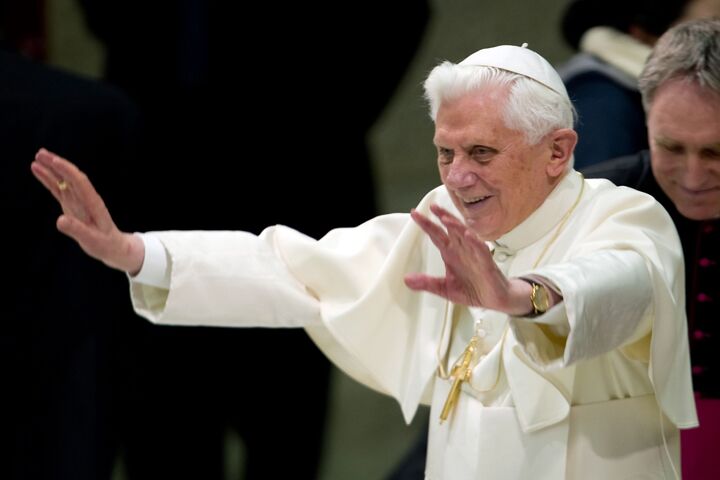
Catholics and Orthodox Need to Unite to Rescue Europe, Says Pope
The Catholic and Orthodox churches must unite in order to defend Europe’s Christian roots, Pope Benedict xvi told a group of Romanian bishops, February 12.
As the bishops concluded their regular consultation with the pope—their “ad limina” visit—Benedict emphasized the need for them to work with their Orthodox counterparts. This comes less than a fortnight after the pope admonished English and Welsh bishops to be generous toward any Anglicans wishing to return to Rome.
“[O]f particular importance is the witness of fraternity between Catholics and Orthodox,” he said. “It prevails over divisions and disagreements and opens hearts to reconciliation.”
“I am aware of the difficulties that Catholic communities must face in this realm; I hope that adequate solutions can be found, in that spirit of justice and charity that must animate relations between brothers in Christ,” he said.
“A particularly important realm of collaboration between Orthodox and Catholics today has to do with the defense of Europe’s Christian roots and of Christian values, and with common witness on subjects such as the family, bioethics, human rights, honesty in public life and ecology,” he said. “Undivided determination on these arguments will offer an important contribution to the moral and civil growth of society.”
Herbert W. Armstrong long forecast that the Catholic Church would bring unity between East and West Europe. “Bible prophecy says this European unification will be also a union of church and state (Revelation 17),” he wrote in 1982. “Many European political leaders do not want religious domination, or even participation. But they are coming to realize they cannot be welded together into one great European super nation without the unifying power of the Catholic Church” (member and co-worker letter, Nov. 22, 1982).
This is exactly what is happening now. Unity between the Catholic and Orthodox churches will bring “unity and concord not only for your countries, but also for the whole of Europe,” the pope said.
Back in 1963, Mr. Armstrong wrote: “The final—albeit short-lived—triumph of Catholicism is recorded in literally dozens of Bible prophecies. Right now—whether we want to believe it or not—the stage is being set for the greatest revolution in religion the world has witnessed. … The mighty problem of achieving unity is twofold. First, it involves reconciliation of the Orthodox Schism that officially commenced in 1054 and divided the churches in the East. … Second, it involves restoration to the Roman Communion all Protestantism which developed from 1517 onward” (Plain Truth, November 1963).
We can see the pope working hard on both fronts right now. He is working to unify with the Orthodox Church in order to present a common front toward secularism.
Already, he has made much progress. In his speech to the bishops, he pointed back to May 2009—the 10th anniversary of Pope John Paul ii’s visit to Romania. “On that occasion, divine Providence offered the successor of Peter the possibility of undertaking an apostolic journey to a nation of Orthodox majority, where for centuries a significant Catholic community has been present,” he said. “May the desire for unity aroused by that visit nourish prayer and the commitment to dialogue in charity and truth and to promote joint initiatives.”
Since that visit the Catholic and Orthodox churches have reached a number of historic agreements. On Oct. 13, 2007, the Vatican released a statement that both churches had agreed upon that specifically declares that the pope held the highest position in the unified church before the Great Schism in 1054, and that the bishop of Rome was the protos, or first, among the patriarchs, including those of Constantinople, Alexandria, Antioch and Jerusalem.
In January, a document was leaked that suggested even greater unity between the two churches was on the horizon. The draft text is currently being studied by an international Catholic-Orthodox commission, and deals with how the East and West viewed the role of the pope before the Great Schism. “Distinct divergences of understanding and interpretation did not prevent East and West from remaining in communion,” it states.
Also in January, Serbia’s new Orthodox patriach Irinej Gavrilovic invited the pope to Belgrade. This invitation ends a millennium of hostility between the Serb church and the Vatican.
The Vatican is right on the cusp of bringing its daughter churches back into line. Watch this space as Bible prophecy unfolds just the way Mr. Armstrong said it would.


