

Israel Concerned About Strengthening Egypt-Iran Axis
Iran and Egypt have taken strides to bolster ties in their first round of high-level talks since 1979.
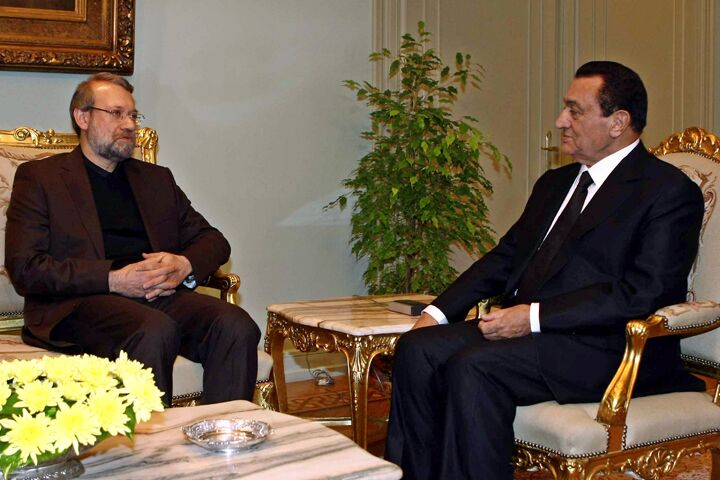
On December 20, Egypt’s ailing and aged president, Hosni Mubarak, received a rare two-hour, face-to-face visit from Iranian Parliament Speaker Ali Larijani. Larijani had flown to Cairo to represent Tehran at a committee meeting for member states of the Parliamentary Union of the Organization of the Islamic Conference.
In addition to the meeting with Mubarak, Larijani also held talks with his counterpart Ahmed Fathi Surur and Egyptian Foreign Minister Ahmed Aboul Gheit. According to the Los Angeles Times, Egyptian sources said that Iranian President Mahmoud Ahmadinejad is trying to bring an end to tensions between his country and Egypt.
Immediately following Larijani’s visit, Mubarak, who rarely travels because of his failing health, flew to Saudi Arabia, Kuwait and the United Arab Emirates. In meetings with his fellow Arab heads of state, Mubarak placed Arab-Iranian relations at the top of the list of discussion items.
Iran severed official ties with Egypt in 1979 when Egypt’s president at the time, Anwar El Sadat, signed the Camp David peace treaty with Israel. The rift between Tehran and Cairo grew in 1981 when Iran named a Tehran street after Khaled El Islambouli, the Egyptian Islamist accused of assassinating Sadat.
As recently as 2008, Iran chastised Mubarak for Egypt’s participation in the Gaza blockade against Israel. Cairo countered the criticism saying Iranian support of Hamas and Hezbollah was designed to bolster Tehran’s power in the region.
For these reasons, Egypt-Iran relations were chilled, but Cairo’s new step toward coexistence with a nuclear Iran indicates a substantial loss of American influence within Egypt and the region at large. It also further isolates an increasingly remote Israel.
Upon his return to Iran, Larijani told reporters that Tehran and Cairo do not differ in strategies regarding Israel. “There may be differing views in tactics [over Israel] between Iran and Egypt but the strategies of the two countries are not different,” he said.
Larijani, who is also a top aide to Supreme Leader Ayatollah Ali Khamenei, said that the strategy Iran is now pursuing aims to rally all of the Muslim world behind the Palestinians in a campaign against Israeli occupation. He also said Israel is upset by the growing cooperation between Egypt and Iran.
Israel has reason to be concerned.
Author and columnist Alan Caruba wrote about the significance of Mubarak’s zealous response to Larijani’s visit in an article titled “The Middle East Rethinks Its Options” (emphasis ours):
[T]he aged and ailing president of Egypt, Hosni Mubarak, received a visit from the Iranian speaker of its parliament, Ali Larijani, in Cairo on December 20 and, despite the fact he rarely travels these days, Mubarak flew immediately to Saudi Arabia, Kuwait, and the Arab emirates to discuss what must have been deemed a major turn of events.
Trumpet editor in chief Gerald Flurry has prophesied for over 15 years that Iran would be the king of the Middle East, and that the Iranian power would ally itself with Egypt. “Daniel 11:42 implies that Egypt will be allied with the king of the south, or Iran. … This prophecy indicates that there would be a radical change in Egyptian politics!” (“Why We Cannot Win the War Against Terrorism,” November 2003).
These strides toward restoration of diplomatic ties between Iran and Egypt signal that this radical change is approaching—remarkably, even with Mubarak still in office. For more on the significance of events in Egypt and the Middle East, read The King of the South.


