

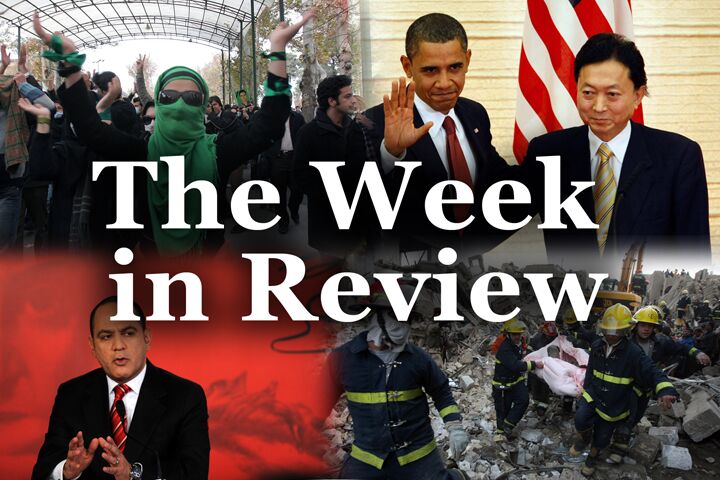
The Week in Review
Middle East
The Iraqi presidency council on Tuesday rescheduled the January parliamentary elections for March 7, 2010. This followed a revised election law being passed by parliament on Sunday. Last month, Sunni Iraqi Vice President Tariq al Hashemi vetoed a previous version of the law asserting that it did not give enough representation to Sunnis. Key to the current agreement was an increase in the number of Kurdish and Sunni seats in parliament. The law will expand parliament from 275 seats to 325.
Meanwhile, violence surged in Iraq, with five car bombs killing more than 100 people and injuring hundreds more in Baghdad on Tuesday. The blasts struck government buildings, including a courthouse, the Ministry of Labor and Social Affairs, and the temporary location being used by the Finance Ministry after its main building was devastated in an attack earlier in the year. Iraqi Prime Minister Nouri al-Maliki said the attacks had the traits of Baathists and al Qaeda, Aswat al-Iraq reported. With political uncertainty continuing in Iraq, more violence is probable.
Pakistan is also experiencing a surge in extremist violence. On Tuesday, a bomb exploded near an intelligence office in Multan, killing at least 12 people. The target appeared to be the office of Inter-Services Intelligence, Pakistan’s most powerful spy agency. On Monday, 59 people were killed in bombings elsewhere. Friday of last week, at least 40 people were killed when gunmen attacked a mosque near the Pakistani military’s main headquarters in Rawalpindi, which was filled mostly with current and retired military personnel. Since October, more than 400 people have been killed by militants. Most of the attacks in recent weeks have been directed at security forces, an effort by the Taliban to avoid getting the public offside.
In Iran, anti-government protestors came out in force on Monday to commemorate the killing of three students under the Shah regime. The student-led demonstrators, appearing to number in the tens of thousands, clashed with security forces armed with batons and tear gas. While Iranian security forces appeared to be more restrained in cracking down on the protesters than they were in the post-election rallies earlier in the year, the Iranian prosecutor general warned on Tuesday that the government would “show no mercy” if demonstrations continued.
Europe
Many minorities suffer regularly from racial discrimination, according to a new report from the European Union’s Fundamental Rights Agency. “The results reveal shocking evidence about the discrimination faced by minorities in everyday life; in the classroom, when looking for work, at the doctor’s, or in shops,” writes the agency. “The survey’s findings serve to highlight beyond any doubt that discrimination on the basis of ethnicity is a major problem for many minorities in the EU,” the report concludes. The survey of 23,500 found that “the Roma, sub-Saharan Africans and North Africans face very high levels of discrimination in their everyday lives in comparison with some of the other large groups covered in the survey, with problems of discrimination and racist victimization being acute in certain member states.” A fortnight ago, Switzerland voted to ban minarets. This is arguably not a racist policy. But it demonstrates the same kind of popular sentiment: Europe is getting fed up with immigrants bringing a foreign way of life and not assimilating into their host countries. Watch for governments to follow popular opinion and enact more racist, or at least anti-Muslim, legislation. For more information on where this is leading, see our article “The European Union’s Fatal Flaw.”
Economists are worried that Greece may be the first EU nation to default on its debt. “It’s five minutes to midnight for Greece,” said Willem Buiter, a former Bank of England policy maker. “We could see our first EU-15 sovereign default since Germany had it in 1948.” Greece’s debt is 110 percent of its annual economic output. Next year it will have to refinance €25 billion of debt. If it can’t borrow enough to pay €25 billion back, it will have to declare insolvency. But if Greece falls, it could hurt all countries that use the euro. The whole situation will end up benefiting Germany. If the euro falls, Berlin could stand ready to save Europe. Or it might bail out Greece and make the country more dependent on German goodwill. German Chancellor Angela Merkel has hinted that Germany may bail out Greece. For more information on what is going on behind the scenes of this fiasco, see our article “Did the Holy Roman Empire Plan the Greek Crisis?”
EU foreign ministers decided to unfreeze the Union’s trade agreement with Serbia at a meeting on December 7. The trade agreement is part of the Stabilization and Association Agreement, the start of the road toward EU membership. The EU is worried about advances that Russia and Turkey are making toward Serbia, and is therefore moving to draw the Balkan nation toward Europe. At another meeting on December 10 and 11, EU heads of state were expected to set a time line for EU entry for a number of potential EU nations, including Iceland and all the former Yugoslavian countries apart from Kosovo. The EU deliberately worked to break up the Balkans, and now it is drawing them into Europe. For more information, see last month’s article “Keep an Eye on the Balkans.”
Asia
The historic military relationship between the United States and Japan may be breaking down over the U.S. base in Okinawa. Japan has suspended talks about the relocation of the Okinawa base as the new government fundamentally alters Japan’s relationship with the U.S. The presence of U.S. troops in Okinawa has long been a sore point in U.S.-Japanese relations. Whatever Prime Minister Yukio Hatoyama decides on the issue, the dithering shows a clear change in the relationship between the two countries. Japan used to be a pillar of American foreign policy in the Pacific, but that is changing. Watch for the Japanese to edge the U.S. out of their country as they become more militarily powerful. For more information, see Chapter Four, “Japan’s Place in the Future,” of our free booklet Russia and China in Prophecy.
Africa/South America
aids Free World, a humanitarian group in Zimbabwe, says President Robert Mugabe’s zanu-pf party systematically raped opposition supporters during the 2008 elections. Seventy women across 10 provinces reported the atrocities. One woman from Harare gave an idea of just how brutal the attacks were: “When the tenth man finished raping me they said they were going to rape my daughter …. My daughter was 5 years old,” she said. “During the rape my daughter was crying and trying to resist but they kept pushing her down. I was confused and in shock and had no strength to say or do anything or even move.” Others described gang rapes, beatings with sticks or metal rods, or being taken to the hospital in a wheelbarrow afterward. Some were infected with hiv. Three hundred and eighty rapes were documented according to the 64-page report, surely only a fraction of the true number.
The ex-president of Honduras, Manuel Zelaya, canceled his plans to visit family in Mexico because the Honduran government would only let him leave if he requested political asylum from Mexico. Accepting asylum would remove Zelaya’s ability to reclaim his office. He promptly claimed victory because, he said, “the de facto government … experienced another failure in its plan to get me to renounce my post.” Since the ousted leader cannot find favor within Honduras’s court system, congress or executive leadership, he is claiming victory while holed up in the Brazilian Embassy, unable to visit even countries that will have him. On January 27, the newly elected president, Porfirio Lobo, will take office.
A banking scandal has ended the career of one of Venezuelan President Hugo Chávez’s most trusted allies, Jesse Chacon. Mr. Chacon was science and technology minister, and even went to prison with Chávez in 1992 during a failed coup. Four banks were taken over by the government on November 20, and since then, three more banks have been seized, eight bankers have been detained, and more than 25 arrest warrants are still outstanding. Mr. Chacon’s brother, president of Banco Real, was one of those arrested, leading to his brother’s resignation. As the scandal taints those closest to the top, opposition parties have identified it as a clear example of the cronyism they have warned about in President Chávez’s government where those closest to him become powerful and rich through illegal government help. As people demand their money from the banks, the liquidity of Venezuela’s entire system is in danger, and President Chávez’s party may pay a price in next year’s national assembly elections.
Anglo-America
Five Americans have been arrested in Pakistan and accused of seeking to become terrorists and plan a major attack, local law enforcement in central Punjab, Pakistan, said on Thursday. The Sargodha chief of police told McClatchy Newspapers that the five men from the Washington area might have been trying to become part of al Qaeda. One of the men has family connections to the mosque where Fort Hood terrorist Maj. Nidal Hasan and two of the September 11 hijackers worshipped.
The federal government wants to extend its reach so far as to have the United States Congress legislate how college football is played. On Wednesday, a House subcommittee passed legislation that would ban college football’s current Bowl Championship Series.
Even as America has snubbed its special relationship with Britain in recent months, Britain is snubbing Israel. The government has advised supermarkets that they should specify what produce they sell that comes from Israeli settlements—one step short of a boycott. The move gives a glimpse into the deteriorating relationships between America, Britain and Israel, three nations mentioned together in Bible prophecy.
Tuesday marked a major milestone for the Philadelphia Church of God, publisher of theTrumpet.com. On December 7, the church celebrated its 20th anniversary and astounding growth since its beginning in 1989 with 12 members and only $80 in resources. For more about the pcg, visit www.pcog.org.


