

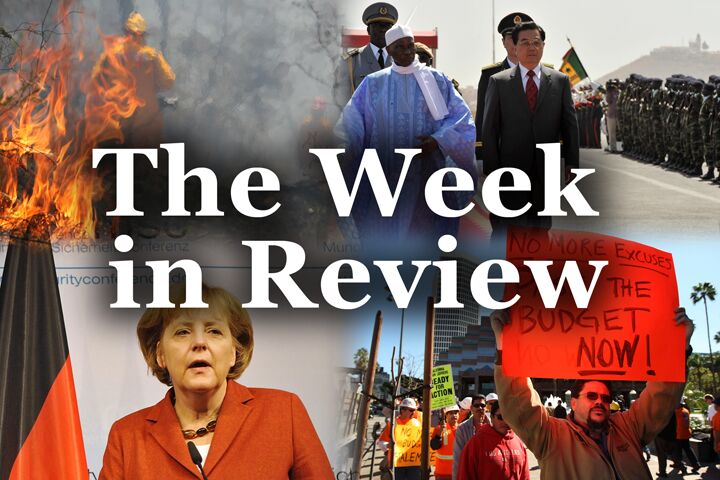
The Week in Review
Middle East
The Israeli elections held on Tuesday have failed to produce a clear winner. While the centrist party of Foreign Minister Tzipi Livni won one more seat than right-winger Benjamin Netanyahu’s Likud, right-wing parties collectively won a broad majority. Both Livni and Netanyahu are claiming victory, though it is more likely Netanyahu will be the next leader of Israel. Once the results become official next Wednesday, President Shimon Peres will have one week to decide whether Livni or Netanyahu should have first dibs at forming a coalition government, and then the selected leader will have six weeks to form that government. One thing is clear from the election results: There has been a strong shift to the right in the Israeli electorate, which will be reflected in whatever coalition comes together. This is something theTrumpet.com has been predicting for some time. Read last week’s column by Stephen Flurry to learn what this means in prophecy.
The Taliban carried out multiple attacks on government buildings in Kabul on Wednesday. Suicide bombers and gunmen killed at least 26 people and wounded nearly 60 in one of the most complex and bold attacks in the Afghan capital since 2001. While it appears the Taliban had hoped for even more casualties, the attack demonstrates the strength and confidence of the terrorist group. Such attacks will likely continue, making the U.S. and nato’s job in Afghanistan increasingly difficult.
The Taliban also stepped up its attacks on nato supply lines into Afghanistan when it blew up a bridge along the main route in northwestern Pakistan on February 3. The bridge in the Khyber Pass, which links Pakistan to Afghanistan, was built during the time that Britain had control over this strategic land gateway. The bombing was the first time the terrorists had attacked infrastructure, as opposed to convoys or supplies themselves, in order to disrupt the flow of supplies through Pakistan. Stratfor says this shift to targeting infrastructure is significant and could indicate more attacks on critical infrastructure along the supply route in the future. The attack further highlights how unreliable the Pakistan supply route is, increasing pressure on the U.S. to look for alternatives as it seeks to intensify its efforts in Afghanistan. The alternatives, however, require America kowtowing to unfriendly powers—Russia and/or Iran. And until alternative arrangements can be made, the Pakistan route is all the more critical.
Europe
A record number attended the highest-profile annual gathering of governmental, defense and security chiefs worldwide in Munich, Germany, last weekend. Topics included nuclear disarmament and the future of nato in Afghanistan. German Chancellor Angela Merkel spoke about how she wants Russia to be more involved in Europe’s security. “Russia is also part of Europe,” said Merkel. “Therefore, relations with Russia are of extraordinary importance.” Merkel called upon Europe to intensify the dialogue already begun by the nato-Russia Council. Merkel also said the European Union should pay attention to Russian President Dimitry Medvedev’s proposal for a regional pact for Europe that included Moscow. Speaking in Berlin last June, Medvedev suggested a “a regional pact, based on the principles of the UN Charter, which would clarify, finally, the meaning of the power factor in relations within the Euro-Atlantic community,” according to Xinhua.
The German military is training a special unit of cyberwarriors with the ability to scout out and destroy foreign computer networks, according to a Spiegel Online report. This unit, known as the Department of Information and Computer Network Operations, operates under the command of Friedrich Wilhelm Kriesel, a brigadier general and the head of the Bundeswehr Strategic Reconnaissance Unit. Seventy-six of the hackers in uniform under Kriesel’s command have already been secluded in the Tomburg barracks near Bonn to test out the latest methods for infiltrating, exploring, manipulating and destroying computer networks. This new unit of German cyberwarriors could pose a major security threat to American security and information systems in the future. To understand this threat in detail, read “America’s Achilles Heel—and Germany” by editor in chief Gerald Flurry from the May 2005 Trumpet.
Germany, Britain and the Netherlands agreed to increase cooperation in countering Islamic terror at a joint symposium this week organized by the German Interior Ministry. “It’s clear that we share a common threat that demands a united response, even if the specific nature of that threat differs from country to country,” said British Interior Minister Jacqui Smith. “We can learn a lot from each other, not only in how we can counter the threat, but also how we can coordinate our actions.” While radical Islam is a major problem in Britain (see our article “The Sickness in Britain’s Heart”), it is Germany that is beginning to take the lead in seeking to counter the threat.
Asia
As the global economic crisis worsens, Russian Prime Minister Vladimir Putin and his Kremlin cohorts are being forced to allocate funds to only the most high-priority projects. According to a statement on Thursday by Alexander Fomin, deputy director for the Russian Federal Service on Military-Technical Cooperation, one of the highest priorities is weapons dealing. “Despite the financial crisis, we are planning to boost our arms exports in 2009. I believe I would not be mistaken if I were to mention a figure of around $8.5 billion,” said Fomin—a figure that would represent a 6 percent increase over last year’s figures. Traditionally, the two largest buyers of Russian-made weaponry have been China and India. These strong financial relations create a client base that can later be transformed into a broader relationship. Russia is welding the rest of Asia to itself through strategically selling arms.
Another high-priority project for Moscow is the effort to pull Ukraine back into the Kremlin’s sphere of control. On Monday, the Russian Finance Ministry announced that its Ukrainian counterpart requested a $5 billion loan from Moscow to cover Ukraine’s budget deficit. The Ukrainian economy simply cannot stand up under the high natural gas prices that Moscow is currently charging. Since the Europeans are not in a position to bail out Ukraine, the leaders in Kiev are being forced to look to Moscow for money. If this money does come, it will undoubtedly come with strings attached—strings that will serve to tie Ukraine to Russia.
Africa, Latin America
China is continuing its efforts to develop strategic relationships in Latin America and Africa. For the first time, three of its top leaders—the president, vice president and vice premier—are all on trips to those regions at the same time. Chinese President Hu Jintao is visiting Saudi Arabia, Mali, Senegal, Tanzania and Mauritius; Vice President Xi Jinping is visiting Brazil, Mexico, Colombia, Venezuela and Jamaica; Vice Premier Hui Liangyu is touring Argentina, Ecuador, the Bahamas and Barbados. President Hu’s visit to Saudi Arabia is no surprise: Riyadh is China’s primary oil provider. China also has deals with Saudi Arabia for a railway system, and infrastructure for oil production and refining. Brazil, already China’s largest Latin American trading partner ($29.7 billion) and which is emerging as an energy powerhouse, is also an expected stop.
The smaller countries are also important to China’s long-term strategy. Stratfor observed that “China is attempting to turn lemons into lemonade, converting the financial crisis into an opportunity to improve its long-term economic advantage and energy and food security. China typically provides countries with financing and expertise for building all kinds of infrastructure and, in return, gains access to mineral resources, trade channels and new markets for Chinese goods. With plentiful cash reserves, Beijing and its state-owned companies can try to secure access to strategic commodities now, while global competitors are hamstrung by credit crunches and retrenching” (February 11). Stratfor pointed out that China views any gains in Latin America as an opportunity to “take a bite out of U.S. trade with the region, [while] gaining new destinations for its exports.” Ultimately, we can expect Europe to sew up resources in both Latin America and Africa, but in the meantime, China is gradually eroding U.S. influence and economic power in a region where the dwindling superpower is already strained for allies.
Anglo-America
Australians are struggling to cope with the aftermath of gigantic bushfires in Victoria, South Australia and New South Wales. Massive firestorms in Victoria have killed 181 people—with that number expected to rise much higher—making this Australia’s worst-ever bushfire disaster. Many were tragically burned alive in their cars as they tried to escape the blazing infernos that caused unprecedented damage, wiping out entire communities. Close to 2,000 homes have been destroyed and more than 7,000 people displaced, while six main fires continue to burn uncontrolled in the state. It is estimated that more than 800,000 acres have been burned out. Meanwhile, to the north of the country, 60 percent of Queensland has been declared a disaster as the worst floods on record sweep down in the wake of the northern monsoon season. The downtown center of Ingham has been under 12 meters of water. Just one property has lost an estimated 1,000 head of cattle. At least 13 towns, and hundreds of cattle stations and mines are still cut off by flood waters. Read Ron Fraser’s February 9 article “Australia: Fires, Floods and Fulfilled Prophecy!” for the reason for Australia’s worst-ever natural disasters.
California knuckled down this week and got ready for insurrection. California counties are threatening to withhold their money and some constitutional officers are refusing to accept Gov. Arnold Schwarzenegger’s authority to furlough workers as the government desperately tries to blunt the economic trauma of its projected $42 billion deficit through next year. In addition to county governments, the state controller, the lieutenant governor, the secretary of state, the treasurer, the public instruction superintendent, the insurance commissioner and the attorney general have all rejected the governor’s order to make their employees work reduced hours. Two more California banks failed last weekend, and a judge ordered the state to release up to 37 percent of its prison population due to overcrowding.
Meanwhile, in Washington, President Barack Obama succeeded in passing a $789 billion spending package through a split Congress on the backs of Congressional Democrats and a handful of Republicans. But the spending bill, the largest since World War ii, was almost dwarfed by Treasury Secretary Timothy Geithner’s announcement of the price tag for the rescue plan for the financial sector: $2.5 trillion.


