

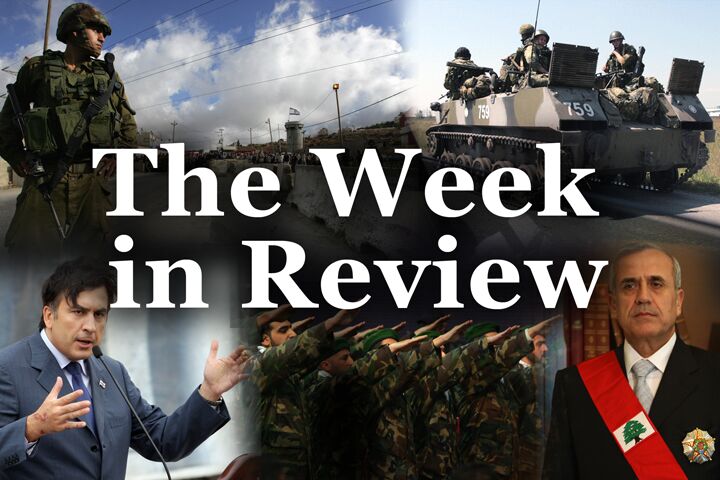
The Week in Review
Middle East
It is becoming increasingly evident that the “Cedar Revolution” of 2005—when Lebanon supposedly kicked Syria out of its country and reclaimed its independence, a move hailed as a victory for democracy in the Middle East—is dead. On August 13, Lebanese President Michel Sleiman and his Syrian counterpart, Bashar Assad, agreed to establish full diplomatic ties for the first time since independence more than 60 years ago. Suleiman was in Syria for a two-day visit, the first visit to Damascus by a Lebanese president since Syria withdrew its troops from Lebanon in April 2005. Jonathan Spyer, writing for Global Politician, explains why Syria is looking to engage Lebanon diplomatically: “The formation of the new Lebanese government after the Beirut clashes in May represented a very significant gain for the pro-Syria element in Lebanese politics. Hezbollah now controls a blocking 11 of the 30 cabinet seats. With a Lebanese government of this type, there is no reason for Syria to be in dispute there.” But, as Spyer points out, the establishment of friendly relations “will represent not the normalization of Syrian-Lebanese relations, but rather the enveloping of Lebanon into the regional alliance led by Iran, of which Syria is a senior member” (emphasis ours).
Hezbollah’s controlling power in the Lebanese government was actually just cemented on Tuesday, when the Lebanese parliament overwhelmingly approved—100 to 5 (with two abstentions)—a national unity cabinet that gives Hezbollah a greater say in how the country is run. Associated Press reported, “It took the two sides about 45 days of negotiations to name the new cabinet and another three weeks to approve its policy platform, which in the end implicitly allowed Hezbollah to remain armed.”
Amid these political developments, a roadside bomb exploded in the northern Lebanese city of Tripoli on Wednesday, killing 18 soldiers and civilians, and wounding dozens. This was the deadliest bombing in Lebanon in more than three years.
In recent weeks, violence among the Palestinians has also worsened in a widening crackdown on political opponents, the Associated Press writes, both by the Western-backed Fatah movement in the West Bank and by the Islamic terrorist group Hamas in Gaza.
Meanwhile, on August 12 Haaretz reported that Olmert offered Palestinian Authority President Mahmoud Abbas 93 percent of the West Bank for a future Palestinian state. The Palestinians’ response? Abbas’s spokesman said the proposal was “not acceptable,” calling it “a waste of time.” With Olmert desperate to get a deal in place before he leaves office, expect the Palestinians to hold out for their demands—which include Israeli withdrawal from Jerusalem—without budging an inch.
And finally, Pakistani President Pervez Musharraf has agreed to resign rather than face impeachment, government officials told the Financial Times Thursday. Formal impeachment proceedings were expected to begin Monday.
Europe
Russia’s war with Georgia dominated the news this week. In addition to having accurately forecasted that Russia would ruthlessly go after Georgia (see our April 1 article, “Russia’s Balkans”), the Trumpet has made other forecasts based on Bible prophecy of what will soon unfold in Europe. Frightened by Russia’s aggression, Europe will become more unified both politically and militarily. In Eastern Europe, former ussr states are even more alarmed. On Thursday, Poland and the United States reached a deal to permanently station elements of the U.S. ballistic missile defense system on Polish soil. But Europe won’t look to the U.S. for protection for long. The debacle in Georgia proves that the U.S. is powerless. Europe will be forced to unite to face Russia. Estonia, Lithuania, Poland and Latvia all acted with unity in support of Georgia.
At the same time, Ukraine is nervous it could be next. In an expression of solidarity with Georgia, the Ukrainian government limited the previously free movement of Russian ships and planes through Ukrainian territory. Ukraine is on the border of two emerging powers. Both powers are in the process of drawing their borders. Expect for Ukraine to be a major point of contention between Russia and Europe. The more Russia threatens Europe’s periphery, the more Europe will be driven to unite. In the short term, Europe and Russia will likely forge some sort of peace agreement, akin to the pre-World War ii Ribbentrop-Molotov pact between Stalin and Hitler.
Europe also wants to get its troops into Georgia. “We’re determined to act on the ground. Many countries said ‘we’re ready to join in,’” French Foreign Minister Bernard Kouchner said this week. Europe is using crises around the world to spread out its military presence. Its peacekeeping forces are small for now, but they could provide useful outposts for a more powerful EU.
Asia
Russian Prime Minister Vladimir Putin proved to the world that he is the man who runs his country by the way he handled the invasion of Georgia. When Putin returned from Vladikavkaz, a city near the war zone, he went on national television and publicly started issuing orders to President Medvedev. In addition to this, he never once called a session of the Russian parliament to discuss how or if the invasion should be handled. Putin has returned Russia to authoritarianism and succeeded in giving Europe a startling wake-up call.
Even as the Beijing Summer Olympic Games continue, China is experiencing an increase of Islamic terrorism in the Muslim-majority province of Xinjiang. Islamic separatists in this province have released two videos threatening the Olympics and have conducted three violent attacks on government establishments and security personnel within the past week and a half. The stringent security crackdowns and omnipresent controls that the Chinese government have enacted in response to these violent incidents, however, have only succeeded in pushing many of the separatists across the border into Pakistan and Afghanistan. The influx of Muslim jihadist from China into these terrorist safe havens may serve to strengthen the global jihadist movement.
Similar measures have been enacted by the Indian government against rioting Muslims in the Kashmir region. These measures have also pushed many jihadists into the terrorist safe haven of northeastern Pakistan, and have pushed India-Pakistan relations into a freefall. India and China conducted joint anti-terrorist exercises for the first time in history last December. As nations like Pakistan start falling under the influence of radical Islam, watch for Indo-Chinese cooperation to increase even more.
South America
Venezuelan President Hugo Chavez has banned 272 officials from participation in November’s elections, prompting an uproar. A constitutional referendum designed to increase his authority was defeated by popular vote last year, but he has since attempted to shore up his power by passing decree laws giving him most of the authority the popular vote denied him, taking over Banco de Venezuela, and now banning his opposition—some of whom were favored to win—from running in elections. Chavez called the objections to the ban the “work of the empire”—referring to the U.S.—continuing his opposition to the United States even as he tightens his stranglehold on Venezuela. For more on the anti-American actions Latin American leaders are taking, read “The Hidden Enemy in America’s Backyard” from the September Trumpet.
Anglo-America
The number of people losing their homes for failing to make their mortgage payments rose over 40 percent in the United Kingdom during the first half of this year. The number of households that are over three months late on their mortgage payments rose from 129,600 at the end of 2007 to 155,600, making up 1.33 percent of all mortgages. Repossessions are now at their highest level in over a decade.
The Washington Post reported Thursday that inflation in the United States continued to surge in July due to increasing food and energy prices. This was the third month in a row of rapid inflation; in the previous 12 months, prices rose 5.6 percent, a spike not seen since 1991. Retail sales fell as well, constituting the weakest performance in five months. Consumers’ purchasing power was at an 18-year low. Food prices rose 1.2 percent from June and energy prices jumped 4 percent.
Newsweek’s Christopher Dickey wrote an interesting opinion piece Thursday on this week’s raging Georgia conflict and Washington’s underwhelming response. Dickey wrote that tiny Georgia’s desire to appear defiant against Russia has come from a major miscalculation: that the United States would back it. Washington has wooed the former Soviet state away from Moscow, backing its nato bid even against European resistance, and sending 1,000 U.S. troops there for joint exercises just last month. To say the least, America was getting their hopes up. Referring to Georgian President Mikheil Saakashvili, the author wrote,
A more thoughtful man might have recalled the way Hungarians fighting the Soviets, Argentines fighting the Brits, Shiites and Kurds fighting Saddam Hussein in the 1990s thought they could depend on Washington to come to their rescue, only to be deceived and then destroyed. But when you’re caught up in the romantic cause of defying the enemy you sometimes start defying reason, as well.
Georgia challenged Russia—and is absorbing the consequences shell by shell; meanwhile, the White House has done nothing but make disapproving noises. The writer quickly moved on from this perceptive observation to a politicized promulgation of his personal partisan viewpoint, but in doing so he accidentally ran smack into a major truth without realizing it. America has lost its will to fight, and is now useless to its allies—a dangerous position to be in in a world where nations rely on themselves and their allies for protection, rather than God.


