

The Week in Review
Middle East
Thirteen people were killed in Algeria last Sunday when two bombs exploded at a train station in a town about 50 miles from the capital, Algiers. A French engineer and his driver were killed in the first explosion; minutes later, a second blast claimed the lives of 11 first responders, including soldiers and firefighters. This was the latest of several terrorist attacks in Algeria so far this month, including a roadside bombing that killed six Algerian soldiers. It is believed the attacks were carried out by al Qaeda of the Islamic Maghreb, the main terrorist group in Algeria. It appears the terrorist group is becoming more active in the country. Read our June 5 article “Al Qaeda’s North African Safe Haven” for information on where this trend is leading.
A U.S. airstrike on June 10 just across Afghanistan’s border in Pakistan’s northwestern tribal area killed 11 Pakistani troops, placing further stress on already deteriorating relations between Washington and Islamabad. The U.S.-led coalition forces reportedly were responding to a cross-border attack by Taliban fighters. Pakistan’s military condemned the operation, with a spokesman calling it a “completely unprovoked and cowardly act” that “hit at the very basis of cooperation” between the two countries in the war on terror. Such strong language being used by the Pakistani military against the U.S. is unprecedented, according to Stratfor. “Given the situation in Pakistan, where the state is already under considerable stress and strain, the military had to resort to such language in order to minimize public backlash. Concerns about U.S. military action in Pakistan is a key national issue that not only could lead to social unrest but also could place pressure on military leaders to ensure that such tensions do not spread within the military’s rank and file” (June 11). Meanwhile, Pakistan’s government is losing control over the border regions of the country as it continues to cut deals with terrorists.
Israel is reaching out to its enemies on all sides. On Wednesday, Lebanon’s caretaker government rejected a request the previous day by Israeli Prime Minister Ehud Olmert for peace talks, demanding Israel withdraw from the Shebaa Farms area first. Olmert also said on Wednesday that Israel would support Egyptian mediation efforts to reach a truce with Hamas. His Security Cabinet decided to hold off on military action against Hamas after the terrorist group handed over a hand-written note by Gilad Shalit, the Israeli soldier taken hostage by Hamas two years ago. Meanwhile, Palestinian rocket attacks on Israeli towns continue.
Just three days after Iraq’s prime minister sought to ease Iranian fears over a proposed security deal with the U.S. by promising Tehran that Iraq would not become a launching pad for an attack on its neighbor, U.S. President George W. Bush said June 11 that the U.S. has no plans for permanent bases in Iraq under the security deal being discussed. Reality is, Iraq will not sign up to any deal with the U.S. without Washington first coming to an understanding with Iran. Iran has stirred up much resistance in Iraq to the proposed security pact, which is to replace the current mandate that expires in December. On June 8, senior Iraqi Shiite cleric Grand Ayatollah Mohammed al-Modaressi, who has close relations with Iran, warned that the U.S.-Iraq security pact might cause an uprising in Iraq. Moreover, a Stratfor source reveals that Iran’s Islamic Revolutionary Guard Corps and its Iraqi ally, the Badr Organization, are directing a new militant unit in Iraq called al Tariqa al Safraa (June 12). This unit is responsible for carrying out clandestine operations such as kidnappings, assassinations and spying. Tehran could use this group to instigate attacks and help provoke an uprising should it seek to increase pressure on Washington. Iran is determined to get its way in Iraq through the many means at its disposal.
Europe
For the first time ever, Germany’s neo-Nazi National Democratic Party (npd) has representatives in every county council in the eastern German state of Saxony. During Saxony’s municipal election on June 8, the npd received approximately 160,000 votes from across the state—a 400 percent increase from the npd votes received in the 2004 municipal election. While the npd gained over 5 percent of the vote statewide, in some counties the results were even more shocking. In two counties, the npd came in ahead of even the Social Democrats—the second-most popular party in Germany. In the small town of Reinhardtsdorf-Schöna, the npd garnered over a quarter of the vote. For more information on the increasing popularity of right-wing extremism in Germany, read “Pro-Nazi Party’s First Win” by Trumpet editor in chief Gerald Flurry, written a decade ago.
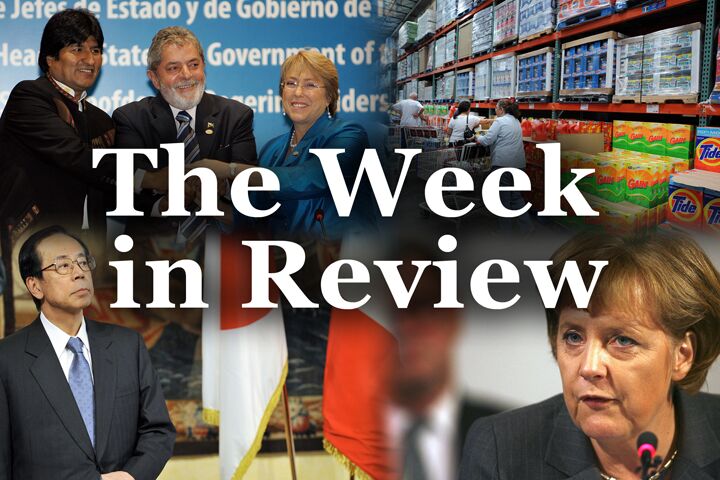
Germany is seeking a return to nuclear power. During a meeting between Christian Democratic Union and Christian Social Union officials, German Chancellor Angela Merkel openly advocated reversing official government policy that stipulates a phase-out of nuclear power by 2021. French and Italian leaders have also said they plan to invest in nuclear power. It appears Europe may be on the cusp of a nuclear renaissance. Of course, as Germany and other European nations improve their nuclear power capabilities, they also increase their ability to make nuclear bombs. Back in 2006, former German Defense Minister Rupert Scholz claimed that Germany needed to develop its own nuclear weapons in order to counter the threat posed by terrorist states. In 2007, President Sarkozy offered Germany access to France’s nuclear defense systems. So far, the German government has turned down such ideas. Yet a future administration may be much more interested in developing Germany’s nuclear arsenal. In fact, the Bible forecasts that Germany will soon be the full-blown leader of a nuclear-powered European empire. For more information on what the Bible foretells about a nuclear-armed Germany, read chapter five of Germany and the Holy Roman Empire.
Angela Merkel also said this week that Europe should lead the regulation of financial markets. Ahead of next month’s G-8 summit, at which leaders are expected to discuss new regulations, Merkel said she believed the Anglo-Saxon model of regulation had failed. Merkel has simply expressed the ambition of several prominent leaders in Europe. Soon the European Union will become the financial regulator of the world. For more information, see our March 2007 article, “New Global Trend: Dump a Dollar, Buy a Euro.”
Asia
Yasuo Fukuda faced major humiliation Wednesday as he became the first Japanese prime minister under Japan’s post-World War ii constitution to have a censure passed against him. This censure, passed by both houses of the Japanese parliament, was initiated and supported by the Democratic Party of Japan (dpj)—Japan’s main opposition party. It carries no legal force, but instead is a symbolic representation of the parliamentary majority’s dissatisfaction with Fukuda. Although chief opposition leader Ichiro Ozawa has said that the censure was a call for the resignation of Fukuda and all his cabinet, Fukuda has responded that he has no plans to call an early general election. If Fukuda is not forced to step down early, he will hold his office until the next general election in September 2009. Fukuda has played a vital role in bringing Japan closer to the rest of Asia by fostering goodwill between Japan and nations like China, Russia, India and Korea. At the same time, he has also maintained Japan’s relationship with the United States. If opposition leader Ichiro Ozawa, or some other nationalistic leader like him, were to ascend to the Japanese premiership, Japan would likely ditch its relationship with America and focus more exclusively on Asian integration.
On Thursday, Taiwanese representatives met with Chinese officials in Beijing to hold the highest-level talks between the two nations since 1999. These talks were aimed at improving economic relations between Taiwan (which regards itself as a self-governing part of China) and mainland China (which regards Taiwan as a renegade province). The two sides agreed to relaunch regular direct weekend passenger flights starting on July 4 and to allow mainland tourists into Taiwan two weeks later.
Yet even as Communist China was talking peace with Taiwanese officials, Chinese Foreign Minister Qin Gang was urging the United States to permanently end arms sales to Taiwan. China is more than willing to accept Taiwan’s voluntary steps bringing it closer to the mainland, but at the end of the day the Taiwanese are going to be forced back into the mainland mold.
In Russia, President Dmitry Medvedev is fitting nicely into his new role as Prime Minister Putin’s friendlier face. During a celebration on Thursday of Russia’s resurgence as an independent world power, Medvedev gave a holiday address stressing the importance of freedom and democracy in Russia. Medvedev says these things while also pledging his support for the policies of his mentor. While some may look to Medvedev as a sign of coming changes in Russia, the truth is that Russia is more embedded under the authoritarian rule of Vladimir Putin than ever.
South America, Africa
Truckers have joined the dispute in Argentina, blockading roads and demanding that farmers and the government reach an agreement. Farmers are protesting the new administration’s taxes on agricultural exports: 40 percent on wheat and beef, and 45 percent on soybeans. President Cristina Fernandez de Kirchner has recently skipped several scheduled negotiations with the farmers, prompting the truckers to get involved. She claims the high taxes will fund necessary social programs.
The military is running President Robert Mugabe’s reelection campaign in Zimbabwe. The bbc has obtained documents that “outline plans by ruling party Zanu-PF to harass and drive out opposition supporters, especially from rural areas.” Another document says food scarcity can be used as a political weapon. Accordingly, the government announced on June 5 that it would suspend relief agency operations in Zimbabwe. The government is flagrantly attempting to coerce voters, and members of the opposition party fear for their lives. Police have said the secretary general of the Movement for Democratic Change will be charged with treason. President Mugabe’s direct opponent, opposition candidate Morgan Tsvangirai, has been arrested three times this month. The Timesreports that seven men in white pickup trucks grabbed the wife of Patson Chipiro, the head of the Zimbabwe opposition party in Mhondoro, then “chopped off one of her hands and both her feet. Then they threw her into her hut, locked the door and threw a petrol bomb through the window.” The leader returned home to find his three brick huts on fire and his wife dead from the severity of her injuries and burns. No wonder President Mugabe has called his conflict with the Movement for Democratic Change “an all-out war.”
A French company, Areva, will probably win the contract to build a nuclear energy facility in Algeria. France may also win a contract to explore Algerian uranium mines, giving the EU another inroad to Africa.
Libyan leader Muammar Qadhafi opposed French President Nicholas Sarkozy’s Mediterranean Union on June 10, saying it would harm Arab and African unity efforts. For more information on Qadhafi’s threats toward Europe and the coming clash between the EU and a Middle Eastern power, read “Al Qaeda’s North African Safe Haven.”
Anglo-America
Hackers in China have penetrated and compromised a number of congressional computers, officials said Wednesday. Rep. Frank Wolf said that Chinese hacking of politicians’ computers began in 2006 and gave reason to believe that China was specifically trying to extract the identities of dissidents. Following one cyber attack, lawmakers discovered that a vehicle belonging to Chinese officials drove to the home of a dissident in Fairfax County and photographed it, the Washington Timesreports. Wolf said that the Chinese cyber attacks on Capitol Hill computers have been known to lawmakers since 2006, but “a lot of people have made it very, very difficult” for him and others to make the problem public.
Farmers across the U.S. are facing heavy rains. Farms in Iowa, Illinois, Indiana and Nebraska have received as much as 12 inches of rain already this month, more than four times the average. Areas of Wisconsin, Minnesota and Missouri also experienced flooding last week. The resulting crop damage has the Agriculture Department slashing its estimates for this year’s corn crop, and July contracts have surged to $7.25 a bushel, more than double 2006 levels. American farmers produce 60 percent of world corn, 33 percent of soybeans, 25 percent of wheat and 10 percent of rice. With global food shortages already widespread, relying on a U.S. bumper crop to rally grain reserves is all wet.
Miles away from the Midwest cornfields, New Yorkers are dealing with a different plague. A recent New York City Health Department study found that more than one in four New York City adults are infected with the genital herpes virus. Specifically, 26 percent of adults tested carried Herpes Simplex-2, a lifelong sexually transmitted infection. The New York lifestyle also has an above-average number of New Yorkers carrying gonorrhea, chlamydia and infectious syphilis.
Also in New York, the iconic Chrysler Building is about to be sold to Abu Dhabi. Ranked the ninth-favorite building in America last year by the American Institute of Architects, the East Manhattan landmark has been a symbol of American capitalism and wealth. Abu Dhabi’s sovereign wealth fund is negotiating a deal to purchase a 75 percent stake in the building from twm, the German arm of an Atlanta-based investment fund.
The New York Stock Exchange and consumers everywhere are watching prices surge not only for gas but also for oil-based goods. Less than half of every barrel of crude oil is refined into gasoline. The rest is used to produce an estimated 57 other major types of goods including asphalt, detergents, cleaners, paint, pharmaceuticals, plastics and dozens of others. “Not quite half of what we consume is energy, food and other commodities that are significantly affected by the rising cost of petroleum,” Mark Zandi, chief economist at Moody’s Economy.com, said. The cost of asphalt has jumped 65 percent already this year, and Dow Chemical has announced an across-the-board 20 percent price hike on all of its products.
In Britain, rising petroleum costs have some considering what would happen if the oil were cut off completely. Lord Cameron of Dillington, the first head of the Countryside Agency, says it would take only three days for the nation to descend into anarchy, the Daily Mailreports. Empty shelves, he said, could drive Britons to loot and steal from one another, plunging the nation into chaos à la post-Katrina New Orleans.
The UK economy continues to hemorrhage, principally in the housing market. After peaking last summer, average house prices have sunk £15,489 (us$30,572) and are now falling at their fastest rate in at least 25 years, the Telegraphreports. Economists are saying the slump could be turning into a “rout.”
Finally in Britain, sentiment is at a poisonous level against the nation it helped found: Israel. Israel’s ambassador to Britain, Ron Prosor, said that the nation has become a hotbed of radical anti-Israeli sentiment. A teacher and professor trade union has called for a boycott of Israeli academia, and much of the British media continues to air programming and reporting biased against the nation’s historic ally and national brother. Read The United States and Britain in Prophecy to discover Britain and Israel’s historic link.


