

The Sad Symbolism in the Sinking of the SS United States
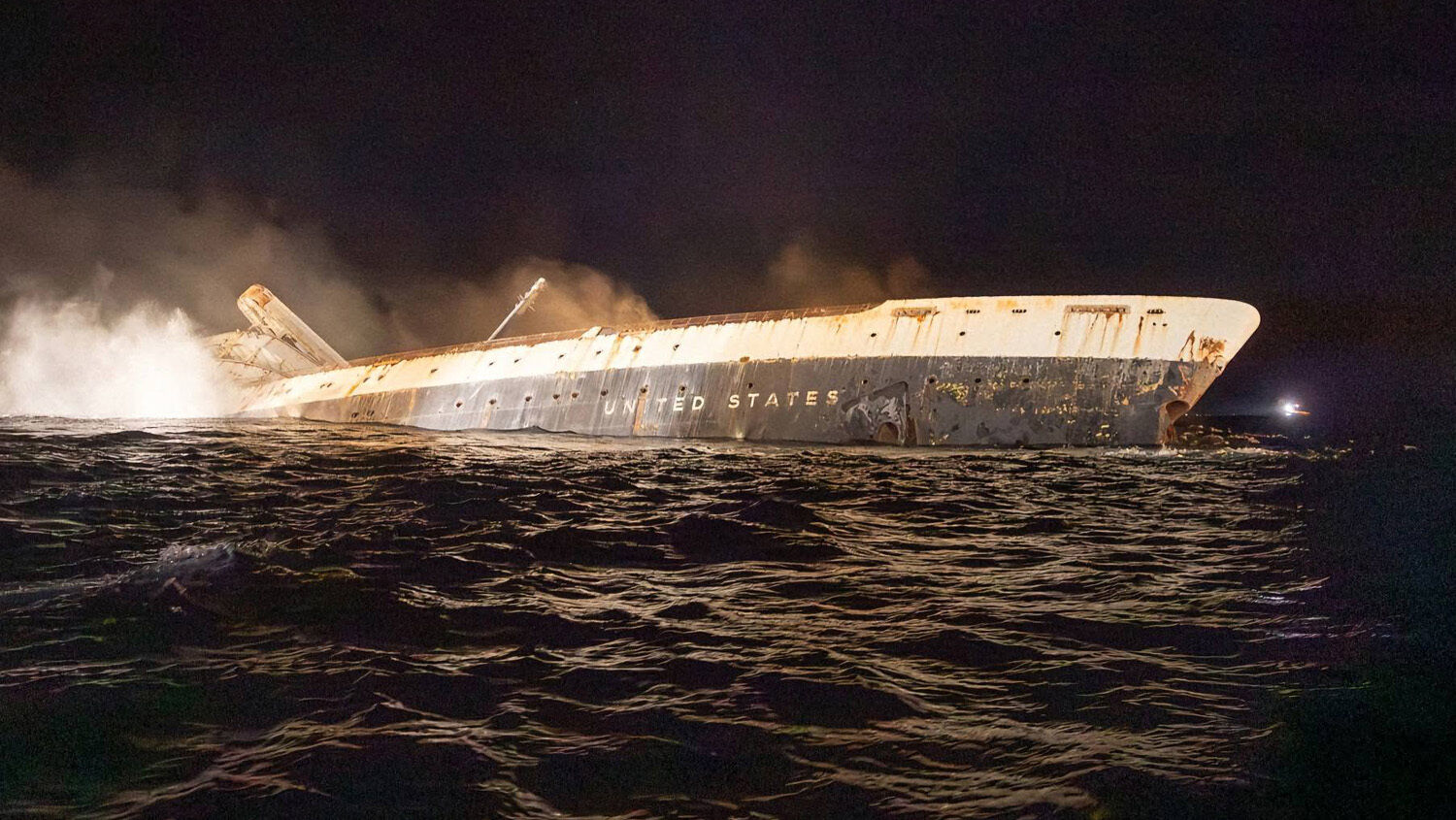
In the closing hours of Wednesday night, November 11, the American ocean liner SS United States slipped beneath the waves. It had not struck an iceberg nor been hit by a torpedo—fates that have befallen ocean liners of yore. Instead, the old glory had suffered decades-long decay and neglect before finally being deliberately scuttled off the Florida coast to become an artificial reef and diving spot.
One can’t help but see a sad irony and symbolic significance in the sinking of this iconic ship, emblazoned with the very name of this nation, at this moment in time. Valves were opened, and water poured into its cut-open sides. The ship put up a fight—the sinking was expected to take just 45 minutes, but it stayed afloat hours longer than anticipated. After four hours, the ship began to capsize, sinking on its side, with the forward starboard panels bearing its emblazoned name, “United States,” as the last part of the ship to go under.
While cheers could be heard from the crowd gathered to witness the scuttling, other observers were much more morose. A common refrain posted to social media was the poor timing of the sinking: Veterans Day (Remembrance Day in the United Kingdom and Commonwealth).
More than that, though, the sinking of this ship can be seen as far more symbolic in the wake of the recent United States midterm elections—“a disaster in the nation’s history,” as Trumpet editor in chief Gerald Flurry wrote in a November 11 editorial. “In these elections, the United States surrendered”—to Iran, to the most radical Democrat platform and the most Islamic and homosexual government assemblies the country has ever seen. “Time will prove that these elections are going to hasten America’s downfall,” he wrote—ironically at the same time that crews were attempting to hasten the sinking of the SS United States.
Built over 70 years ago, the SS United States was a truly iconic ship. Not only was it significantly larger than the famous rms Titanic—over 100 feet longer, three decks higher and with a gross registered tonnage (grt) 7,000 tons heavier—it remains the largest ocean liner ever constructed in the United States. Even more remarkably, it remains the fastest ocean liner ever to cross the Atlantic Ocean, producing record times in both directions of the crossing of 3½ days—beating the previous record set by the rms Queen Mary by half a day. The incredible 248,000 shaft horsepower produced by its engines (compared to the Titanic’s 55,000 and Queen Mary’s 200,000) allowed it to reach speeds of over 40 miles per hour—not bad, for a 53,329 grt hulk! And its reverse speed almost matched the Titanic’s forward speed.
The SS United States also played a role in the religious legacy of our predecessor, Herbert W. Armstrong, who sailed aboard it several times. He wrote in his autobiography: “It was now time that I personally inspected that situation abroad, where the work had now secured such a firm foothold. Mrs. Armstrong and I sailed, Aug. 5, 1954, on the new, fastest ship in the world, the SS United States.” In an Aug. 9, 1954, co-worker letter describing the same trip, he included a “few brief sidelights about our voyage that may interest you,” including an invitation for Mr. Armstrong to officiate a church service aboard the vessel. “It was an honor that I was recognized and given first preference to conduct the church service” aboard “America’s biggest, fastest and proudest ship”—albeit one that he turned down because of religious differences with the scheduled program.
In a December 1960 Good News article, Roderick Meredith described another journey aboard the mighty vessel: “We were sailing across the Atlantic but a few short months ago on the SS United States. With us on board ship was the treasurer of the United States, Ivy Baker Priest, and many other dignitaries. … Traveling with Mr. and Mrs. Herbert W. Armstrong and others in God’s work, we were soon to reach the shores of England to begin the busiest and most fruitful summer so far for God’s Church in Britain.” In a November 1961 Plain Truth personal, Mr. Armstrong described a return journey to the U.S. aboard the vessel the following year, where he was met by a chief steward who “said he and his wife have been reading the Plain Truth for years, and their children have The Bible Story almost memorized. Their lives, he said, have been completely changed, and they are a most happy family. They live in New Jersey and hear the World Tomorrow on our New York stations. It was an inspiring start for the ocean voyage!”
While the SS United States was larger and faster than the rms Titanic, the latter of course remains more iconic and recognizable, given the nature of its sinking in 1912—not to mention James Cameron’s 1997 blockbuster. This was the topic of a dedicated article from Mr. Flurry, “A Titanic Lesson,” in the March-April 1998 issue of the Philadelphia Trumpet:
Many people around the world are talking about the Titanic. They have either seen the movie, or television and newspaper reviews about the movie and the ship. As fascinated as everyone is, however, it seems to me that nobody has learned the important lesson it teaches. And it does contain a titanic lesson and great symbolism. …
I’ll tell you what haunts me when I see video footage of the Titanic today. It is very emotional. I see Britain and America in a similar condition—if they fail to heed God’s warning message. Our nations are headed for a disaster that will make people forget the Titanic tragedy …. They somehow think America and Britain are “unsinkable.”
The 1912 sinking of the British rms Titanic was a fateful and symbolic harbinger of the demise of Great Britain, which was plunged into the ruinous (and avoidable) World War i just two years later. Now, 114 years after the sinking of that iconic ship (for what it’s worth, six 19-year time cycles on—the significance of which Mr. Armstrong described in his autobiography), the SS United States has likewise slipped below the waves to become the largest passenger vessel on the ocean floor—albeit not to screams of terror and agony but to cheering.
While many see the scuttling of the SS United States as a necessary and beneficial reuse of an otherwise-neglected old scrap heap of steel, it’s hard to look past the sad symbolism and timing of the demise of this once-mighty vessel—a symbol of its very namesake, these United States of America. In the words of one observer: “Old, proud, sabotaged by men who couldn’t build her replacement, could have been preserved for posterity but there was insufficient will, still went down slowly but leaves nothing behind. There are metaphors everywhere for those with eyes to see. SS United States, indeed.”
The exultation from the crowd gathered to watch the ship’s sinking only adds to the symbolic dissonance, alongside the frantic and deliberate attempts to make the ship sink faster. In the words of another observer: “The SS United States refusing to sink is honestly beautiful. She’s rotted, gutted and uncared for—but she’s still putting up a fight because her core, her foundation, is so strong. She’s the greatest there ever was. The United States, despite everything, refuses to die.”
Hours after Mr. Flurry concluded his election appraisal that same day—with the prophetic words of warning that a “lack of willpower means the nation is destined to die!”—the SS United States, which “could have been preserved for posterity but there was insufficient will,” rolled over and disappeared.


