

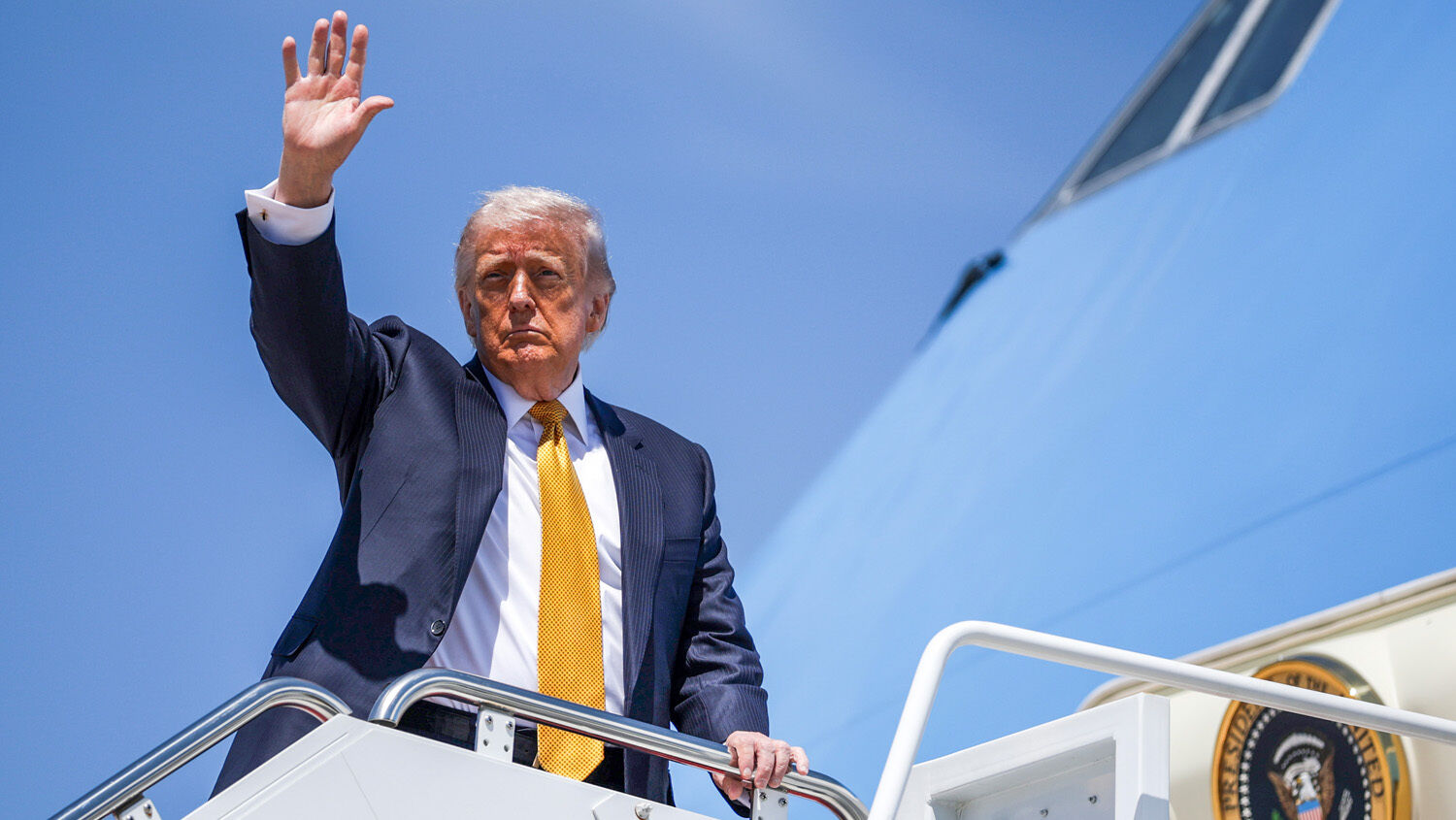
The U.S. Is Abandoning Allies and Empowering Enemies
The message to allies is clear: America’s protection of their security and wealth is no longer guaranteed.
A generation ago, the United States was viewed as a reliable, predictable protector. Today, America’s allies question its commitment. The U.S. seems less likely to fight terrorists, it won’t always back its allies, and it might even use its economic power against them.
This is prompting nations to form new alliances that will soon have fiscal and physical consequences for all Americans.
Abandonment
On September 14, Iran-backed Houthi terrorists seized the Red Sea islands of Greater and Lesser Hanish, increasing their control of this crucial trade choke point.
Since July, the Houthis have effectively controlled the Red Sea. Currently, they allow all non-Saudi Arabian ships to pass through.
Saudi Crown Prince Mohammed bin Salman asked President Donald Trump on September 10 for military support against the Houthis. Trump refused, offering only intelligence assistance.
America’s reputation partly depends on its ability to keep major routes such as the Red Sea open for everyone. If the U.S. leaves Saudi Arabia to fend for itself against an officially designated terrorist organization, what message does that send to Europe, Japan and the Gulf states, who rely on the Red Sea for oil?
On August 24, the South Korean Marine Corps announced the U.S. wouldn’t participate in this month’s “SsangYong” (“Twin Dragon”) joint amphibious exercises. South Korea is one of the few bulwarks of Western ideals in East Asia and one of America’s closest allies.
The U.S. blamed the decision on a strain on resources due to the Iran war.
This exercise has been held every two years since 2012. It includes naval vessels, aircraft and more than 10,000 marines. It helps show enemies like China and North Korea that the U.S. stands with South Korea and will come to its defense.
Eight days before, President Trump announced the U.S. was cutting back its participation in “Ulchi Freedom Shield,” another South Korean military exercise. One stated reason was to keep America’s relationship with North Korea intact. In a social media post announcing the decision, President Trump claimed he had a “very good relationship” with North Korean leader Kim Jong-un and that his nation has been “unthreatening and respectful.”
Days later, North Korea test-launched 10 ballistic missiles in a show of its “unthreatening and respectful” nature.
Earlier this month, Argentinian President Javier Milei threatened annexation of the Falkland Islands, citing his nation’s ties with the Trump administration and President Trump’s declaration that “the U.S. is reevaluating its historic position in relation to” the islands. Milei launched sanctions against companies drilling oil around the islands to symbolize his control.
While Argentina likely won’t seize the islands anytime soon, the U.S.’s response was important. When reporters asked President Trump if he would help the United Kingdom defend the Falklands, he didn’t give a clear answer but implied America wouldn’t, noting Britain wasn’t “there to help” in the Iran war.
Unpredictable Business Partner
The U.S. is also shaking up the global economic status quo.
On September 4, President Trump threatened to cut off trade to nations where the U.S. has a trade deficit if U.S. interest rates weren’t lowered. The U.S. has trade deficits with Canada, China, Germany, France, Mexico, Japan, Indonesia, India, Israel, Italy and South Korea—to name a few.
It is doubtful he will follow through, but it’s not the first time he has threatened to use economic power against American allies. He threatened to end trade with Spain entirely when it didn’t allow the U.S. to use its airspace earlier this year. He also threatened to tariff European Union nations who stood with Denmark against him over his Greenland claims in January.
Why would countries want to trade with the U.S. if it uses its economic power as a threat? They will form new alliances to replace trade with America.
Look at Canada, America’s closest ally after the United Kingdom. Last week, the Trump administration banned select Canadian goods as a counter to Canada’s 50 percent tariffs on $20 billion worth of U.S. goods that took effect September 8, which was a counter to the 50 percent tariffs the U.S. levied on select Canadian goods on August 22.
Now Canada is looking to deepen its ties with the EU.
Other nations, particularly in Europe, are asking: If the U.S. is willing to harm its trade with Canada, what is it willing to do to other countries?
Consequences
The loss of global trust combined with unsustainable debt spells financial doom for America.
The U.S. dollar and economy rely on America’s reputation of reliability. It is what brings foreign capital into the U.S. and motivates foreign central banks to buy U.S. treasuries.
That perception is changing as America’s national debt surpasses $40 trillion. That’s a debt-to-gdp ratio of roughly 125 percent—meaning if every product sold last year in the U.S. were used to pay off the debt, it would still fall trillions short. The debt will continue growing as the U.S. runs a nearly $2 trillion deficit that will grow into $3 trillion over the next decade.
U.S. Treasury yields hit a 19-year high on Tuesday. Norway’s $2 trillion sovereign wealth fund announced earlier this month that it wants to sell some of its American treasuries. Foreign central banks are increasingly buying gold instead of U.S. treasuries.
A financial crisis in the U.S. will lead to the formation of anti-American alliances, the seeds of which are being sown by America’s unreliability.
The late Herbert W. Armstrong warned in 1984 that a major financial crisis in the U.S. “could suddenly result in triggering European nations to unite as a new world power larger than either the Soviet Union or the U.S.”
Isaiah 23 and Ezekiel 27 warn that the U.S. will be besieged economically by its current “allies,” including the EU, Argentina and South Korea.
As the Bible prophesies in Ezekiel 5, once these nations join together to besiege the U.S., it will lead to famine, violence and invasion. The U.S. will be brought to its knees. That is where America’s diminishing reliability is leading.
For more information on how American “allies” will besiege America, read our Trends article “Why the Trumpet Watches the Development of a Massive Anti-American Trade Bloc.”


