

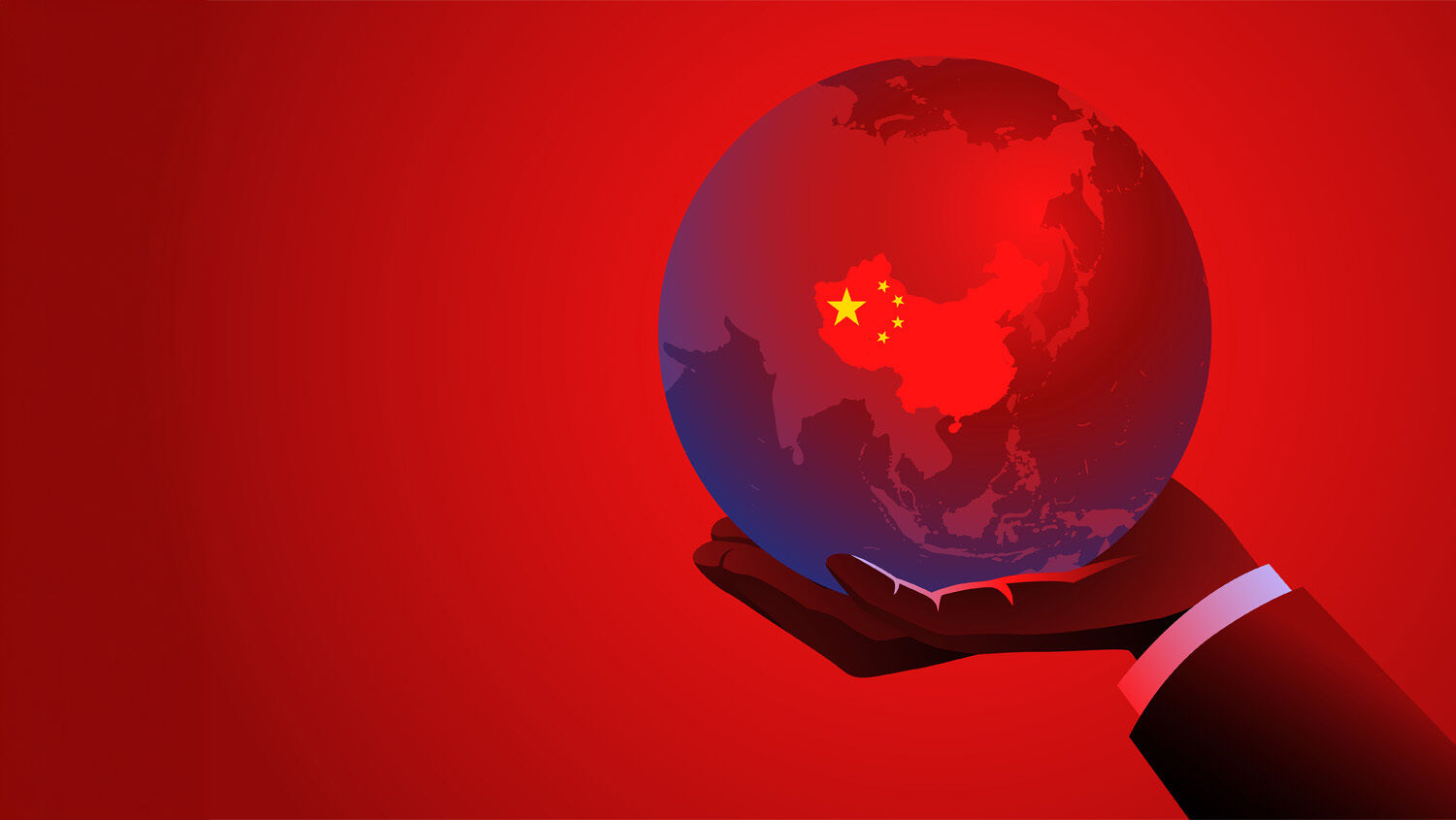
As America Fades, the Chinese Are ‘Feeling Like the Champions of the World’
The Chinese are now “feeling like the champions of the world.” That was the assessment of a diplomat quoted in an August 3 New Yorker feature.
That confidence stems largely from recent United States’ actions that have strained its relationships with longtime allies, reduced confidence in government institutions, and tarnished America’s image as a reliable partner and global leader.
And the consequences are becoming increasingly visible on the global stage.
America’s global approval rating has fallen by nearly 40 points over the last two years, according to the Alliance of Democracies Foundation’s Democracy Perception Index. In several international polls, China now receives higher approval ratings than the U.S.
And the Chinese can hardly contain their glee. They see America’s missteps as a gift—and they are openly expressing schadenfreude-laced gratitude. A research institute at the nation’s famed Renmin University recently released an analysis called “Thank Trump,” which sarcastically praises the U.S. president’s policies for accelerating what it describes as the “twilight of an empire.”
Meanwhile, U.S. policies dating back several years have allowed China to pull ahead in numerous key industries of the future. The nation now produces 70 percent of the world’s electric vehicles and drones, 75 percent of lithium-ion batteries and 80 percent of solar cells. It operates more than half of the world’s industrial robots, giving it the largest automated manufacturing base on the planet.
The contrast with America is stark, with the U.S. producing only a small fraction of these technologies that will define economic and military power in the decades ahead.
The picture is similar in medicine, where China has overtaken the U.S. as the world leader in registered clinical trials—a milestone once unimaginable for a nation that lagged decades behind American biomedical research. Chinese biotech firms also now generate nearly one third of the world’s new drug candidates—a stunning advance that puts China nearly on par with the U.S. and could soon propel it into the lead.
“The current world order was built by a group of geniuses, mainly in the U.S., who hailed from Europe,” Chinese neurobiologist Yi Rao said. “If Trump had maintained the order effectively, China would find it very hard to get through. Trump really helped us.”
At the same time, China’s shipbuilding capacity now dwarfs that of the U.S. by two hundredfold. And many analysts warn that America’s munitions stockpiles may not be sufficient to sustain a major war over Taiwan—particularly amid the Iran war.
Even in artificial intelligence—the crown jewel of the modern technological race—China is making remarkable advances. Last month, the Chinese company Moonshot released a model that performs on par with America’s leading systems—but at a fraction of the development cost. The achievement was all the more striking since it came despite U.S. efforts to restrict China’s access to advanced microchips—the essential building blocks of modern AI.
China expert Rush Doshi told the New Yorker that if America loses the race over the next generation of industries—such as AI, robotics and biotechnology—as it did with solar panels, electric vehicles and batteries, “it would irreversibly change the balance of power.” And by many measures, that race is already slipping out of America’s hands.
So it is no surprise that many Chinese are now feeling like the champions of the world. It is true that they are facing grave internal challenges, including a full-blown property crisis, soaring youth unemployment, a rapidly aging population, slowing economic growth and a ruling party increasingly bent on preserving its rule at all costs. But none of those factors has stopped China from winning greater international confidence than the U.S. or from pushing past America in several strategically crucial fields.
As the U.S. keeps turning inward, China’s star is rising in some dramatic ways. The question now is how the nation will use its growing power and influence.
‘We Are Inevitable’
A glimpse of what a more China-centered world could look like may already be visible through Beijing’s Belt and Road Initiative. Since its launch in 2013, the program has pumped roughly $1 trillion into infrastructure projects around the world, from railways, roadways and ports to mines, hospitals and “smart cities” powered by Chinese technology.
And the initiative is clearly about more than economics. It also exports aspects of China’s governing model to nations who sign up to join the Belt and Road.
As Doshi said, Chinese leaders consider autocracies “perfectly legitimate” governments and China’s “technology is used to strengthen them.” He explained: “China increasingly says to autocrats, Would you like to stay in power? I can help you with that.”
Beijing has increasingly made good on that offer, exporting surveillance technology and digital infrastructure to strengthen state control in various nations. In Venezuela, for example, Chinese technology has helped build powerful digital systems that connect personal data with government records, giving authorities unprecedented tools for monitoring and tracking citizens.
In Nepal, the dangers are even more apparent. The Chinese have provided advanced facial-recognition systems, including thousands of Chinese-made cctv cameras that are now operating across the nation. Nepal’s government has already used the systems against activists and Tibetan refugees. And China has ensured that its involvement is unmistakably clear: At one security headquarters, above a wall of video feeds hangs a sign reminding operators of the source of the technology: “With Compliments of the Ministry of Public Security of China.”
Yet the clearest window into the Chinese Communist Party’s vision for the world is China itself. As Doshi explained, “A country tends to create an external order that looks a lot like its internal order.” And the way the Chinese Communist Party governs at home—through rigid centralized control, zero tolerance for dissent, strict management of information and a sweeping surveillance system that echoes Orwell’s darkest warnings—shows the type of international system it seeks to build.
It is a system built to perpetually preserve and increase the Chinese Communist Party’s grip on power, crushing all manner of dissent and opposition with ruthless pragmatism. Yet today, the Chinese rarely arrive with a clenched fist. They simply ask countries to open the door to their easy cash, let them build smart ports and cutting-edge railway systems, install some cameras, and trust that there is nothing to worry about.
In Doshi’s words, “China doesn’t want you to think too hard about what its ascendance will mean for the world. They want to show you the edge of the future. They have two messages they want to sell everybody. One is ‘We are inevitable.’ And the other one is ‘Don’t worry.’”
But the world has every reason to take notice.
‘Times of the Gentiles’
During His ministry on Earth, Jesus Christ warned of a global age that would begin shortly before His return. Luke 21:24 records Him describing this era as “the times of the Gentiles.”
This term “Gentile” refers to peoples who do not descend from ancient Israel. The countries that do descend from Israel include America, Great Britain and the Jewish nation today called Israel, which you can understand by picking up a free copy of The United States and Britain in Prophecy.
In the 19th and 20th centuries, Great Britain and then the U.S. wielded their global power in a way that brought comparative stability to much of the world. But now the era of Israelite leadership has ended, and the balance of global power is shifting instead to “Gentile” nations.
In the October 2023 Trumpet issue, editor in chief Gerald Flurry explained that the primary powers in “the times of the Gentiles” are a European alliance headed by Germany, a Middle Eastern grouping led by Iran and a great Asian bloc led by Russia and China.
“We are deep into the times of the Gentiles already,” he wrote. “You can see it happening. Look at Iran. Look at Europe especially, and at Asia. The times of the Israelite powers are over!”
The fact that humankind has now entered the times of the Gentiles is a momentous event. China’s rise—and how it has come at America’s expense—offers clear evidence of this.
Mr. Flurry stressed that although this shift in the global power balance is deeply alarming and means a time of darkness is near, it is also connected to very good news. To understand more about China’s rise and the bright future that is intimately tied to it, order your free copy of Russia and China in Prophecy.


