

China’s Private Space Industry Has Achieved Lift-off—the U.S. Has Barely Noticed
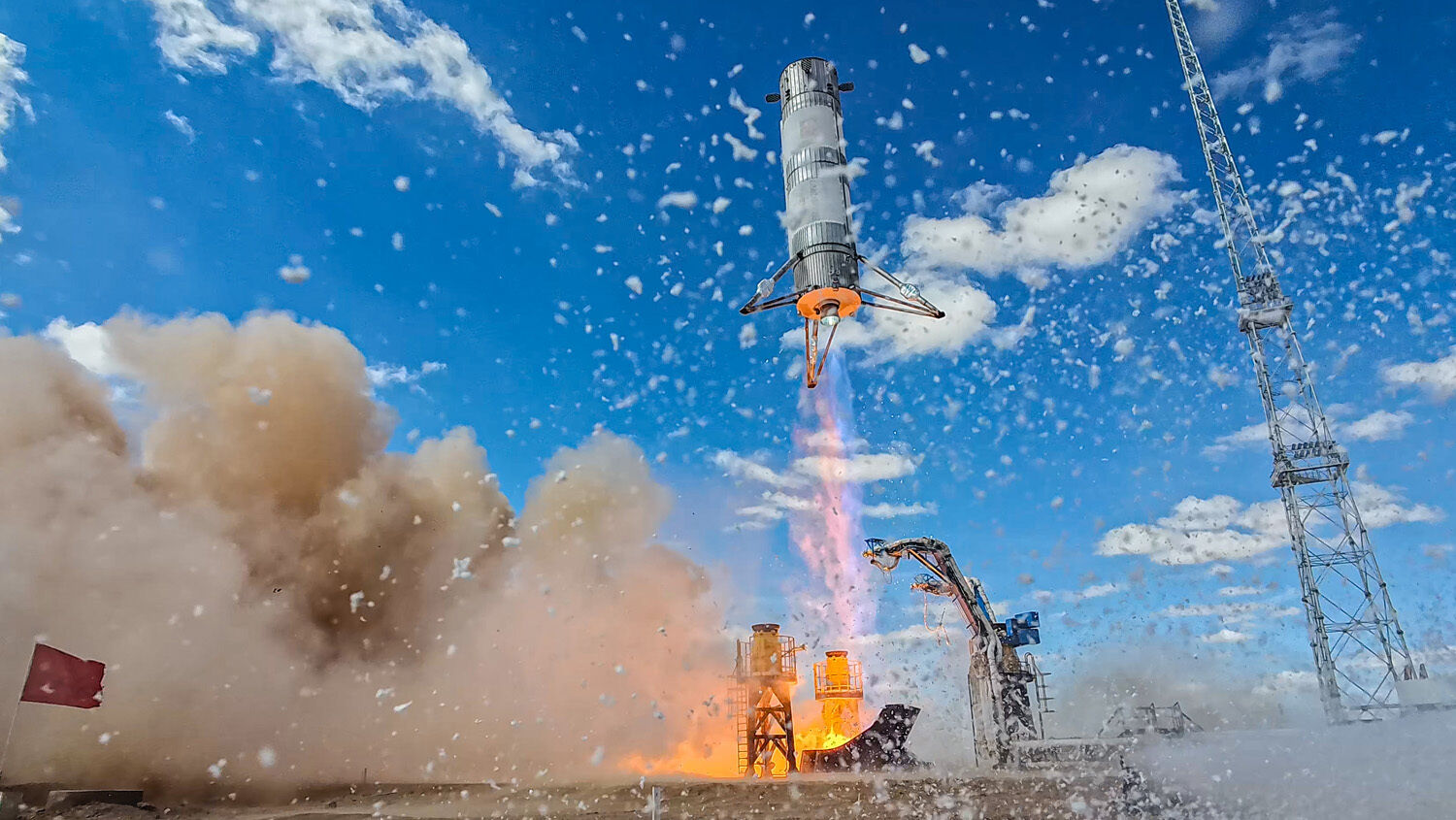
Ten years ago, China’s private space industry was barely on the launchpad. Today it is on rapid ascent, with around 430 commercial space firms up and running across the nation.
These companies are racing to develop vast satellite constellations, reusable launch vehicles, navigation services, asteroid-mining programs and even space-tourism missions. Together, they are lifting China into a higher orbit in the global space race.
“This development is often overlooked because many Western observers continue to see China’s space program as a purely state-run enterprise,” Rainer Zitelmann wrote for Fortune Magazine this month. “That perception is increasingly outdated. While state-owned organizations remain powerful, private companies have become an important driver of innovation and competition.”
It wasn’t long ago that China’s space program was the exclusive domain of government agencies and state-owned companies, with virtually no space available for private organizations. But that all changed after Dec. 21, 2015, when the Chinese—like much of the rest of the world—watched Elon Musk’s privately owned SpaceX successfully return a Falcon 9 rocket from space and land it upright on a launchpad.
This astronomical breakthrough was a wake-up call for the Chinese. By proving that rockets could be flown again and again, it was clear that the economics of space exploration had fundamentally changed—and that the industry was entering a new era. Chinese authorities recognized that if they wanted to keep pace, they would have to move beyond an exclusive dependence on state-owned aerospace companies.
The Private Sector Gets Lift-off
Soon after the Falcon 9 milestone, the Chinese government began dismantling barriers that had long kept private companies on the ground and out of the industry.
Hundreds of companies were launched in the years that followed, many by former engineers from state-owned aerospace giants who were eager to escape the bureaucratic gravity of government agencies—and push ahead with greater thrust. By 2024, China was home to more than 400 private space corporations, with the largest 100 valued at approximately $100 billion.
Instead of venturing into entirely new frontiers, most of them aim to go where SpaceX and other Western companies have already charted a course. This continues a familiar pattern in China’s industrial rise: acquiring foreign technology and expertise—through partnerships, talent recruitment and theft—then reverse-engineering what works well and building on it to create global competitors of its own. Massive government subsidies make it a ruthless but effective business model.
Some privately owned Chinese space companies have already had stellar successes. In 2019, iSpace made history by becoming the first Chinese private space company to launch a rocket into orbit. In 2023, LandSpace became the first company in the world to successfully launch a methane-liquid oxygen (methalox) rocket into orbit. Geespace has deployed 64 satellites in a low-Earth-orbit constellation that competes with Starlink; it plans to get the number up to 240 soon. Galactic Energy is racing to develop reusable rockets—the technology that transformed the economics of spaceflight.
“[I]t would be a mistake to underestimate China’s private space sector,” Zitelmann wrote. This is largely because the nation’s leaders recognize that this is an area the government can’t afford to suffocate. He wrote: “Contrary to the broader trend under Xi Jinping toward a larger role for the state in the economy, private space companies have emerged and continued to grow during his leadership.”
The Other Mission: Preparing for Space Conflict
At the same time, China’s state-owned aerospace companies have also been reaching new heights—largely because General Secretary Xi prioritizes the industry so highly. In recent years, China’s BeiDou Navigation Satellite System has achieved global coverage and emerged as the most significant alternative to gps. At the same time, China has built its own space station, landed spacecraft on the far side of the moon, returned lunar samples to Earth, and even placed a rover on Mars.
But the Chinese Communist Party’s space ambitions extend well beyond communication and exploration.
Its leaders recognized early that giving a lift to the private space sector would allow state-owned aerospace companies to devote more and more attention to military objectives, including the development of counterspace weapons.
In recent years, state-run giants have been investing astronomical amounts into space-based anti-satellite weapons, Earth-based anti-satellite weapons, satellite jamming systems, cybercapabilities and other technologies designed to operate in an increasingly contested space environment.
The combination of China’s booming private space sector, state-owned aerospace industry and expanding counterspace capabilities has transformed the country into one of the world’s most ambitious and capable space powers.
The United States still leads by a considerable margin. Every footprint ever made on the moon belongs to an American, and the number of those footprints is expected to multiply as soon as 2028. Innovations and breakthroughs continue to be overwhelmingly from Americans. And of the more than 15,000 active satellites now circling Earth, a stunning three quarters are American.
The U.S.’s advantage in the final frontier is undeniable and formidable. But the paradox is that in space, the brightest stars are the most enticing targets.
Space: Where Lead Becomes Liability
America’s vulnerability is mainly due to how heavily it depends on its thousands of satellites for everything from weather monitoring and communications to banking, navigation and Internet connectivity. For the U.S. military, space has become particularly indispensable—providing the intelligence, surveillance, reconnaissance, communications, navigation, missile warning and precision-targeting capabilities that define modern warfare.
“We are almost as dependent on satellites as we are on the sun itself,” Rep. Jim Cooper wrote in a recent Space Threat Assessment report. They are, he wrote, the “infrastructure of infrastructure.”
This heavy dependence leaves the U.S. far more vulnerable to attacks on its space infrastructure than any other nation. “Our vulnerability is acute because our satellites are the juiciest targets,” Cooper wrote. “Cripple our satellites, and you cripple us. Satellites are not only our crown jewels but the crown itself—and we have no castle to protect them.”
Steve Lambakis, an international affairs analyst, agrees with this assessment. “U.S. space systems are among the most fragile and vulnerable assets operated by the U.S. military,” he said. The multibillion-dollar infrastructure is “vital to nearly every activity of the United States and, increasingly, the armed forces of U.S. allies.”
This is a reality that the Chinese keenly understand, as demonstrated by how much of their space developments are focused on antisatellite weapons along with other counterspace capabilities.
Due to the U.S.’s unmatched dependence, nations such as China would likely be willing to lose their own space-based assets if that’s what it took to destroy America’s. Frank Rose of the Brookings Institution said, “Adversarial nations are developing antisatellite weapons because they believe space represents an asymmetric vulnerability of the United States.”
The vulnerability is so asymmetrical that Representative Cooper says America could be sidelined within a matter of hours:
The risk of a space Pearl Harbor is growing every day. Yet this war would not last for years. Rather, it would be over the day it started. Without our satellites, we would have a hard time regrouping and fighting back. We may not even know who had attacked us, only that we were deaf, dumb, blind and impotent.
Our ‘Achilles’ Heel’
Trumpet editor in chief Gerald Flurry has warned on several occasions about the danger of America’s reliance—specifically that of its military—on various computer technologies that are susceptible to enemy attack. In a January 1995 article, he quoted analyst Joseph de Courcy, who called this reliance “the Western world’s Achilles’ heel.” This was a reference to the warrior of Greek mythology who was susceptible to injury only on his heels. “America is the greatest superpower this world has ever known,” Mr. Flurry wrote. “But we have a very vulnerable point in our military—our own Achilles’ heel.”
Mr. Flurry said de Courcy’s warning about the U.S.’s vulnerability reminded him of a biblical prophecy in Ezekiel 7. The first verses of the chapter show that God is addressing “the land of Israel” in the time of “the end.” This refers mainly to the U.S. and Britain in the modern day (to learn why, read our free book The United States and Britain in Prophecy).
Ezekiel 7 discusses a future when God will punish these two powers for their “abominations” and their refusal to turn to Him (verse 8). Verse 14 vividly describes one aspect of that punishment: “They have blown the trumpet, even to make all ready; but none goeth to the battle: for my wrath is upon all the multitude thereof.”
Mr. Flurry said this “alarming” passage is about a time when U.S. military technology will have been compromised by enemies. “It seems everybody is expecting our people to go into battle, but the greatest tragedy imaginable occurs!” Mr. Flurry wrote. “Nobody goes to battle—even though the trumpet is blown! Will it be because of computer terrorism?”
Isaiah 59 offers details that may apply to this future time of calamity for America and Britain. In verses 9 and 10, the people are shown to be robbed of vision: “[W]e wait for light, but behold obscurity; for brightness, but we walk in darkness. We grope for the wall like the blind, and we grope as if we had no eyes: we stumble at noonday as in the night ….”
Such blindness is already apparent in a spiritual sense for America and Britain today: Many in these countries are groping around in spiritual blindness. And the vision that is absent in this prophecy might also include physical types, including those made possible by America’s thousands of satellites. As Cooper said: “We may not even know who had attacked us, only that we were deaf, dumb, blind, and impotent.”
In his booklet Isaiah’s End-Time Vision, Mr. Flurry discusses prophecies recorded in Ezekiel 5 and 27, Isaiah 22 and 23 and Revelation 18, which reveal the specific nations that will attack America and its allies. He says they will include certain Asian powers, such as China and Russia, as well as a European empire.
When these warnings are examined together, the significance of China’s thriving private space sector, its state-owned firms freed up for greater military focus, and America’s growing vulnerability becomes clear. It is plain to see that a terribly dark time—an era marked by suffering, blindness and uncertainty—is on the horizon. Yet the Bible also makes clear that there is a higher vision we can cultivate—one that cannot be blinded, hacked or destroyed by any human power.
To understand the prophetic context of trends now underway and the kind of vision that can withstand the conflicts on the horizon, order your free copy of Isaiah’s End-Time Vision.


