Why Britain Can’t Find a Leader
Why Britain Can’t Find a Leader

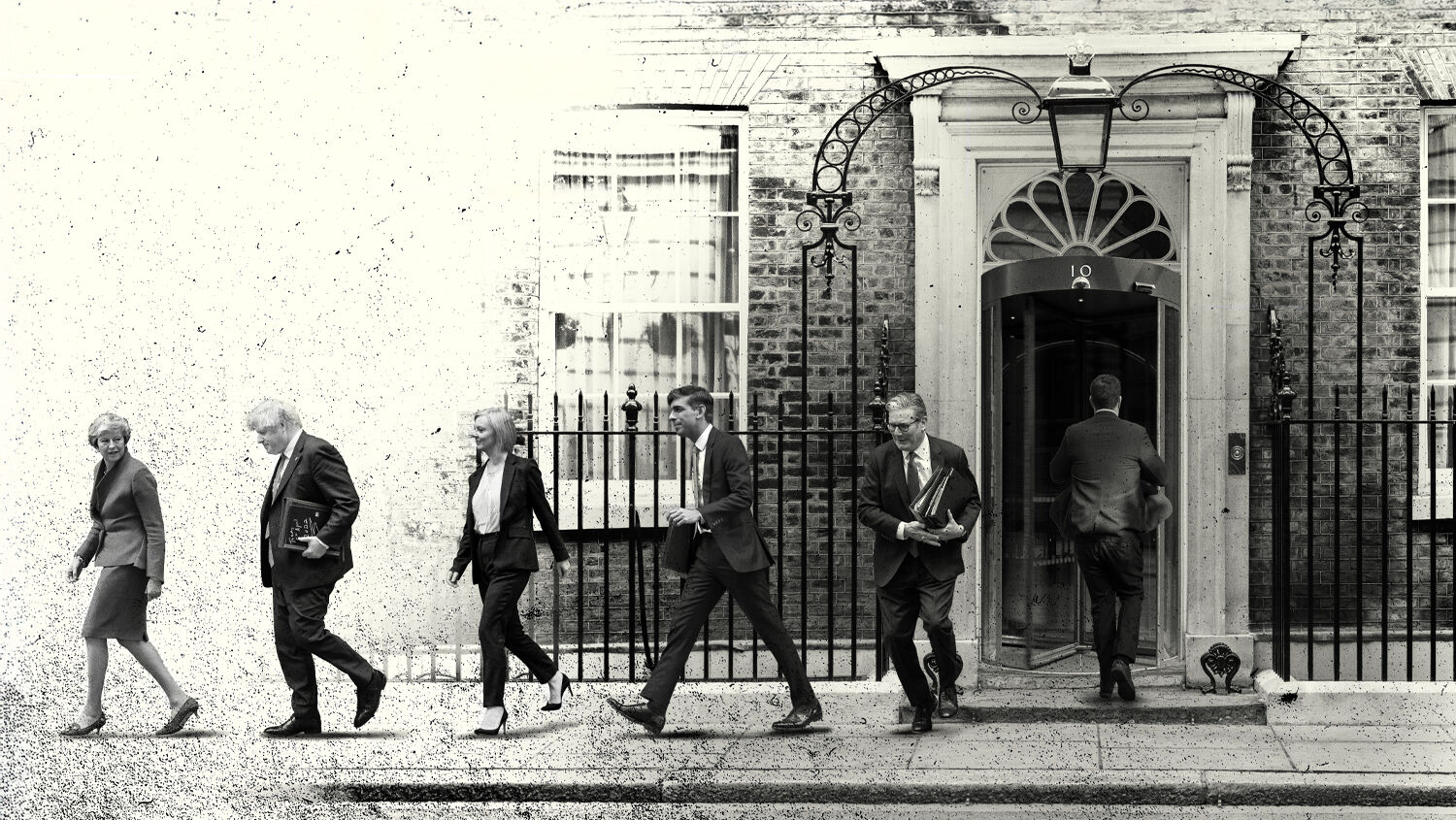
Outside 10 Downing Street, the prime minister announced that it was time to resign. This happened in 2016, 2019, 2022, 2022 again, 2024 and, most recently, in June of this year.
The nation is now heading for its seventh prime minister in a decade.
“The conduct of the great office of prime minister of the United Kingdom in the last 15 years has no precedent in the history of that position,” wrote former newspaper editor Conrad Black last year. First the Conservative Party imploded, cycling through five leaders in quick succession. Now the Labour Party has proved this isn’t merely a Conservative problem: The UK’s major left-wing party can’t produce a stable leader either.
This cycling of prime ministers is a symptom of a much deeper failure.
In the decade before 2008, British productivity grew 21 percent. In the decade after, it grew by just 7 percent.
By 2027, taxes will reach their highest level in postwar history.
Britain’s debt is rising faster than any other nation in the world, except Botswana.
Migration numbers hit a record high of more than 1.3 million in 2023. About 40,000 migrants arrive each year in small boats. So far, about 2 percent of the entire adult male population of Albania has arrived this way.
One in five English schoolchildren doesn’t speak English as a first language: In London, it’s a majority.
Shoplifting has reached the highest level ever recorded, rising 20 percent in the 12 months ending in March 2025. In only 18 percent of incidents was anyone ever charged.
The people are poorer, crippled with taxes, and watching their country transform before their eyes, while police do nothing to stop flagrant lawlessness. No wonder they quickly become unhappy with their leaders. By February, Prime Minister Keir Starmer had reached a net approval rating of minus-49, lower than anything ever “achieved” by Theresa May, Boris Johnson or Rishi Sunak.
Why can’t anyone seem to deal with the mess?
Is Brexit to Blame?
Starmer announced his resignation the day before the 10-year anniversary of Britain’s Brexit vote. David Cameron was prime minister at the time, and he resigned soon after. He had held the office six years. Since then, no one has lasted more than three.
Was Brexit the moment it all went wrong?
Do you remember the wave of optimism that washed over Britain after it voted to leave the European Union on June 23, 2016? That hope has now receded. The Brexit campaign promised a new era of absolute sovereignty, lucrative global trade deals and rising wealth. Instead, the tide went out and left behind bureaucratic overregulation, economic stagnation and a nation more adrift than ever, one that no one can steer.
The political establishment never truly accepted the Brexit result. Instead, it quietly continued many of the European Union’s stifling economic policies in all but name. As a result, the only meaningful change since Brexit is that Britain lost full access to the European market while retaining much of the bureaucracy.
“Take back control” was the slogan of the Vote Leave campaign. But Britain’s bureaucracy didn’t really want control. Three quarters of members of Parliament who expressed an opinion, including Cameron, opposed Brexit. The unelected experts and technocrats who run the country massively favored the EU.
Even after leaving the EU, the British people have allowed their nation to be hijacked by an EU-style bureaucracy more interested in perpetuating its own authority and power than delivering on the change the British voted for.
Radical change, the kind Britain needs in order to solve its problems, is hard. It’s risky, it upsets people, it means offending elites and academics, endangering careers, and not getting invited to dinner parties.
While Brexit is not at the root of Britain’s problems, it certainly failed to solve them. That is exactly what the Trumpet predicted, even as the waves of optimism were still fresh. “Is this a new birth of freedom for Britain?” we asked in 2016. “At the Trumpet, we have certainly pointed to the flaws in Britain’s relationship with Europe. We have lamented the loss of sovereignty to Europe. So is it sunlit uplands from now on? Sadly, no. While the EU has certainly caused problems for Britain, the biggest wounds are self-inflicted and won’t go away even when this divorce is finalized” (Trumpet, August 2016).
We then pointed to many of the same problems that Reform leader Nigel Farage is pointing to now: Britain’s huge debt problem, dire trade situation and catastrophic family breakdown. These problems are the result of a spiritual sickness that was not cured when Britain left the EU. In fact, many of Britain’s problems got much worse after Brexit. The astronomical debt, the broken families, the gender ideology moral confusion, the social rot—none of them came from Brussels. They came from within.
New Leader, New Solutions?
Greater Manchester Mayor Andy Burnham turned member of Parliament seems almost certain to become Britain’s next prime minister—its seventh within a decade.
Burnham’s first policy speech, on June 29, did little to address Britain’s sickness. He promised the “biggest rebalancing of power” in British history—shifting authority from the capital to the regions. He promised a new “No. 10 North” to shift some power from London to Manchester. There may be advantages to this, but they fall far short of the scale of the problems.
One of Britain’s most disgusting problems is Pakistani rape gangs that have manipulated and violated British girls for years. M.P. Rupert Lowe recently produced a report estimating that there are 250,000 victims of these rapists nationwide. It is a very rough estimate due to a dearth of authoritative sources, but the authorities are not interested enough to produce more accurate figures.
Police and other authorities looked the other way—and continue to—as part of an effort not to “rock the multicultural community boat,” as an M.P. for one of the affected towns put it. “Several staff described their nervousness about identifying the ethnic origins of perpetrators for fear of being thought racist; others remembered clear direction from their managers not to do so,” states the official Jay report on victims in the town of Rotherham.
Too often, police sided with rapists rather than their victims. In two cases, girls’ fathers tracked down their daughters, found the houses where they were being abused, and called the police. The police arrived—and arrested the fathers.
In another case, the police found one of these victims in a derelict building with some adult males. Her companions were not investigated for child rape—instead, she was arrested for being drunk and disorderly.
Much of the abuse went on in towns in Greater Manchester, where Burnham was mayor. The worst of that abuse happened before he was in office. But he did little to expose or punish wrongdoers in the aftermath. In Greater Manchester, no police officer or social worker has faced criminal proceedings for what happened.
None of Britain’s leaders have dealt with the problem. Every one of the six prime ministers who has run Britain since the Brexit vote is partially complicit in these crimes. And so is Britain’s next leader.
Britain’s Next Solution
The Bible offers a deep analysis of Britain’s problems—and tells us what is coming next. As Herbert W. Armstrong proved in his free book The United States and Britain in Prophecy, Britain is one of the nations that descended from ancient Israel—particularly the tribe of Ephraim. Isaiah 1:5-6 prophesy of these modern nations: “[T]he whole head is sick, and the whole heart faint. From the sole of the foot even unto the head there is no soundness in it; but wounds, and bruises, and putrifying sores ….”
The sickness is everywhere. Devolving power to regional councils or local assemblies will not solve anything, because the sickness is there too.
The book of Hosea directly addresses Ephraim’s (Britain’s) problems. Hosea 5 begins by declaring that the leaders—“the priests” and “house of the king”—are a snare and a net for the nation. “God is putting the blame where it belongs,” writes Trumpet editor in chief Gerald Flurry in his booklet Hosea—Reaping the Whirlwind. “Who has led the nation of Britain astray? It has been the ministers, rulers and even the royal family. The leaders of the nation have been a snare to the people.”
Hosea 5:13 tells us that Britain’s leaders will wake up to that sickness soon: “When Ephraim saw his sickness, and Judah saw his wound, then went Ephraim to the Assyrian, and sent to king Jareb: yet could he not heal you, nor cure you of your wound.”
The nation realizes that it is sick and that another change in prime minister will not fix it. So it turns to a foreign country: Germany. (Germany’s identity in Bible prophecy is also proved in The United States and Britain in Prophecy.)
Britain was called the “sick man of Europe” in the 1960s. After Britain joined the European Economic Community in 1973, Mr. Armstrong consistently prophesied that it would leave it. The reason he prophesied Britain’s exit from the EU, however, was not that he believed the British people needed independence to fix their country, but because Bible prophecy says a German-led Europe would attack Britain.
“[T]he soon-coming resurrected ‘Holy Roman Empire’—a sort of soon-coming ‘United States of Europe’—a union of 10 nations [will] rise up out of or following the Common Market of today (Revelation 17),” Mr. Armstrong wrote in his 1985 book Mystery of the Ages. “Britain will not be in that empire soon to come.”
This prophecy was dramatically fulfilled 10 years ago. But it was not a sign that things were about to improve in Britain. Rather, it was a sign of impending invasion, captivity and enslavement.
Subsequent events have proved these forecasts correct. Britain’s decline has accelerated.
But turning to a foreign power for help will make things much worse.
The Lesson Britain Must Learn
God is trying to get Britain to see one simple truth: “O Israel, thou hast destroyed thyself; but in me is thine help” (Hosea 13:9).
Britain is destroying itself! The nation’s sins are at the root of the crisis.
Most of Britain relies on the government for its income, either in the form of pensions, welfare or employment in the civil service. People don’t save for their retirement, nor do children look after their parents—they expect the government to do it. Too many invent trivial “mental health” excuses to get a payout, a car and other absurdly generous benefits at taxpayer expense.
The government allows mass migration to try to bring in more workers, but many of those migrants quickly become eligible for the same benefits.
The nation has embraced woke, family-destroying ideologies. Divided homes have contributed to a “mental health crisis” across the country. There are now five times more children and young people in contact with mental health services as there were in 2016.
Yet the nation is so wedded to this misguided cause that police and businesses find their ability to get anything done stifled by diversity initiatives and endless paperwork, designed to prove that no one-legged lesbian Afghan is being discriminated against.
Britain’s leaders have led the way into this disaster. But the sickness infects every corner of British life.
A new prime minister will not solve it. A foreign country will not solve it. It will take a wholesale change in national lifestyle.
“If my people, which are called by my name, shall humble themselves, and pray, and seek my face, and turn from their wicked ways; then will I hear from heaven, and will forgive their sin, and will heal their land” (2 Chronicles 7:14).
If Britain will not repent nationally, the Bible makes plain that this course ends in the Great Tribulation (Matthew 24:21-22). But you can repent individually. Do not be lulled to sleep; don’t ignore the problems. The signs are there for those with eyes to see. Britain needs to repent toward the only leader who can truly govern it and lead it to safety, power, peace and purpose.