Does AI Make You Stupid?
Does AI Make You Stupid?

Artificial intelligence is revolutionizing the world and transforming every walk of life. This technology’s unparalleled ability to process data, condense information, answer questions, and automate tasks is bolstering productivity, driving innovation, and reshaping industries at a pace never before seen.
It’s also eroding your ability to think.
For the first time since record-keeping began in the 1930s, human iq scores have been dropping. iq scores rose roughly 3 points every decade throughout the 20th century. That long upward trend has now reversed in many Western countries, with notable declines documented since the late 1990s.
What happened? Calculators made you less sharp at math. gps weakened your sense of direction. Search engines hurt your ability to remember facts. Google allowed you to skip memorizing information you knew you could look up later. And now chatbots like Chatgpt, Claude and Grok may erode your thinking in unprecedented ways.
Your brain is like a muscle: You use it or lose it. It needs exercise. This is why the world’s sharpest thinkers read deeply, memorize key concepts, and let knowledge compound in their minds.
The question you now face is not whether AI is good for productivity; it is whether you are willing to trade cognitive capacity for convenience. If you want to protect your mind, you must choose to do so.
The risk is not that machines will out-think you. It is that you will stop thinking altogether.
Cognitive Offloading
Computers are not the first tools to change how the human mind functions. Inventions like the alphabet, written text and the printing press also revolutionized how humans processed and stored information.
Greek philosopher Plato wrote in Phaedrus (370 b.c.) that his teacher Socrates refused to write anything down, believing it would “produce forgetfulness in the minds of those who learn to use it, because they will not practice their memory. Their trust in writing, produced by external characters which are no part of themselves, will discourage the use of their own memory within them.”
Technology always comes with trade-offs. While the printing press replaced the average person’s ability to memorize facts by encouraging readers to rely on indexing and skimming rather than internalizing information, it also freed up time and energy for higher-order work beyond simple recall—work like analysis, criticism and synthesis.
Yet ai chatbots are different. They don’t just do simple math like a calculator or let you look up a quick fact like a Google search. They perform the exact skills that make you smarter: reasoning, combining ideas and making judgments. So while the printing press traded some memorization ability for stronger reasoning ability, the chatbot may be replacing your reasoning ability for nothing other than convenience.
Cognitive psychologists are calling artificial intelligence a “cognitive offloading” accelerator. They warn that handing over your thinking to chatbots can cause a sharp decline in problem-solving skills. One study by researchers at Carnegie Mellon University, mit, ucla and Oxford in April showed this trend.
Researchers gave 354 people fraction arithmetic problems to solve. As expected, the group with access to an ai helper solved the problems faster and more accurately. But when researchers took the ai away, those same people did much worse on new problems than people who never used ai in the first place.
Just 10 minutes with AI was enough to weaken their skills. The researchers said the problem wasn’t just wrong answers. People also stopped trying as hard. Coauthor Rachit Dubey explained: “Once the AI is taken away … they’re also not willing to try without AI.” The study warned that if such a short session can cause this much harm, daily AI use over many years could have serious, long-lasting effects.
In another study, researchers at mit Media Lab wired 54 students with special headsets that measure brain activity. The students had to write essays on unfamiliar topics under time pressure. One group used Chatgpt, another used regular search engines, and the last group used no external resources at all.
These brain scans told a stark story. Students using search engines showed a 34 percent to 48 percent drop in brain connectivity compared to students who wrote their essays completely on their own. Students using Chatgpt showed an even bigger drop of about 47 percent to 55 percent. That means Chatgpt reduced brain activity 10 percent to 20 percent more than regular search engines did. The students who wrote their essays without any tools could clearly remember their main arguments a few minutes later, but the students who used Chatgpt could not and often felt the ideas in their essays weren’t really their own.
Perhaps most concerning of all, the students who used AI performed significantly worse on new writing tasks when they no longer had AI to help them. AI had weakened their ability to think on their own.
Some emerging research suggests that intentionally structured AI use—where you actively critique, verify and reflect on the output—can potentially enhance critical thinking skills. But such use does not save you time and effort. Using a chatbot to poke holes in your arguments forces you to spend more time deepening your thoughts rather than authorizing a computer to think for you. The real danger arises when users passively accept AI-generated information or lazily delegate complex mental tasks to AI in an effort to avoid flexing their own mental muscles.
Critical Thinking
To understand why AI is hurting your thinking, you need to understand what thinking is.
In 1922, Woods Hutchinson pointed out how rare deep thinking really is: “Some cynic declares that 5 percent of the people think; 10 percent of the people think they think; and the other 85 percent would rather die than think.” Most people avoided serious thinking long before AI chatbots were created.
A thought is a mental picture you hold in your mind’s eye, a personal representation of something real. Computers can’t have thoughts because they don’t have minds capable of awareness or inner experience. Computers can only match patterns from the huge amounts of information uploaded into them.
But thinking is not merely having a thought. Thinking is the act of analyzing, connecting, evaluating and manipulating your individual thoughts into new ideas, opinions or arguments.
Memorization is not the same as thinking, but it is an important first step. Memorization is the act of storing and recalling thoughts. Since you can’t analyze, evaluate or manipulate thoughts you cannot remember, you cannot think about something until you recall it. This is why Google and Chatgpt hurt your ability to think. When you stop memorizing information that you believe you can look up instantly, you limit thinking to only the moments when you are connected to the Internet.
A poor memory is a serious disadvantage in the thinking process. The mind needs quick, easy access to a large number of facts and ideas so it can combine them into bigger ideas and deeper understanding. One main reason animals are poor at critical thinking is that they have much more limited memories than humans. They can only hold a few thoughts in their brains at one time. Crows, for example—some of the smartest birds—can only count up to about four. This means any thought process that involves connecting more than four ideas is basically impossible for the average crow.
To truly think critically, you must connect a large number of thoughts using mental math operations like addition, subtraction, multiplication, division and even logarithmic exponents.
This is why some of history’s greatest thinkers, such as John Locke, Thomas Jefferson and Abraham Lincoln, actually used some of their spare time to practice logical reasoning by solving geometric proofs. Lincoln memorized all 173 propositions in the first six books of Euclid so he could “demonstrate” legal arguments with the same logic the Greek geometer Euclid used to prove theorems about triangles.
These thinkers understood that the small percentage of people who actually think critically do not connect ideas with hasty guesses, illogical fallacies or wishful thinking. They rigorously analyze, evaluate and combine thoughts with a level of mathematical precision that the human mind is unlikely to develop if it is outsourcing its problem-solving abilities to a chatbot, search engine or calculator.
Spiritual Empowerment
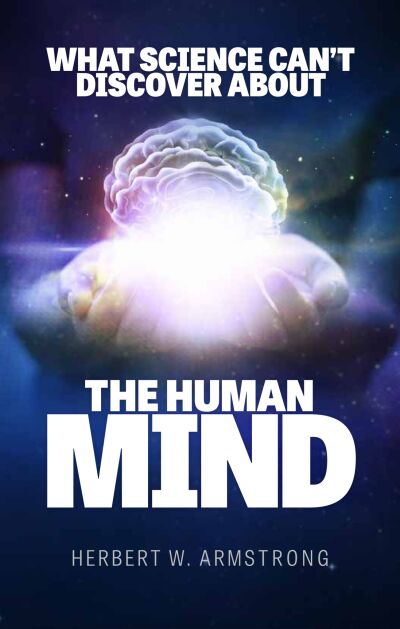
In What Science Can’t Discover About the Human Mind, the late Herbert W. Armstrong explained a vital truth about how the human mind works. He observed the fact that there is “virtually no difference in shape and construction between animal brain and human brain,” and notes a key fact: “there is a spirit in man: and the inspiration of the Almighty giveth them understanding” (Job 32:8). Mr. Armstrong called this the “human spirit.”
Most religious people and even some scientists who study the brain understand that there must be a nonphysical component of the human mind, but few have given much critical thought to how it works.
“Remember, this spirit is not the man—only something in the man,” Mr. Armstrong wrote. “Remember, too, this spirit cannot see, hear or think. The man sees, hears and thinks through his physical brain and the five senses of seeing, hearing, tasting, smelling and feeling. The spirit in man imparts the power of physical intellect to the physical brain, thus forming human mind. This spirit acts, among other things, as a computer, adding to the brain the psychic and intellectual power. Knowledge received in the brain through the eye, ear and the senses is immediately ‘programmed’ into the spirit computer. All memory is stored in this spirit computer. This ‘computer’ gives the brain instant recall of whatever portion of millions of bits of knowledge may be needed in the reasoning process. That is to say that memory is recorded in the human spirit, whether or not it also is recorded in the ‘gray matter’ of brain” (ibid).
This human spirit explains why humans far surpass chimpanzees, crows, dolphins, elephants and octopuses in intelligence. Human brains are not necessarily superior to dolphin brains in physical biology, yet humans possess a spirit that amplifies critical thinking, imparts free will, and stores millions of bits of knowledge beyond what the smartest animal can manage. As Mr. Armstrong wrote, it is this spirit that gives human beings a God-like intellect with the ability to think, reason and make decisions.
Because the human spirit is not the man, only something in the man, it still needs a physical brain to record and form thoughts. This all-important fact highlights the importance of neural health.
Like muscles, neural connections atrophy if not used. The reason for this is that the brain’s immune cells eliminate unused neural pathways to conserve resources. Therefore, delegating your thinking to AI will eventually weaken your neural pathways and reduce your ability to form high quality thoughts.
If you let this happen, your human spirit will still record at least some of the information you absorb passively from AI chatbots, friends, television and the Internet. But such passive “learning” will not differentiate you from the 85 percent of humanity who “would rather die than think.”
If you truly want to develop the God-like intellect your Creator gave you, then you must not only avoid cognitive offloading but you must also actively develop your brain and mind. No dumb animal is able to come to conclusions, to indulge in creative thought, to decide how to put things together, to plan something new, to reason rationally, or to think logically. These abilities involve the power God gave man alone.
Mental Exercise
Mr. Armstrong described three basic ways people acquire their beliefs and convictions. The most common is to carelessly believe, without proof, that which they have read or heard. The second is to prejudicially accept any evidence that supports what they want to believe while rejecting any contrary evidence. The least common way is by sifting through all the facts, seeking full information, and considering the question objectively.
The rise of AI has made using the first method easier than ever. Sifting, seeking and considering is hard work, so the temptation is to let Claude, Chatgpt, DeepSeek, Gemini, Grok, Perplexity and a myriad of other AI programs do it for you. But this lazy approach has two major consequences. First, you risk being deceived by misinformation when you don’t verify facts. Second, you miss out on opportunities to strengthen your mind though rigorous mental exercise.
God created the mind to need exercise. That is an important reason the Bible encourages us to meditate. In Psalm 143:5, King David wrote, “I remember the days of old; I meditate on all thy works; I muse on the work of thy hands.” The Hebrew word for remember in this verse simply means to recall, but the word for meditate infers talking to oneself. It is the act of deep concentration, especially on a spiritual subject.
Verses like this show that simply reading about God’s law or listening to a sermon is not enough to ingrain God’s law into the human spirit. You must take time to meditate about God’s law, mull it over, and effectively “talk to yourself” about it. That is how the human mind works.
“For as he thinketh in his heart, so is he …” (Proverbs 23:7). To truly master God’s law or any other topic, you must devote substantial time to thinking about it. If you do not, you will never learn the subject matter. And if you let your mind atrophy, you will start losing even the ability to form deep thoughts.
The reviews in cognitive science showing the link between heavy reliance on digital tools and poor mental performance highlight the importance of scheduling time to actually think. AI is an impressive tool that may have some good uses, but the very purpose of your life is to learn to think, feel and act as God does—to develop His thoughts, emotions, character and mind. An AI chatbot does not have that ability, so beware delegating your decision-making responsibility to a machine.
You have a choice to make: Will you let machines do your thinking, or will you rise to become the clear-thinking individual your Creator designed you to be? The future of your mind depends on that choice.