

As Russia’s Fuel Crisis Deepens, Don’t Rule Out a Dramatic Escalation
Russia’s economy runs on energy the way our bodies run on oxygen. Since 2014, oil and gas have comprised at least 30 percent of federal budget revenues and, at times, as much as 50 percent. But in recent weeks, Ukrainian forces have waged relentless attacks on Russian refineries, fuel storage sites, pipelines and energy export infrastructure. As of July 4, over 40 percent of Russia’s overall refining capacity was offline, with the massive Moscow Refinery and other major facilities not expected to resume operations for a year or more.
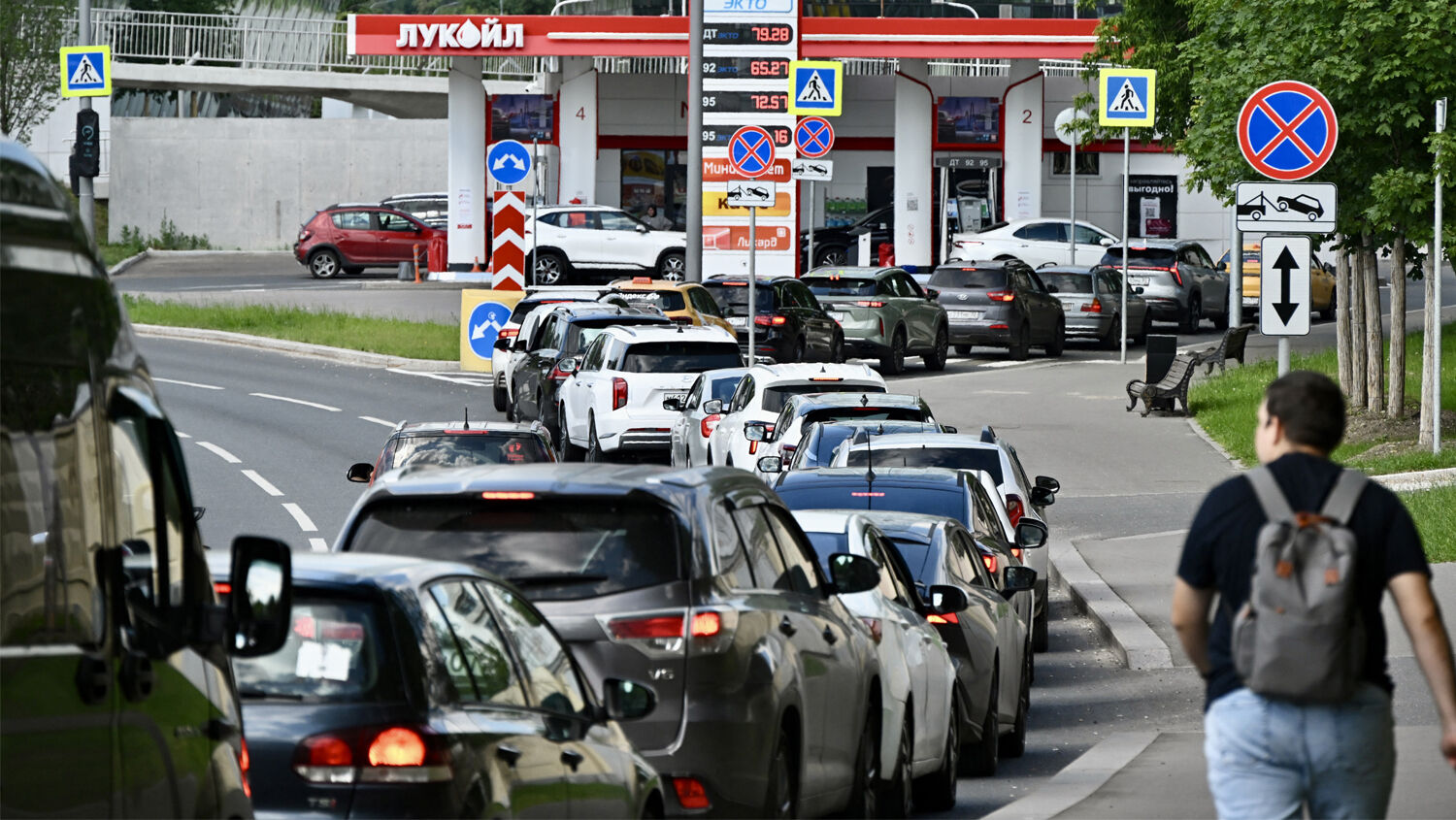
Fuel shortages have set in across the nation, with vehicle owners waiting in lines for hours to fill up—or to learn that no fuel is available. As a result, the world’s main “petrostate” is now actually importing refined fuel.
After years of Russian President Vladimir Putin largely insulating the population from the more-acute economic effects of the war, Russians are feeling the burn firsthand.
The situation has grown so grave that on June 28, Putin issued a rare public admission of the hardship and humiliation. But his acknowledgment has done little to mitigate the pain or improve the outlook of the Russian people.
It is not just queuing for hours for fuel that has the Russian people down, but also a broader economic slowdown that is starting to touch on most aspects of life and a realization that their nation is not making gains in its war on Ukraine.
The mood of the Russian people is souring—not just among ordinary citizens but also among the elite who have previously supported Putin, largely because his kleptocracy enriched them.
Elite Exasperation
“Everyone is furious,” the Financial Times quoted a senior Russian businessman as saying last month on the condition of anonymity. “People [in the Russian elite] are in full agreement: This is a catastrophe.”
The Guardian quoted another business mogul on the condition of anonymity who echoed those sentiments:
There’s definitely been a shift in mood among the elites this year … there is profound disappointment in Putin … a growing sense that some kind of catastrophe is looming.
No one believes everything will suddenly collapse tomorrow. But there is a growing realization that utterly senseless, self-destructive decisions keep being made. People who once defended Putin no longer do. Any sense of a future has disappeared.
As pressure on Russia and Putin builds, more and more analysts argue that the status quo—a slow grind on the battlefield coupled with mounting losses at home—is no longer sustainable. They say Putin could soon feel pressured to raise the stakes—perhaps dramatically.
Expectations of Escalation
As pressure mounts, the publication Foreign Policy warned of a potential “drowning man” dynamic:
[A]s things get worse for Russia on the battlefield, in the economy, and for Putin personally, there is the risk that the flailing Russian leader will succumb to drowning man syndrome—when a swimmer in difficulty pushes others under the water in a desperate attempt to stay afloat. … [H]is temptation will be to escalate both at home and abroad. … Beware the drowning man: The coming months will likely be dangerous outside and inside Russia as Putin tries desperately to stay afloat.
Analyst George Friedman of Geopolitical Futures discussed the dynamic in a June 30 interview, emphasizing that Putin retains three major escalation pathways. One is to fully mobilize Russia’s reserves: hundreds of thousands of men who have considerable training and who could be mobilized quickly to join the fight. The second is to force Belarus to enter the war more directly. Belarussian President Alexander Lukashenko would not be enthusiastic to deploy his forces to fight alongside Russia’s, but since he is entirely beholden to Putin, he would have little choice. The third possibility, in Friedman’s view, would be for Putin to use nuclear weapons.
Russia maintains the world’s largest nuclear arsenal. Putin understands that using it would carry severe international consequences, including the risk of a direct confrontation with the West and heavy opposition even from his main ally, China. But for a drowning man, thrashing for any chance to keep his head above water, this option is not off the table.
Other analysts, including Peter Zeihan and Gordon Chang, have likewise suggested recently that the increasing pressure on Russia raises the possibility of nuclear escalation.
Chillingly relevant to this discussion is the fact that at the end of 2024, Putin formally revised Russia’s nuclear doctrine, significantly lowering the threshold for the use of nuclear weapons. The new policy stipulates that an attack by a nonnuclear country that is backed by a nuclear power could trigger a Russian nuclear response. This clearly creates a legal latitude for Russia to use nuclear weapons against nonnuclear Ukraine, since the nation has received backing in the war from nuclear nations such as the United States, Britain and France.
The ‘Prince’ Will Persevere
The pressure on Russia is building, and Putin’s options are narrowing. Much remains unknown about how exactly the war will progress in the time ahead, but whatever may occur, we can be sure Putin will not be defeated. Although the war is clearly not going the way he had hoped and Russia may not achieve its aims, we can be confident that he will not be ousted. This is because of what Trumpet editor in chief Gerald Flurry has written about Putin’s role in biblical prophecy.
Mr. Flurry has identified Putin as the end-time figure called “the prince of Rosh” in Ezekiel 38 and 39 (New King James Version). These chapters show that this “prince” will soon be fighting far larger wars at the head of a massive pan-Asian military juggernaut.
Mr. Flurry, in his booklet The Prophesied ‘Prince of Russia,’ takes a careful look at these passages in Ezekiel, as well as other biblical prophecies about this future Asian force. He examines Putin’s leadership in this context, which is simply unavailable anywhere else.
To understand Putin’s dark rule in the prophetic context and to see the hope that lies ahead for Russia, Ukraine and the world, request your free copy of The Prophesied ‘Prince of Russia.’


