

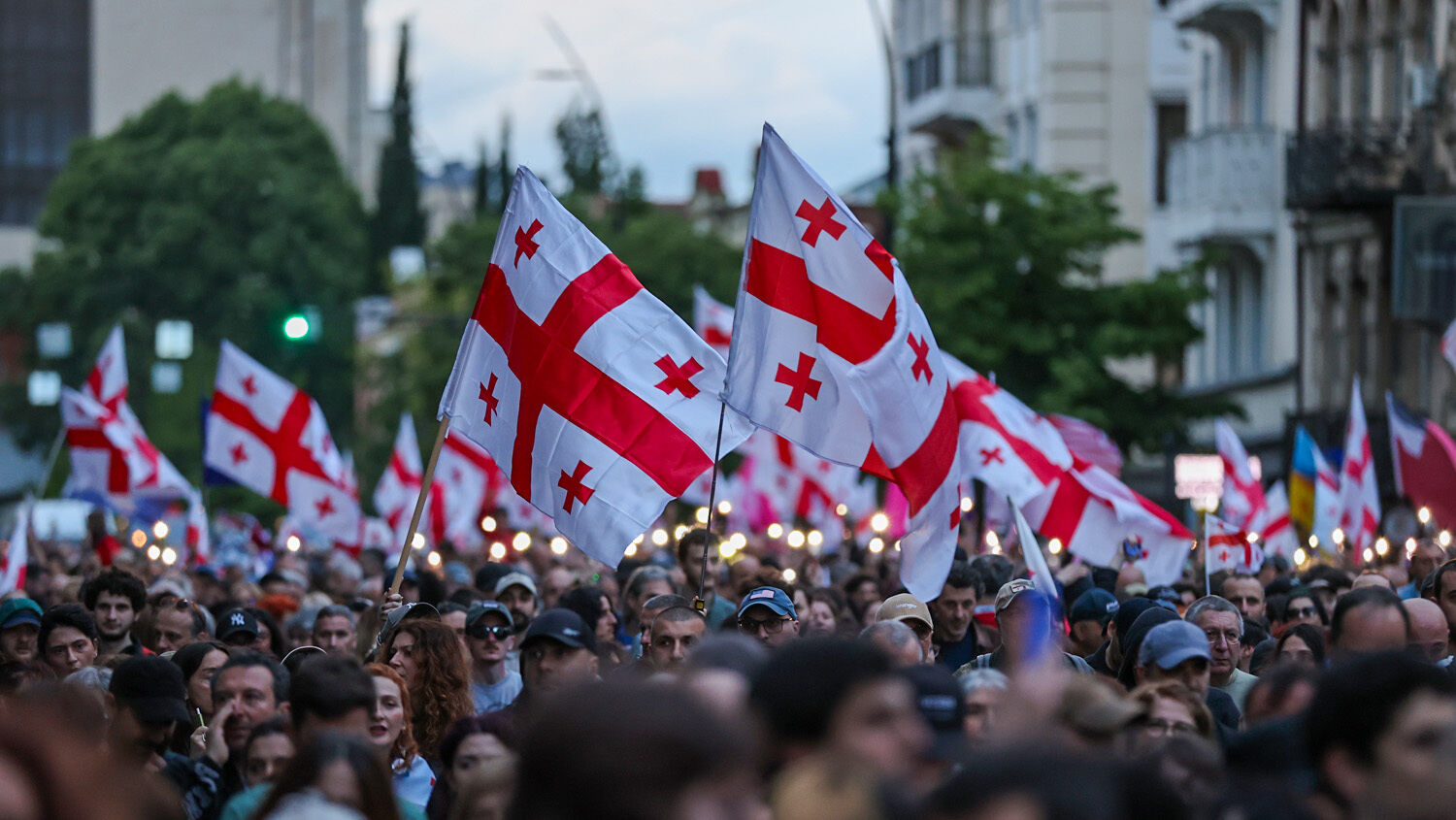
Russia Carries Out ‘New Phase of Annexation’ in Georgia
Russian President Vladimir Putin tightened his hold over Georgia’s breakaway province of South Ossetia on June 16 with the appointment of Kremlin bureaucrat Marat Kambolov as the territory’s prime minister.
This followed a deal Putin signed with de facto South Ossetian President Alan Gagloev last month, the Treaty on Deepening Allied Interaction. As part of the deal’s broader economic alignment measures, it eases rules on participation in South Ossetia’s separatist government. For the first time, Russian nationals are legally permitted to hold official posts in the region.
And now, just over a month later, the Russian-born Kambolov—who has held numerous positions over the years in Russian federal government bodies—is in power.
To understand the significance of this development and what it means for the region, we have to take a look at Georgia’s modern history.
The ‘Pearl of the Caucasus’
Georgia is a small, mostly Orthodox Christian nation nestled between Russia and Turkey. Its stunning alpine landscapes and world-renowned wines have helped it earn the nickname the “pearl of the Caucasus.” In 1921, the Soviet Red Army set its sights on this gem, invading and forcibly incorporating it into the Soviet Union—part of the same wave that brought Ukraine, Belarus and a dozen other territories under Soviet control.
Georgia remained part of the Soviet bloc until its collapse in 1991, after which it became an independent nation once again. But even before the Soviet Union formally dissolved, pro-Russia separatists in the region of South Ossetia began fighting against the Georgian government. This war culminated in 1992 with the region breaking away from Georgia’s control.
For more than a decade, South Ossetia existed as a semiautonomous entity that was, for the most part, at peace with the rest of Georgia. But in 2004, the Georgian government launched a campaign to reassert control over the region, and conflicts between Georgian soldiers and South Ossetian separatists increased.
The tensions exploded in 2008, with Georgia carrying out an air and ground assault on South Ossetia’s main city, Tskhinvali. Watching from Moscow, Putin feared a successful Georgian campaign could turn South Ossetia away from Russia and toward the West—like the majority of post-Soviet Georgia. So he deployed Russian forces and thrust the Georgian soldiers out of both South Ossetia and Georgia’s other pro-Russia breakaway province, Abkhazia.
Moscow then recognized South Ossetia and Abkhazia as independent states and entrenched a long-term military presence in both regions to assert Russian control over them.
Georgia, along with the United States and the European Union, protested the Russian move as a blatantly illegal land grab. But the deed was done. In less than a week, Putin had made a fifth of Georgia’s total territory a de facto part of Russia.
But with the installation of Kambolov, Putin may be pushing for more than de facto control. He may be on the verge of making it official.
“[T]he installation of a Moscow bureaucrat looks to eliminate whatever plausible political distance may have remained between [South Ossetia] and Moscow,” the Moscow Times wrote. “With the broad parameters of the Russia-South Ossetia agreement, Kambolov is likely to be the first of many Russian administrators to come.”
Former Georgian Prime Minister Giorgi Gakharia called the recent moves “a new phase of annexation” by Russia.
Likewise, Georgian politician Tamta Mikeladze labeled it “the practical annexation of the region.”
Georgian Foreign Minister Maka Botchorishvili also commented on the move: “Russia continues to disregard its international obligations and is taking further steps toward the annexation of Georgia’s regions.”
‘A Dangerous New Era’
Just after that 2008 war, Trumpet editor in chief Gerald Flurry said the Russian maneuver marked the “beginning of a dangerous new era.” Seventeen years later, as Putin is set to install a Kremlin veteran over South Ossetia, and as he asserts increasing control over all of Georgia, it is clear that Mr. Flurry’s forecast was accurate.
He also said the dangers of the “new era” would extend beyond Georgia’s borders. In our October 2008 issue, he wrote:
Russia’s attack on Georgia … was the first military strike of a rising Asian superpower—and there will be more! … Will a crisis occur over Ukraine? That area is the breadbasket of Russia, and surely it is willing to wage war over that as well.
Just 5½ years later, Russian forces invaded Ukraine’s Crimean Peninsula and annexed it to Russia, proving Mr. Flurry right.
In the years since, Putin has made vicious cyberattacks a cornerstone of Russia’s asymmetric warfare, deepened Russia’s strategic alignment with China so the two can push against the U.S.-led international order, and strengthened dangerous regimes in Belarus, Cuba, Iran, North Korea, Syria, Venezuela and parts of Africa. Putin has also invested billions of dollars in mass media and social media to fill them with misinformation and disinformation that makes it impossible for newswatchers to agree on even the most basic facts. Most significantly, he has expanded his invasion of Ukraine into a full-scale war that has become Europe’s largest and deadliest since World War ii.
Compared to today, the world before the 2008 invasion was relatively stable. In retrospect, Russia’s act of aggression in Georgia stands out as a watershed moment, after which global risks multiplied significantly. It is clear that the 2008 invasion indeed marked “the beginning of a dangerous new era.”
A Halcyon Era
This “new era” that began in 2008 is bringing suffering to countless people in Russia, Georgia, Ukraine, North Korea and other countries and regions where Putin exerts influence. And it will only get worse in the years ahead.
But Bible prophecy indicates that the Putin era will come to an end and will be followed immediately by a far longer era of prosperity and tranquility for all peoples of the world.
In his booklet The Prophesied ‘Prince of Russia,’ Mr. Flurry writes that Putin is specifically mentioned in ancient Bible prophecies in the book of Ezekiel about a “prince of Rosh.” These passages reveal that his destabilizing rule happens near the very end of mankind’s attempts to rule itself. So his wicked reign signals that righteous, godly governance is fast approaching. Mr. Flurry writes:
Vladimir Putin is a sign, literally a sign, that Jesus Christ is about to return! This is one of the most inspiring messages in the Bible. What we are seeing in Russia ultimately leads to the transition from man ruling man to God ruling man! And it is almost here! It is just a few short years away. We need to watch Vladimir Putin closely. I believe he is almost certain to be the “prince of Rosh” whom God inspired Ezekiel to write about 2,500 years ago! We need to watch what is happening in Russia and how Europe responds to it.
To understand more about Putin’s role in Bible prophecy, and the hope-filled “sign” that he represents, order your free copy of Mr. Flurry’s booklet The Prophesied ‘Prince of Russia.’


