
See God in American History

See God in American History

Why did Britain create the largest empire in world history? Why does America dominate the world today? Why does Western science, culture, art and literature dominate?
Historians have devoted their entire careers to examining these questions. They lie at the heart of understanding the world today.
But the rise of Britain and America is hard to explain. There is nothing like it in human history. It is stunning, profound and quite moving.
The British Isles are specks of land sitting more than 3,500 miles from the equator, cold, dark and damp, and sparsely populated for millenniums. Then, suddenly and unexpectedly, they sprang forth into the greatest empire ever.
Germany is 1.5 times larger than Britain. China is over 40 times larger, and Russia is 74 times larger. Each of these powers has possessed the materials necessary to build great empires: territorial assets, natural resources, technology, strong populations, strong leadership.
But study their history. Study the Greeks, the Romans, the Ottomans, the Aztecs, the Spanish. None have come close to controlling as much of Earth’s surface, possessing as much wealth, commanding as many subjects, or influencing as many nations as the British, who acquired their greatness “in a fit of absent-mindedness.”
Across the Atlantic, Britain’s American colony went from brand-new nation to world-dominating superpower in about a century.
Historians struggle to explain it, but one of the most important prophecies in the Bible contains the answer.
Thank Abraham
Genesis 12 contains one of the most important passages of Scripture for understanding the history of Britain, America and the world.
First, God promised Abraham, “I will make of thee a great nation.” This means tremendous national, material prosperity and power for Abraham’s descendants.
Second, God promised Abraham, “in thee shall all families of the earth be blessed” (verse 3). This is the promise of salvation through Jesus Christ, a descendant of Abraham.
“Right here is where those who profess to be ‘Christians’—and their teachers—have fallen into error and scriptural blindness,” Herbert W. Armstrong wrote in The United States and Britain in Prophecy. “They have failed to notice the twofold promise God made to Abraham. They recognize the messianic promise of spiritual salvation through the ‘one seed’—Christ [Genesis 22:18; Galatians 3:8, 16]. … This is a pivotal point. This is the point where professing ‘Christians’ and their teachers jump the track of truth. This is the point where they switch off the track that would lead them to the missing master key to the prophecies. They miss the fact that God gave Abraham promises of physical race as well as spiritual grace” (emphasis added throughout).
God’s promise “I will make of thee a great nation” is the key that unlocks Bible prophecy and world history!
Birthright Promise Conferred
In Genesis 17:7, God reaffirms His promise to Abraham and gives more details, saying that His “everlasting covenant” would continue long after Abraham died.
Genesis 26:3-5 record God’s promises of national blessings, as well as spiritual blessings, passing on to Abraham’s son Isaac.
Genesis 27:26-29 and Genesis 35:10-12 record God passing on His promises to Isaac’s son Jacob, telling him: “I am God Almighty: be fruitful and multiply; a nation and a company of nations shall be of thee, and kings shall come out of thy loins.”
Notice how specific this promise is: When the time came to fulfill His promise of race, God would do it by facilitating the advent of a single great nation and a great “company of nations.”
Genesis 48 records God passing the “birthright” promise of national greatness on to Joseph’s two sons, Ephraim and Manasseh. (See also 1 Chronicles 5:1-2.) The promise became even more specific: “[Manasseh] also shall become a people, and he also shall be great: but truly his younger brother [Ephraim] shall be greater than he, and his seed shall become a multitude of nations” (Genesis 48:19). God prophesied that Ephraim’s descendants would become a commonwealth of nations and that Manasseh would become a single great nation.
Blessings Not Given to Ancient Israel
Has God kept His promise to Abraham? By about 1450 b.c., the children of Israel numbered 2 to 3 million people. God led them out of Egyptian slavery, gave them His law at Mount Sinai, and led them 40 years through the wilderness and finally into Canaan, the Promised Land. This is where God intended to make Israel great, into a powerful nation and a “company of nations,” as promised.
However, Mr. Armstrong wrote, “[t]here was a condition—a great big ‘if’—to their receiving actual fulfillment of this stupendous birthright promise in their time! God said: ‘If ye walk in my statutes, and keep my commandments, and do them; Then I will give you rain in due season, and the land shall yield her increase …’ [Leviticus 26:3-4]” (The United States and Britain in Prophecy).
What were those obligations? The key Bible passage that answers is Leviticus 26. This chapter is critical. Mr. Armstrong described it as the “very pivot of Old Testament prophecies.”
Notice how he explained it: “Leviticus 26 is the basic prophecy of the Old Testament. … In this central prophecy, God reaffirmed the birthright promise—but with conditions—for those of Moses’s day! The birthright tribes of Ephraim and Manasseh were then with the other tribes—as one nation. Obedience to God’s laws would bring the vast national wealth and blessings of the birthright, not only to Ephraim and Manasseh, but the whole nation would automatically have shared them at that time” (ibid).
If Abraham’s descendants rejected God and disobeyed Him, God said He would curse Israel by postponing the fulfillment of His promise!
Seven Prophetic ‘Times’
How long would He postpone it? God tells: “And if ye will not yet for all this hearken unto me, then I will punish you seven times more for your sins” (Leviticus 26:18).
As Mr. Armstrong explained, “The ‘seven times’ implies duration or continuation of punishment. But the word also conveys the meaning of ‘sevenfold,’ or seven times greater intensity of punishment—as a punishment that is sevenfold more intense” (ibid).
In the language of biblical prophecy, a “time” is a specific period—a prophetic 360-day year. (For proof on why a prophetic year in the Bible is 360 days and not 365, request The United States and Britain in Prophecy.) As in other Bible prophecies, each of those prophetic “days” represented a year in the fulfillment of Israel’s punishment.
You can see this day-for-a-year principle in effect when Israel was originally preparing to inherit the Promised Land (Numbers 13-14). Israel had just left Egypt and received God’s law at Mount Sinai. Its spies scouted the Promised Land 40 days, then returned a faithless report, and the fearful Israelites refused to enter the land. God postponed their promised inheritance and sentenced them to roam the wilderness for 40 years. Why 40 years? Numbers 14:34 explains: “According to the number of the days in which you spied out the land, forty days, for every day a year, you shall bear your iniquity, forty years, and you shall know my displeasure” (Revised Standard Version).
Remember, God said in Leviticus 26:18 that Israel would be denied the birthright promise for seven prophetic “times” (years). Seven 360-day years total 2,520 days. The day-for-a-year principle makes this a punishment of postponing the promise for 2,520 years. In this case—just like in Numbers 14—it involves the withholding of God’s promised blessing.
Yes, God specifically prophesied that He would postpone blessing Abraham’s descendants for 2,520 years.
Does the Bible tell us when God enforced this postponement?
2,520-Year Delay
After 40 years of wandering, Moses’s successor, Joshua, led the nation into the Promised Land. It soon endured over 300 terrible years during the time of the judges. God then established the monarchy: Saul, David and Solomon ruled all 12 tribes of Israel, and this united kingdom had considerable prosperity. “However, they had not yet flowered into the full predominant-world-power status promised under the birthright,” wrote Mr. Armstrong (ibid).
After Solomon died, the nation split. The kingdom of Judah retained the tribes of Judah and Benjamin with Jerusalem as its capital. The other 10 tribes, counting Joseph’s sons Ephraim and Manasseh each as a full tribe, split away to become the kingdom of Israel.
The kingdom of Israel was rebellious toward God. He sent prophet after prophet to warn them, but they rejected them. Between 721 and 718 b.c. the kingdom fell to the Assyrian Empire. It had never received the blessings on the scale promised to Abraham.
“From that time,” Mr. Armstrong wrote, “God sent no prophets to them. He gave them no more chance to receive the greatest national blessing of all history—until the end of the 2,520 years!” (ibid).
Take 721–718 b.c. and add 2,520 years. You arrive at a.d. 1800–1803.
Once Israel’s behavior of disbelieving and disobeying God, unlike its patriarch Abraham, had made this new pattern of history necessary, God gave the Prophet Daniel visions showing how it would unfold. With Ephraim and Manasseh not dominating the world for 2,000 years, other powers would rise up: Babylon, then Persia, then Greece, then Rome, then its subsequent revivals. History unfolded in the vacuum created by Israel’s downfall.
Imagine how different world history would have been if Israel had obeyed God and inherited the Abrahamic promise at the time of Solomon. There would be no Greek or Roman history—at least not the way it is written today.
The Great Promise Finally Fulfilled!
Beginning in the year 1800, God began to fulfill the promise to Abraham that had been specifically conferred on the descendants of Ephraim and Manasseh. In the 19th century, He orchestrated the rise of a single great nation and a great “company of nations.”
You can clearly see this in the history of America and Britain.
More than a few historians have documented all the conditions that “mysteriously” converged to facilitate the sudden emergence of the British Empire and the United States.
Consider all the significant developments in Britain between 1500 and 1800, the three centuries leading up to the apex of the British Empire. The Protestant Reformation. England’s divorce from Catholicism under Henry viii. The unification of England, Scotland and even Ireland, for a moment. The rise of England’s navy and its dominance over the water highways. The Industrial Revolution and Britain’s emergence as the world’s economic, cultural, philosophical and technological hub. There is also the demise of Britain’s competitors during this time, such as the miraculous defeat of the Spanish Armada in 1588 that removed Catholic Spain as a threat, and the defeat of Napoleon in 1805.
Many historians recognize Britain’s unique, seemingly inexplicable arrival as a world power. “Some of the elements required for an economic transformation were present in other parts of the world,” writes Paul Johnson. “But only England possessed them all in combination” (The Offshore Islanders).
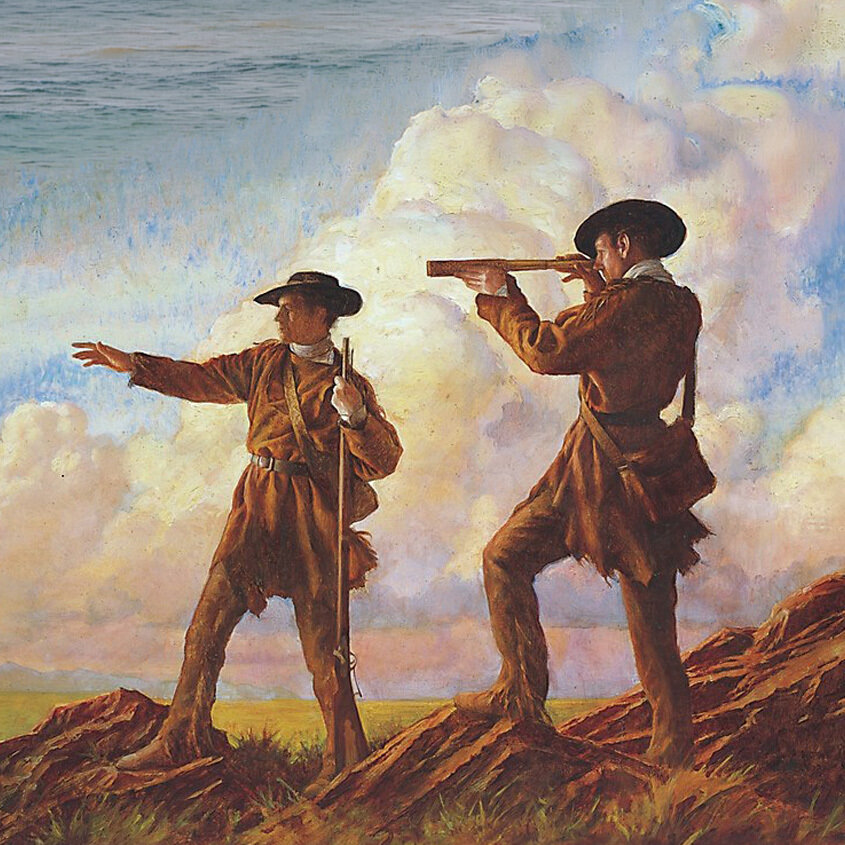
You can conduct the same exercise with America, which inherited the legacy of Britain and then some. Think about the Continental Congress and Declaration of Independence; the development of the Constitution, which gave the fledgling nation a foundation for political stability. Think about the 1800 to 1803 history of the Louisiana Purchase, whereby the American nation suddenly doubled in size to include the most fertile and abundant territory on the face of the Earth, for 3 cents an acre. Think of the expedition of Lewis and Clark and the California Gold Rush. America also witnessed the demise of regional competitors—especially Catholic European powers, namely France and Spain—along its southern border. Each of these events was critical to America’s ascendance. Again, with each event, God was preparing the United States to become the “great nation” He had promised!
A History-Changing Event
I haven’t come close to documenting all the details that fell into place around 1800 to facilitate Britain’s and America’s emergence as world powers. Even the weather in Britain during this time, as Paul Johnson has noted, was historically good, meaning good crops, full bellies, healthy humans and rapid population growth. You can go through the blessings in Leviticus 26 and compare the specific prophecies of material prosperity with history books of the time period—and see these prophecies fulfilled exactly.
“The most remarkable fulfillment of biblical prophecy in modern times was the sudden sprouting forth of the two mightiest world powers—one, a commonwealth of nations forming the greatest world empire of all time; the other, the wealthiest, most powerful nation on Earth today,” Mr. Armstrong wrote. “These birthright peoples came, with incredible suddenness, into possession of more than two thirds—nearly three fourths—of the cultivated wealth and resources of the whole world! This sensational spurt from virtual obscurity in so short a time gives incontrovertible proof of divine inspiration. Never, in all history, did anything like it occur” (op cit).
Stop and think about the implications of this prophecy—not just for America and Britain, but also on world history. Broadly speaking, it is safe to say that world history as we know it is largely the product of the Abrahamic promise, including its postponement and colossal fulfillment.
For more than two centuries, the world has been dominated by two powers: one a single great nation, the other a great company of nations. The world has been transformed in virtually every way—for better and worse—as a result of the material wealth and intellectual, political, cultural and moral advancement and dominance of these two nations.
Finally, think too about the history of Britain, the British Empire and Britain’s phenomenal transformation in the 19th century from a fledgling island into the richest, most expansive and impressive empire in human history.
Britain and America’s story truly is remarkable—its wealth, the grandeur, the vastness of its territory, its accomplishments, its power. But it is remarkable most of all for the way it provides living, tangible, quantifiable proof of God’s existence!


