

A Warning to Britain Silenced?
“Southern Europe lies prostrate before the German imperium,” Britain was warned in 2013, after Germany imposed its bailout on Cyprus. Other wake-up calls included:
- “The Euro Crisis Will Give Germany the Empire It’s Always Dreamed Of,” in 2011 as the European Union set up its bailout mechanism
- “At Midnight Last Night, the United Kingdom Ceased to Be a Sovereign State,” after the Lisbon Treaty came into force in 2009
- “Reckless Germany Is Making War in Ukraine More Likely” was the warning in 2022.
These headlines all appeared in Britain’s Telegraph newspaper. A quick search through our archives indicates the Trumpet has quoted it in twice as many articles as we have any other British newspaper—beating the Times, the Daily Mail and the Spectator.
The Telegraph has been one of the most consistent euroskeptic voices in British media, warning not just that the EU was bad for Britain but that it was a tool Germany was using to dominate the Continent.
Other outlets give a more consistent or precise warning about the rise of the German-dominated Europe. But none have the Telegraph’s mass appeal.
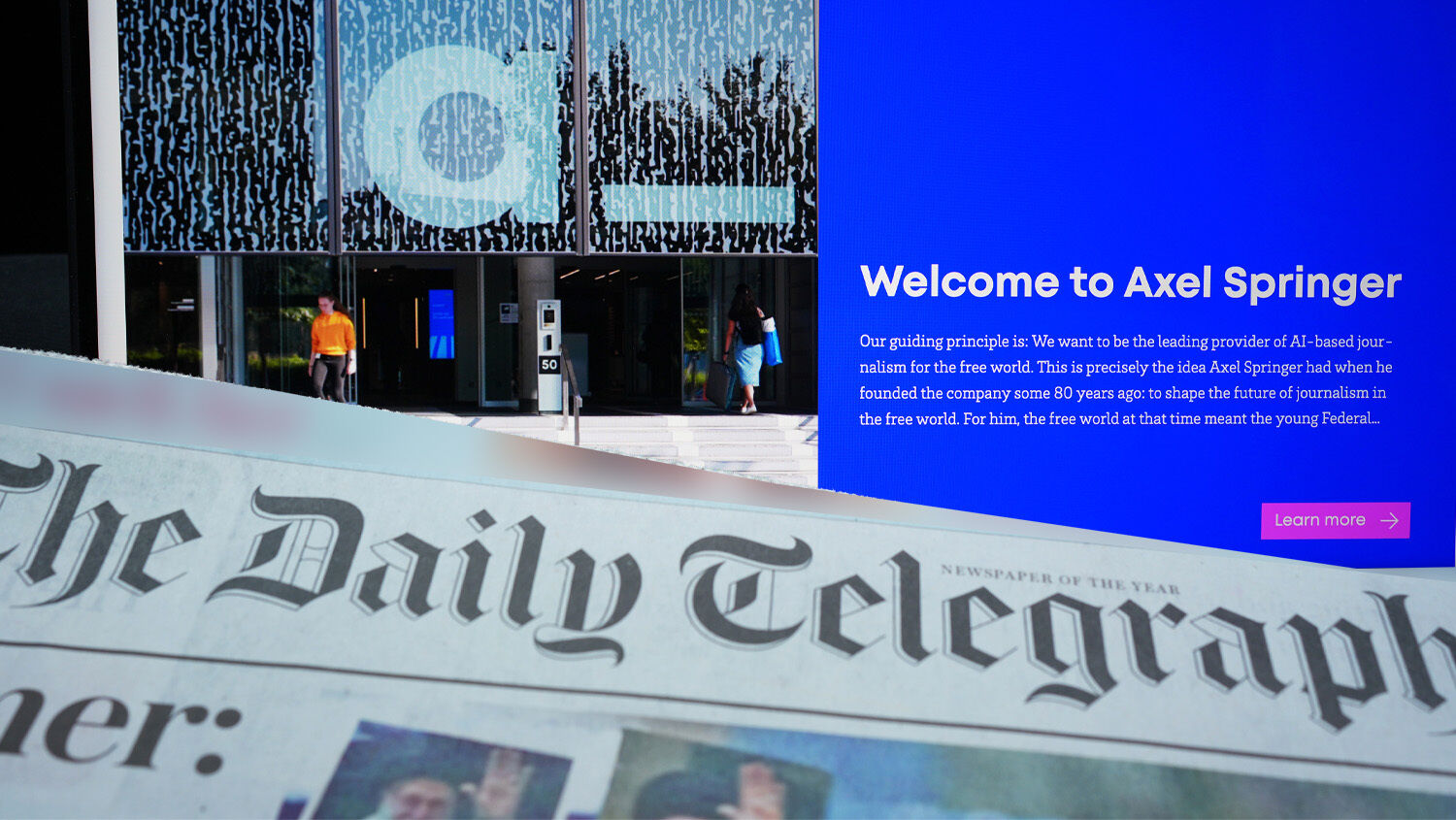
That warning seems likely to be silenced forever. The British government approved the sale of the Telegraph to German publishing giant Axel Springer this week.
Axel Springer, Europe’s largest publisher, comes from a very different, pro-EU right-wing tradition. It owns the German tabloid Bild and the more highbrow Die Welt. In 2021 it bought Politico, a major move into the English-language market.
Its eponymous founder was an influential voice for a united Europe. “No other man in Germany, before [Adolf] Hitler or since Hitler, has accumulated so much power, with the exception of [Otto von] Bismarck and the two kaisers,” said rival publisher Rudolf Augstein.
Of course, Axel Springer’s ceo and controlling shareholder, Mathias Döpfner, has emphasized he will not enforce his own opinions on every writer. But the views of the Telegraph’s new owner will affect what pieces it commissions, how they are edited, and the writers it hires.
We already got a look at what this could look like when the Telegraph announced Axel Springer’s intention to buy the paper last month, in an article titled “How Axel Springer Grew From Anti-Nazi Roots Into Trans-Atlantic Empire.”
What exactly did this anti-Nazi freedom fighter do while Hitler ruled Germany, you may wonder? The article doesn’t say—it picks up the story in 1946.
That means it neglects to mention that Springer divorced his half-Jewish wife in 1938. The Nazis’ race laws banned those married to Jews from being newspaper editors, which may have had something to do with the divorce.
Springer also joined the National Socialist Vehicle Drivers’ Corp. He was medically exempt from serving in the military and instead was an editor for his father’s newspaper, Altonaer Nachrichten. Here he reported directly to Joseph Goebbel’s Ministry of Propaganda, and the newspaper regularly published anti-Semitic material.
Apparently his “anti-Nazi” roots only began in 1946, when all newspaper editors had to be approved by the Allied Control Council. Like having a half-Jewish wife, Nazi sympathies were a career obstacle, so they were jettisoned.
I’m not trying to judge the man, and to give a complete history, myself, he did go on to become a firm supporter of the State of Israel. But this is relevant background information you would expect an article on Axel Springer’s “anti-Nazi roots” to mention. Tablet, for example, published a very positive description of Springer, yet still addressed this history. But the Telegraph, faced with a generous offer from the publishing house Springer founded, is already modifying its coverage.
Poland gives an instructive look at what this could mean for Britain. Ringier Axel Springer Polska is one of the country’s largest publishers. It has used its position to campaign against the Law and Justice Party (PiS). PiS has sounded a Telegraph-like warning for years. In 2021, PiS leader Jarosław Kaczyński accused Germany of trying to create “a German fourth reich … built on the basis of the EU.” In September 2023, he told Sieci newspaper there were “German-Russian plans to rule Europe.” He said, “Independent, subjective, economically strong, socially and militarily, Poland is an obstacle for them.”
In 2017, a letter leaked in which one of Springer’s executives instructed the staff to criticize PiS and Kaczyński. “In the near future, the road of European integration will have a fast and a slow lane … and now is the time for free media like ours to join the game,” he wrote. “Most of our readers and users belong to the vast majority, which supports Poland’s EU membership. Let’s tell them what to do to remain on the fast lane and avoid landing in the parking lot.”
Almost all analysts agree that Axel Springer paid a lot more for the Telegraph than it was worth. It really wanted control. Why? Look at the control it has in Poland and the control Germany wants to have over the Internet. It doesn’t want anyone writing this way about Germany.
But few in Britain are likely to worry.
“If that possibility had even been raised in the last century, there would have been outcry (imagine the reaction of Margaret Thatcher),” wrote Charles Moore, the Telegraph’s former editor. “But nowadays the British middle classes drive Audis with positive pride. I suspect we shall be able to feel similar confidence about a paper owned from Berlin. When Britain was in the EU, we feared the spread of German power. After Brexit, that anxiety has died down.”
The British government could have referred the bid to regulators. Instead, it waved it through.
When Germany was rising in the 1930s, Britain’s media put the nation to sleep. The bbc refused to air Winston Churchill on “controversial questions,” as Churchill biographer Henry Pelling put it. In 1937, Times editor Geoffrey Dawson wrote, “I should like to get going with the Germans. … I spend my nights in taking out anything which I think will hurt their susceptibilities and in dropping little things which are intended to soothe them.”
Amid this shameful history, the Telegraph stands out as a rare bright spot. The Evening Standard fired Churchill in 1938 due to his outspoken criticism of Nevil Chamberlain. The Telegraph gave him a fortnightly column. When Chamberlain signed the Munich Agreement in the same year, just about all the press attacked Churchill. But the Telegraph wrote that Churchill’s warnings “verified by events, have entitled him to be heard ….”
“This issue gets to the heart of the survival of our peoples,” wrote Trumpet editor in chief Gerald Flurry after reviewing some of this history. “That is how important it is.”
Recent headlines from the Telegraph include: “The Plans to Turn Europe Into a New Superpower” and “Germany Is Arming Itself to the Teeth to Transform Europe Again.” Germany dominates Europe again and is rising as a military power. This is exactly what Herbert W. Armstrong said would happen based on Bible prophecy.
Britain needs to be warned now more than ever. The Telegraph was the best hope of getting some kind of wake-up call out to the masses of the British people.
That call wouldn’t have been enough. It did not warn about the sins of the British people that are causing the nation’s weakness. It did not show how the rise of Germany is a direct fulfillment of Bible prophecy—pointing the nation to God, His power to control world events and His plan for the world. But it could have helped put the nation on alert.
Britain and the world need a warning. In Ezekiel 33, God describes the nation setting up a watchman to warn of rising danger. Winston Churchill was a watchman like this. But in verse 7, God says, “So thou, O son of man, I have set thee a watchman unto the house of Israel; therefore thou shalt hear the word at my mouth, and warn them from me.” Now the people need a much tougher warning.
“Today our people are too degenerate to choose a Churchill to lead them,” Mr. Flurry writes. “But there is no hope in such a political watchman anyhow. Our sins are much worse.”
But that warning message is vital. In Ezekiel 33:3-9, God gives eight commands to warn.
In these urgent times, any kind of warning from the Telegraph is likely to peter out. But God makes sure there is still a watchman warning about world events. To learn more about him, read “The Ezekiel Watchman” in our free book Ezekiel—The End-Time Prophet.


