

Is President Trump Trying to Squeeze China’s Economy?
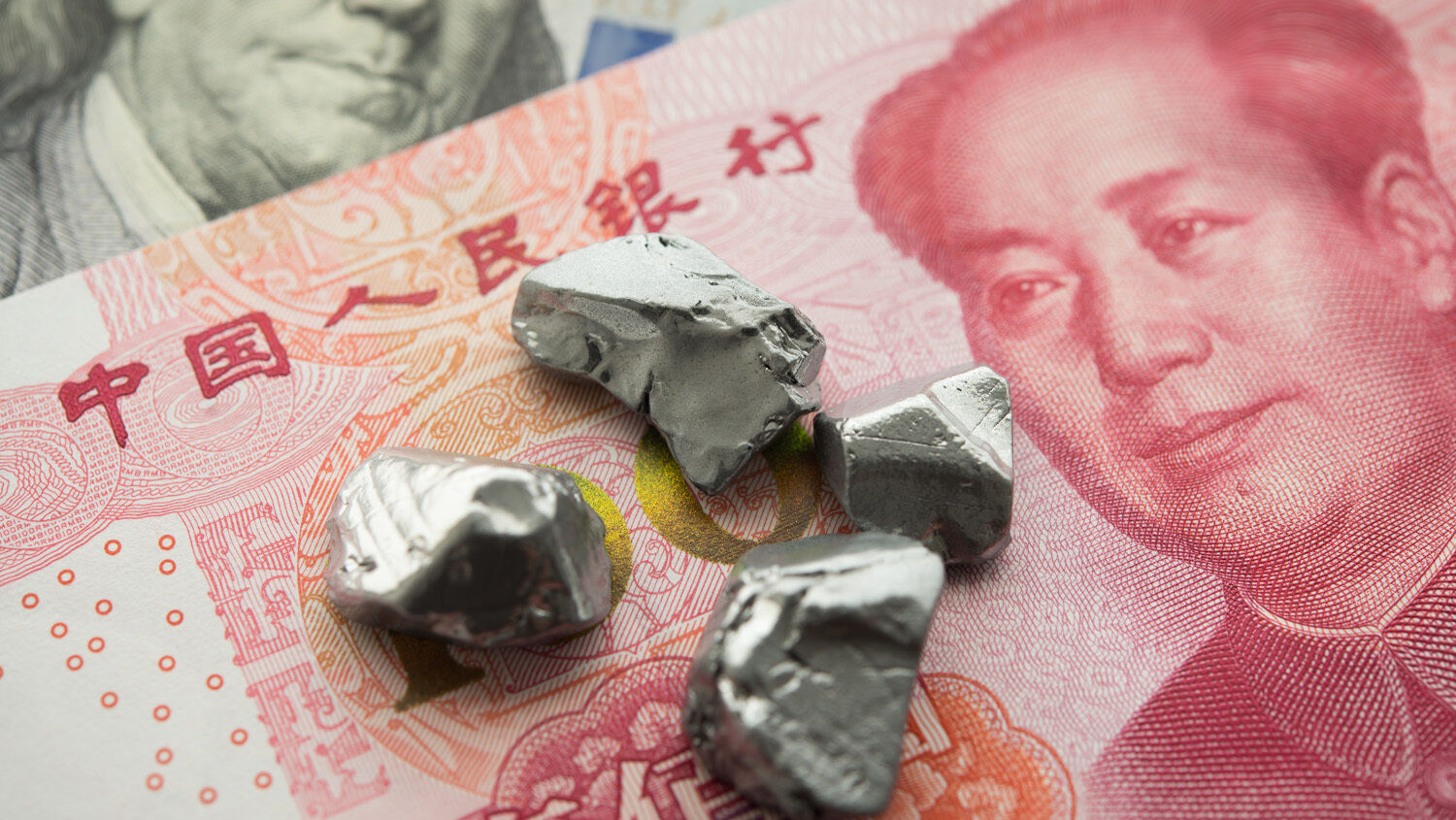
Antimony prices were up 500 percent last year. I doubt if your pocketbook cared much.
Yet antimony isn’t the only thing getting more expensive. The price of silver also hit a record high. In January, it reached $121 per ounce, up 150 percent. Then there are the rare earth minerals. Neodynium? Up 200 percent. Gallium, terbium and dysprosium are all up, up and up.
Still, unless you are an investor, or perhaps work at Raytheon or Lockheed Martin, the trend probably passed you by. But these hard-to-pronounce minerals soaring in price might be flashing a warning sign for the economy.
Inflation makes products more expensive. Shortages due to politics and environmental regulations fuel that fire. The consequence is your paycheck not going as far as it used to.
There is, though, another potentially more dangerous reason elements like antimony are so pricey. They are strategic elements for not only industrial applications but also military technologies. Without them, smartphones are no longer smart, sonar doesn’t sound, cruise missiles don’t fly, and night-vision goggles go dark.
Without these critical minerals and the 10 others that United States President Donald Trump added to the Department of the Interior’s 2025 List of Critical Materials, America’s economic growth and technical leadership could be at risk.
This was highlighted on February 27, the day before the U.S. launched its attack on Iran. That day, the Pentagon asked domestic mining companies to boost production of 13 critical minerals deemed necessary for military purposes.
For the first time since the end of the Cold War, nations are trying to exert control over minerals and resources that are critical to their economies and militaries.
After the fall of the Berlin Wall, the United States and other nations began selling critical materials they had stockpiled for possible conflict. This pushed prices down, retarded domestic mine development, and made manufactured goods cheaper for consumers.
Today, those stockpiles are mostly gone. And nations are once again scrambling to prepare for a scenario where they could be cut off from critical resources.
It is an action that reminds some people of the prelude to World War ii.
When Japan invaded Manchuria in 1937, it did so to obtain supplies of iron, coal and oil, materials that were critical for a growing economy and military manufacturing. Japan’s foreign minister called the invasion a matter of life or death for Japan; he said the captured resources were a “lifeline” for his nation. Historian William Manchester said Japan’s aggression should not have been a surprise. “Japan was a modern industrial power with the resources of a backyard garden. … Manchuria, with its iron, coal and vast wheat fields, was the obvious solution to their national claustrophobia” (American Caesar: Douglas MacArthur 1880–1964).
As the war in Asia progressed, and the U.S. prohibited selling oil, iron and steel to Japan, the island nation grabbed these resources from elsewhere. In 1942, Japan swooped down into the Dutch East Indies for the oil, rubber and bauxite it considered essential. In 1941, its attack on Pearl Harbor was intended to cripple the U.S. Navy’s Pacific fleet—and stop America from interfering with Japan’s supply lines to the Indies.
Similarly, when Germany invaded Poland and Czechoslovakia in 1939, it was largely to obtain not only lebensraum (“living space”) but also materielle ressourcen: Those two countries are rich in tin and oil. Hitler wanted Germany to be more self-sufficient, less reliant on foreign resources, and better able to wage war. In 1942, Germany invaded the Caucasus, primarily to capture Russian oil fields.
Are we repeating 1937 or 1939?
In October, China announced additional restrictions on rare earth exports and related technology. China currently controls almost 70 percent of the world’s rare earth mining and 90 percent of rare earth processing. In January, it announced a new export licensing regime restricting refined silver exports. China controls 60 to 70 percent of global silver exports, which are used in solar panel manufacturing and critical missile technology. The restrictions are seen by some as a negotiating tool for upcoming trade talks with President Trump.
In February, President Trump proposed a critical minerals trade block aimed at countering China.
The critical mineral trade wars are happening as the price of oil and natural gas is skyrocketing.
After the United States attacked Iran on February 28, the price of Brent crude rose from $73 per barrel to a high of $120 per barrel on March 9. China buys almost all of Iran’s exported oil, and that flow has almost completely stopped. Approximately 30 percent of China’s natural gas imports come from Qatar and travel through the Strait of Hormuz, which is currently closed due to the war.
This is potentially a huge threat to China, which is extremely dependent on Iranian oil exports. And the Chinese Communist Party has to be wondering if Washington will control Iran’s oil exports after the war ends. In January, the U.S. captured Venezuelan President Nicolás Maduro. In 2025, China purchased approximately 75 percent of Venezuela’s oil exports. Now Venezuela’s oil is mostly going to American Gulf coast refiners, not Chinese ones.
Where will China get its oil from, if not from Iran and Venezuela?
Where will America get its rare earth minerals from, if not from China?
What kind of world are we heading into?
As President Trump exerts American muscle, other nations are watching. Will Iran be able to disrupt oil exports from the Persian Gulf for any length of time? How will China respond? And how will this affect Europe?
In the scramble for resources, new alliances are taking shape, and nations are preparing to take drastic action. Critical materials are being stockpiled and guarded, and trade routes are being squeezed.
Antimony prices rising 500 percent is a warning sign. One thing is certain: Your world is changing. There will be monumental economic and geopolitical consequences.
Read the March 2026 Trumpet cover article “Germany Unites the World Against America,” by Gerald Flurry, to see how alliances are forming that will change the world.


