
You Can’t Kill an Idea With a Missile
You Can’t Kill an Idea With a Missile
United States President Donald Trump called it a “liberation.” Israel’s defense minister declared that “justice has been served.” The man who spent decades funding terrorism, building proxy armies across the Middle East, and racing toward a nuclear weapon was dead—killed in his own capital on the opening night of a massive U.S.-Israeli air campaign.
On the surface, it is hard to argue with the logic. Remove the head, and the body dies.
But the physical leader was never the main point.
Mahdism—the ideological engine driving Iran—has remained, as experts at the Middle East Institute have noted, “a complete blind spot for Western policymakers.” Like a hydra, cut off one head and two will rise in its place. Until the underlying doctrine is thoroughly confronted, the disease will only spread further.
And that disease has a name. It has a theology. And it has a 2,500-year-old prophecy written about it in the book of Daniel.
The Army That Was Already Waiting
For decades, Iran’s Islamic Revolutionary Guard Corps (irgc) has been doing something that Western policymakers have largely ignored, dismissed or failed to comprehend. They have been building an army—not of soldiers but of true believers.
The irgc’s entire ideological framework rests on a single doctrine: “mahdism”—the belief that the 12th imam, Mohammed al-Mahdi, who Twelver Shia Muslims believe disappeared in a.d. 874, will return at the end of times to lead one final, apocalyptic battle against the forces of evil. And crucially, according to the doctrine, it is the “duty” of the faithful to prepare the conditions for his return.
What does preparation look like? Chaos. Confrontation. The destruction of Israel, which irgc ideologues have explicitly labeled as the “greatest barrier” to the mahdi’s reappearance. The defeat of the United States, the so-called great Satan. The global spread of Iranian-style revolutionary Islam.
This is not fringe theology whispered in seminaries. It is official state doctrine, embedded in the irgc’s training manuals, promoted through billions in state funding, and repeated at the highest levels of command. In 2012, the supreme leader’s representative to the irgc stated plainly: “The irgc is one of the tools for paving the way for the emergence of the Imam of the Age.”
An 11th-grade Iranian schoolbook, quoting Ayatollah Ruhollah Khomeini, put it in even starker terms:
I am decisively announcing to the whole world that if the world devourers wish to stand against our religion, we will stand against their whole world and will not cease until the annihilation of all of them! Either we all become free or we will go to the greater freedom, which is martyrdom.
The irgc was not building a defense force. It was building a messianic army—and it has been marching in formation for over 40 years.
Over 40 Years of Indoctrination
What makes this moment so dangerous is not what happened on February 28. It is what happened in the 40-plus years prior.
Since the 1979 revolution, Iran’s clerical establishment has systematically used mahdism to justify every act of violence, every proxy war, every assassination and every regional destabilization. Khomeini transformed the doctrine from a theological idea into a political weapon—making the Islamic Republic the “guardian” of the mahdi’s waiting world.
His successor accelerated it. Ali Khamenei made mahdist indoctrination an explicit priority within the irgc’s promotion system, ensuring that the most ideologically zealous rose to the top. The irgc commander who died alongside Khamenei on February 28 was not a secular general. He was a true believer, as are the men who have replaced him.
Trump’s strategists appear to have overlooked this critical fact: You cannot decapitate a movement whose entire ideology glorifies martyrdom and whose doctrine welcomes the very chaos that decapitation creates.
The irgc’s statement after Khamenei’s death was telling. They vowed “the most ferocious offensive operation in history” against U.S. bases and Israel. They have struck 27 American military installations across the region. Hezbollah has broken its ceasefire. The Houthis are escalating. Shia militias in Iraq are moving without orders from Tehran because there are no longer orders from Tehran to wait for.
The Chaos They Were Waiting For
Here is the bitter irony that Western strategists cannot afford to ignore. Within the mahdist world view, this moment—the martyrdom of the supreme leader, the bombardment of Tehran, the fires burning across the region—is not a catastrophe. It is a sign. It is the prophesied chaos that precedes the return of the “hidden imam.”
For millions of irgc fighters, Basij militiamen and Hezbollah soldiers who have spent their entire adult lives being told they are foot soldiers in a divine mission, the assassination of their spiritual commander during the holy month of Ramadan does not break their will. It fulfills their purpose.
This is not a population that can be “liberated” by air strikes, the way Trump has suggested. It is a population—or at least a significant and heavily armed subset of it—that has been prepared, spiritually and psychologically, for exactly this scenario.
The Islamic Revolutionary Guard Corps does not require a fully functioning supreme leader to maintain its operations. It does not need a unified command structure to wreak havoc. As analysts have noted, the “restraining hand” of centralized Iranian leadership has been replaced by dozens of isolated, ideologically radicalized field commanders making independent decisions, with missiles, drones and terrorist networks at their disposal.
A broken command structure does not mean silence. It means chaos. And chaos, in the mahdist framework, is the “goal.”
What may emerge from the rubble, however, is something even more alarming than a shattered command: a new supreme leader, likely younger, more radical and “shrewder.” He will use every koranic sanction of strategic deception at his disposal to rebuild. For a brief period, the world may breathe a sigh of relief, looking toward peace talks, signs of diplomacy and a quieter region.
Do not be deceived by that interval. It will be a gathering storm.
The Strategic Blind Spot
Western policymakers have long treated Iran’s nuclear program, its proxy network and its regional aggression as problems to be managed. That blind spot has now become a strategic abyss.
Trump believed that killing the head would cause the body to collapse. That logic works against a conventional nation-state, led by pragmatic actors who govern for self-preservation. It does not work against a theocratic revolutionary movement that has spent more than four decades preparing its foot soldiers to “welcome” their own destruction as a prelude to divine victory.
The irgc is not just an army. It is a cult with ballistic missiles.
And the United States just gave that cult its most powerful recruiting tool since 1979: a martyr.
Decades ago, Herbert W. Armstrong wrote something that now rings with eerie precision: “The government of the United States, Britain, Canada, Australasia, South Africa, would immediately institute drastic changes in foreign policy—would set in motion gigantic crash programs—if they knew! They could know! But they don’t know! Why?”
Tragically, this has not changed. The pride of Western power—its military confidence, its belief that enough firepower can solve any problem—has blinded it to the one weapon it cannot bomb: an idea consecrated in blood. America will not go far enough to remove the Iranian threat. Its efforts will only buy a temporary illusion of peace.
Mr. Armstrong said over six decades ago that “America has won its last war.” He saw then that the pride in its military power had been broken. The fruits since overwhelmingly prove his point. It has won battles, but never a war. And by eliminating Iran’s supreme leader, it has not won anything—it has ignited an Islamic storm.
Jerusalem: The Precious Jewel
Every piece of this puzzle—mahdism, the irgc’s fury, the unification of radical Islam in grief and rage—ultimately points to one city.
Trumpet editor in chief Gerald Flurry wrote in 1995: “The most precious jewel of Iran’s plan is to conquer Jerusalem. This would then galvanize the Islamic world behind Iran!”
Thirty years later, that forecast has sharpened. Jerusalem is more important to Iran than any oil field, any nuclear facility, any missile program. It is the theological prize—the city that, in the mahdist world view, must be “liberated” before the 12th imam can return.
Mr. Flurry writes in The Eternal Has Chosen Jerusalem:
The Jews have Jerusalem now, but not for long. Both Muslims and Catholics have long-cherished designs for this city. These two powers are about to clash again—in the final crusade over Jerusalem. The Bible refers to these two forces as “the king of the north,” led by Germany, and “the king of the south,” led by Iran. “And at the time of the end shall the king of the south push at him: and the king of the north shall come against him …” (Daniel 11:40). This push by the king of the south will probably be directly related to Jerusalem.
Consider what is now in motion. A new supreme leader will rise from the ruins of Tehran—perhaps more dangerous than Khamenei because he will face no restraining hand from a battle-weary general staff. He will rebuild the proxy network, deeper and with more ideological ferocity. He will use the martyrdom narrative to draw in nations that Khamenei never could. And he will, in time, unleash what Daniel calls the “push”—a final, violent, apocalyptic lunge toward the holy city.
When that happens, Germany and a newly resurgent Catholic Europe will respond, not with sanctions or summits but with overwhelming military force. Daniel 11:40 describes it as a “whirlwind.” That response will redraw the map of the entire Middle East.
This is not speculation. This is the sure word of Bible prophecy. And it is moving forward.
What Comes Next
The immediate danger is not a conventional Iranian military response. Tehran’s forces have already been significantly degraded. The greater danger is the one that cannot be bombed away.
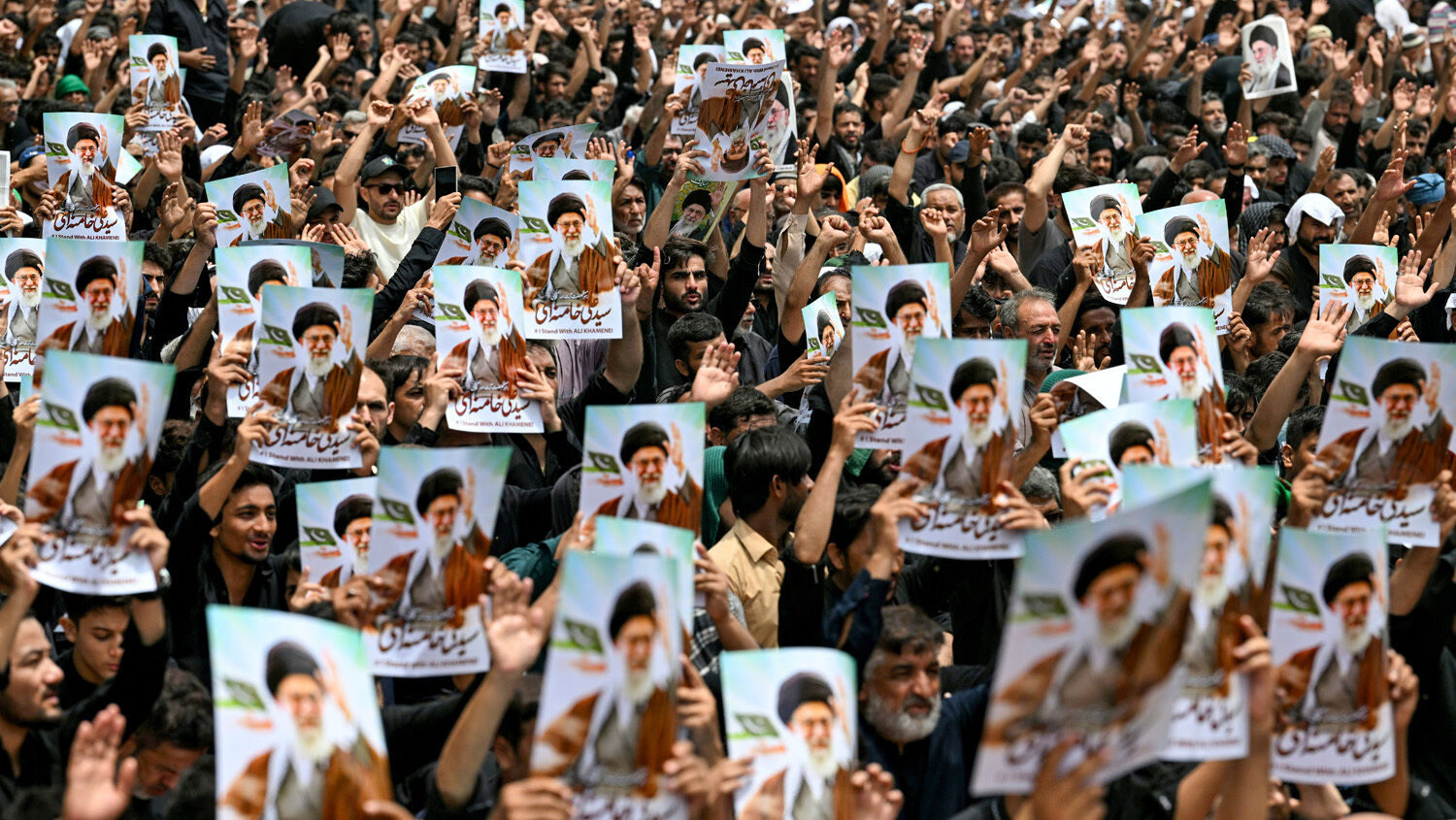
In Pakistan, crowds are smashing the windows of the U.S. consulate. In Baghdad, Iraq, protesters are massing at the Green Zone. In Lebanon, rockets are flying. In Yemen, the Houthis are declaring full readiness. These are not coordinated responses; they are spontaneous eruptions from a network of groups that have been soaked in the same ideology for decades. Remove the central command and what you get is not peace but many smaller conflicts, each driven by local commanders who no longer have anyone to restrain them.
Watch what happens next. Watch for Iran’s successor to rebuild. Watch for Libya, Egypt and Ethiopia to drift further into the Iranian orbit, as Mr. Flurry forecast in 2011. Watch for a German-led Europe to accelerate its military buildup in response to the regional chaos. Watch for a push—in Jerusalem, over Jerusalem, through Jerusalem.
Here is the critical point that most analysts miss entirely: The king of the south was never going to be stopped by America. The Bible does not show America in that battle at all.
This is precisely what is beginning to unfold. The strikes on Iran are not the fulfillment of Daniel 11. They are the prelude to it—a prelude that may accelerate America’s own unraveling.
The White Horseman
As evil and barbaric as Khameini was, he did restrain Iran in certain ways compared to the unrestrained push that Daniel prophesies is yet to come.
The four horsemen of the Apocalypse are riding. The most dangerous by far is the first—riding on a white horse, symbolizing religious deception (Revelation 6:2). The entire world has been thoroughly inoculated with this potent deception by “the god of this world” (2 Corinthians 4:4; Revelation 12:9). Mahdism is not merely a political ideology. It is a spiritual counterfeit, a mirror image of genuine biblical prophecy, twisted to serve destruction.
You can kill a supreme leader, but that won’t free the minds of millions from a 1,400-year-old Islamic prophecy that has outlasted empires, crusades and colonial occupation. The Mahdi tradition holds that suffering is not defeat—it is confirmation; that martyrdom is not an ending but an acceleration; that the blood of the “faithful” is the very seed of divine victory. Every missile fired into Tehran is simply fertilizing the ground of this ideology.
Israel and America are being punished for their sins, yet instead of trusting God to fight their battle, they are trusting their arsenals. Their actions are accelerating this prophecy. Every missile fired, every alliance forged, every act of force is unwittingly leading to the fulfillment of Daniel 11:40:
And at the time of the end shall the king of the south push at him: and the king of the north shall come against him like a whirlwind, with chariots, and with horsemen, and with many ships; and he shall enter into the countries, and shall overflow and pass over.
The Trumpet has warned for years that Iran’s revolutionary ideology—not its military capability alone—represents the defining threat of our era. Understanding the doctrine is not optional. It is the difference between tactical success and strategic catastrophe.
What is happening now is not the end. It is the beginning of the end—and what follows will affect every person on Earth.
For a deeper study of these prophecies, request Gerald Flurry’s free booklet The King of the South and Herbert W. Armstrong’s The United States and Britain in Prophecy.


