

Iran War Exposes Britain’s Pathetic Weakness
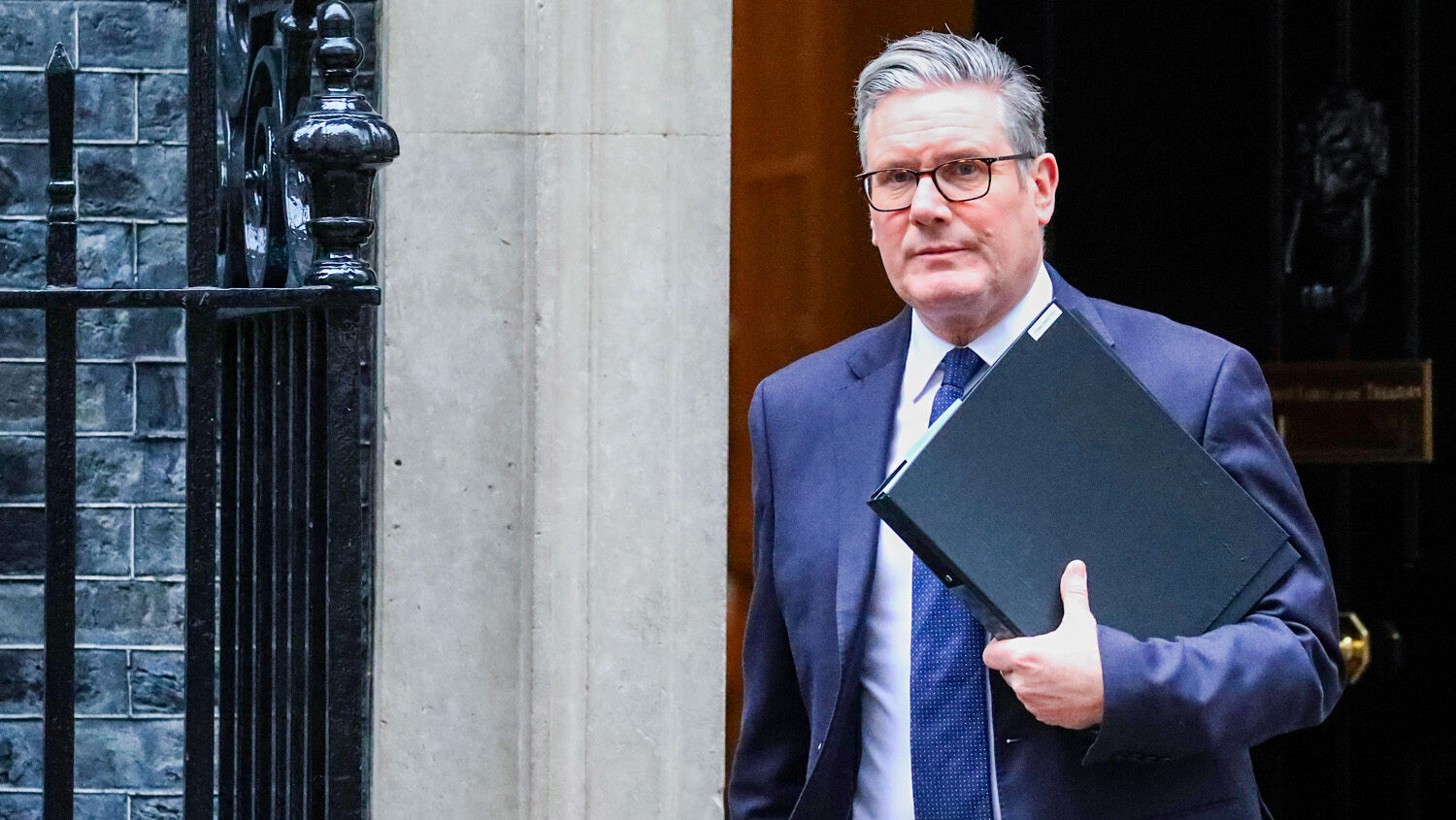
British Prime Minister Keir Starmer is “no Winston Churchill,” United States President Donald Trump said yesterday. That’s an understatement. Starmer lacks the courage even to take a clear stance on the Iran war. Does he support or oppose the bombing of Iran? He won’t say.
The war has proved to be the end of Ayatollah Ali Khomeini. It might also be the end of Britain as a major power, the end of a special relationship, and the end of Britain’s military presence in Cyprus.
There are ways to oppose the war on Iran without being pathetic. Regime change in the Middle East hasn’t gone well in the past. Iran’s government is evil, but it is understandable that some argue for caution.
Yet Starmer hasn’t done that. He has hemmed and hawed about international law, while Britain’s navy has proved incapable of protecting British bases.
Starmer initially refused to let the U.S. bomb Iran from British bases. Then Iran attacked a British base in Cyprus and threatened British soldiers and civilians across the Middle East. “[T]he only way to stop the threat is to destroy the missiles at source,” Starmer said. So would Britain fight to protect itself? No—but it would allow the U.S. to use British bases “for that specific and limited defensive purpose.”
Meanwhile, Starmer is busy trying to hand Diego Garcia, one of the most important military bases in the Indian Ocean, to Mauritius. Note: not hand back to Mauritius. It never owned it in the past and has no historical connection to it beyond once being part of the British Empire. It would be like giving Hawaii to the Philippines because they share an ocean and were both once controlled by America. Yet a former member of the Chinese Communist Party became an international court judge and issued a nonbinding ruling, so Starmer insists it must be given to Mauritius—a small island nation that has been bought up by China. Oh, and he plans to pay Mauritius billions as well.
The deal has not gone into force yet, but Mauritius put out a statement saying it is of the “opinion expressed by various international lawyers that the attacks by the United States of America and Israel against Iran … have no legal underpinning under international law.” If the base is handed over, the U.S. may never be able to use it again.
Starmer, a former human rights lawyer, cannot see that malleable international law is being weaponized by evil regimes against Britain and America. His willingness to go along with the ruling is a major lack of judgment, making Britain an unreliable U.S. ally.
He is also responding to domestic pressure caused by mass migration.
Last week, Starmer’s Labour Party suffered a major defeat, coming in third place in a by-election for a seat the party had held since 1931.
For decades Labour has been pro-immigration because migrants tend to vote Labour. The party has been the default choice for Muslim immigrants in particular.
But the last Labour Party leader, Jeremy Corbyn, went too far. Before becoming Labour leader, he invited his Hamas “friends” to visit him in Parliament. His anti-Semitism lost support among the mainstream and led the party to electoral disaster. Starmer had to go the opposite direction to rebuild support, booting Corbyn from the party.
The Green Party has filled the space left by Corbyn. It won the by-election with a campaign video entirely in Urdu—the language of Pakistan—and used images of Labour politicians meeting with Israeli Prime Minister Benjamin Netanyahu and India’s Narendra Modi, as well as footage of Gaza, to imply that Labour was not on the voters’ side. This weekend, the Green’s deputy leader Mothin Ali attended a pro-Iran rally where the crowd shouted, “Death to the U.S.A.!” and “Death to Israel!”
The latest polls show the Green Party is now more popular than Labour and is the second-most popular in the United Kingdom, behind Nigel Farage’s Reform.
If Starmer takes a position on the Iran war, he’ll lose either the Muslim vote or the same middle-class voters who abandoned Corbyn.
Even if Britain wanted to do more, there are serious questions as to whether it could. The base Iran struck on Sunday is sovereign British territory. Greece immediately dispatched two frigates and four F-16s to help protect Cyprus. A French frigate arrived in Cypriot waters yesterday, and France is redeploying an entire aircraft carrier strike group from the Baltic to the eastern Mediterranean. France is the only power in the world other than the U.S. to operate a nuclear aircraft carrier. A frigate and a nuclear-powered attack submarine will accompany the carrier.
Only after this did Britain decide to send the hms Dragon. However, it is in dry dock and won’t be able to leave for several days.
How much longer will Cyprus tolerate British bases if Britain cannot protect it from attack? European powers are demonstrating that they are more capable allies.
America has been building up resources in the region for weeks. Yet the Royal Navy was stretched too thin for Britain to have a warship on hand in case of war.
Britain has no warships in the Mediterranean or the Persian Gulf despite having a naval base in Bahrain.
Why? Part of it is money. Britain has tried to cut defense costs for years. The tax burden is set to reach its highest level since World War ii in the years ahead, but it is being devoured by welfare spending, the National Health Service and pensions. The only way to allocate more money for defense is to cut these services.
But it’s not just a monetary problem. Britain spends far more on its military than Israel—to much less effect. Bureaucracy, mismanagement and a lack of strategic vision or leadership have all taken their toll.
Britain is socially and economically bankrupt, and the Iran war exposes it.
For years we’ve said that the book of Hosea contains a specific warning for Britain. Today’s situation is precisely described in several passages. Britain is described as a moth-eaten garment (Hosea 5:12) and a burnt-out cake (Hosea 7:8). It looks good on the outside, but when put to the test, it just falls apart. Why?
“Strangers have devoured his strength, and he knoweth it not,” God says of Britain (verse 9). Britain lacks the strength to stand up to Iran because it has let in millions of people who side with Iran, not Britain. Many of these migrants increase the massive welfare and health-care costs that make a proficient military unaffordable.
In its relations with other nations, Britain behaves like a “silly dove” (verse 11), naively taken advantage of by foreign powers.
This is a result of a nation that has forgotten God and its history. “For she did not know that I gave her corn, and wine, and oil, and multiplied her silver and gold, which they prepared for Baal” (Hosea 2:8). God gave Britain tremendous blessings and prosperity. Yet its leaders now believe the nation has largely been a force for evil and its prosperity acquired through exploitation and stealing. History that would point the nation to God is subject to smears and lies.
Britain has been so weakened, it’s hard to see how it could ever be turned around. Yet as the curses worsen, the nation will wake up. “I will go and return to my place,” says God, “till they acknowledge their offence, and seek my face: in their affliction they will seek me early” (Hosea 5:15).
Much worse affliction is coming, but that affliction is the nation’s only hope.
How could a book written over 2,500 years ago precisely diagnose Britain’s problems today? Why is God so concerned with this nation? Why does this book apply so specifically to Britain? These are all questions Herbert W. Armstrong answered in his book The United States and Britain in Prophecy. It is the fundamental book for understanding what the Bible says about world events—and unlocking the only hope behind all the suffering in this world. We would be happy to send you a free copy.


