

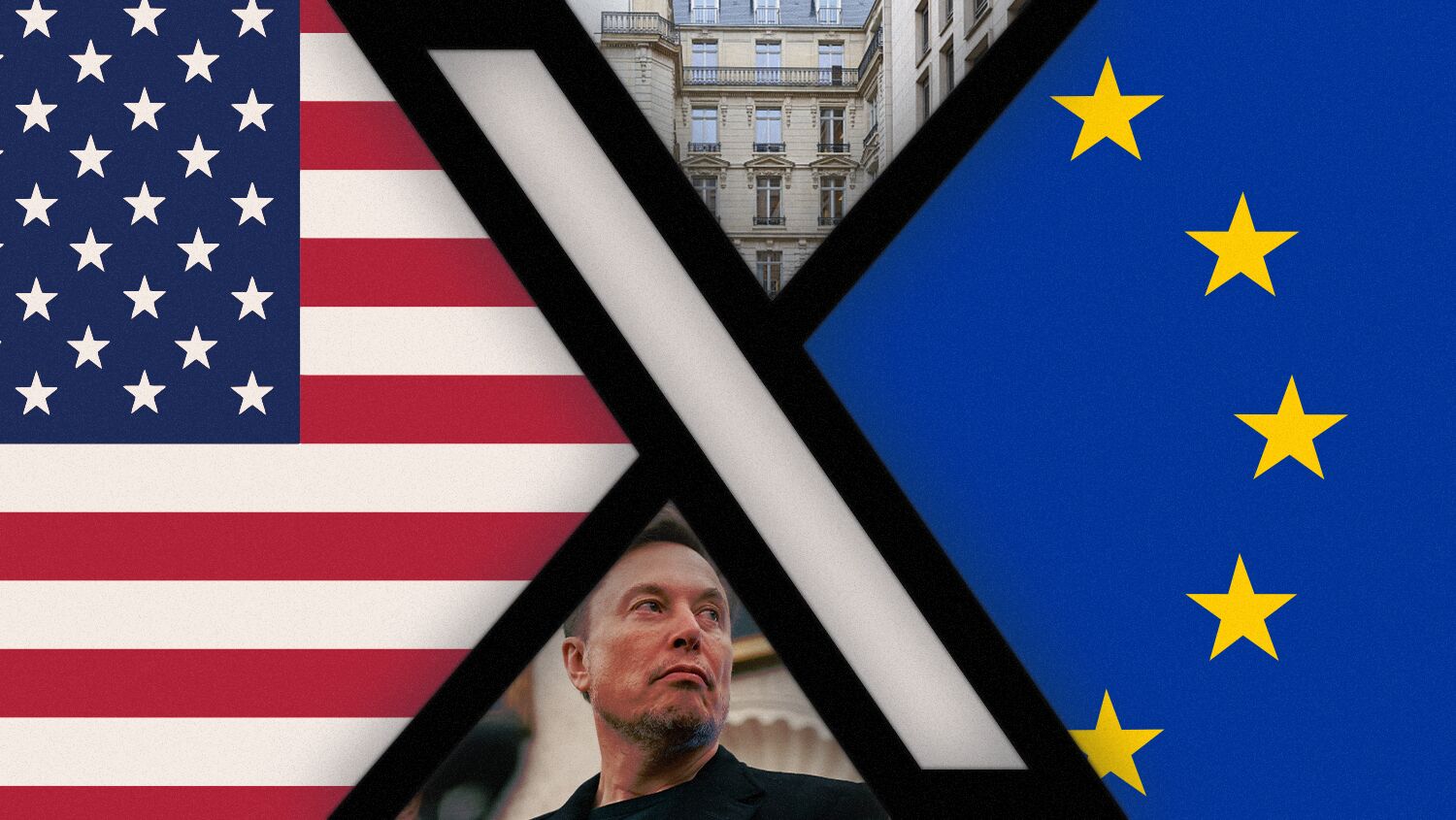
EU Fights U.S. Over X
French government agents raided the Paris offices of X (formerly Twitter) yesterday as part of a criminal investigation of the U.S.-based social media platform. They asked X’s owner, Elon Musk, to attend a voluntary interview in a couple of months.
Authorities accuse X of interfering in French politics by tweaking its algorithm. Before being bought by Musk, Twitter actively interfered in politics in the United States and around the world. However, France’s government establishment generally supported that effort—so the raid carries with it more than a little hypocrisy and perhaps worse.
French prosecutors have added X’s artificial intelligence agent, called Grok, to their investigation, accusing it of Holocaust denial and impugning its ability to respond to users who upload photos of people then prompt it to generate realistic images of what they would look like without clothes.
- Such use of AI is truly abhorrent. But in terms of power and politics, the conspicuous lack of French investigations into other similar AI tools suggests that the agenda here is not online safety, justice or democracy, but rather an excuse to attack X and weaken American tech, especially if it can also indirectly weaken the Trump administration.
Musk may not be the underdog in this fight, though: He has much of the U.S. government on his side. The House Judiciary Committee issued the “European Censorship Files” on X yesterday, documenting the way the EU blocks free speech for Americans on social media.
“Put simply, the boundaries of debate on political topics like mass migration, men in women’s sports, and more are set by community guidelines,” they wrote. “When governments pressure platforms to change their community guidelines, they are changing what Americans are allowed to post in the United States or anywhere else.”
This is not just a fight about X or Musk. It’s a fight between the U.S. government and the European Union.
- The two governments are also sparring over how Facebook, Instagram and YouTube censor speech. The German government is also considering a new law that would force Netflix and Amazon to invest in Germany, which the Trump administration opposes.
EuroIntelligence argued that this war over online contact is actually a “far more important breaking point than Greenland” for the EU and U.S. Here, “there is no foreseeable solution.”
This is not a fight Donald Trump started. The EU has been trying to control what Americans can say online long before he came into office. But it exposes yet another deep crack in the trans-Atlantic alliance and the entire postwar order. For America, free speech is sacred. For Europe, it isn’t. Europeans operate on fundamentally different value systems.
“Germany’s ambitions for the Internet should concern everyone, even those who don’t have a computer,” wrote Trumpet editor in chief Gerald Flurry in 2019. “The EU’s behavior on this issue exposes the dictatorial nature of this German-dominated entity. Really, we are witnessing the manifestation of the spirit of the Holy Roman Empire in the tech world. The biblically prophesied seventh and final resurrection of this empire wants to control the Internet!”
The Holy Roman Empire is rising in Europe. Expect to see more and more revelations that its culture, its economy and, ultimately, its military are fundamentally opposed to the United States.


