

Board of Peace Derangement Syndrome
President Donald Trump’s Board of Peace got off to a rough start. His proclamations of peace and prosperity are being undermined by divisions among world powers that are pushing us toward the next world war.
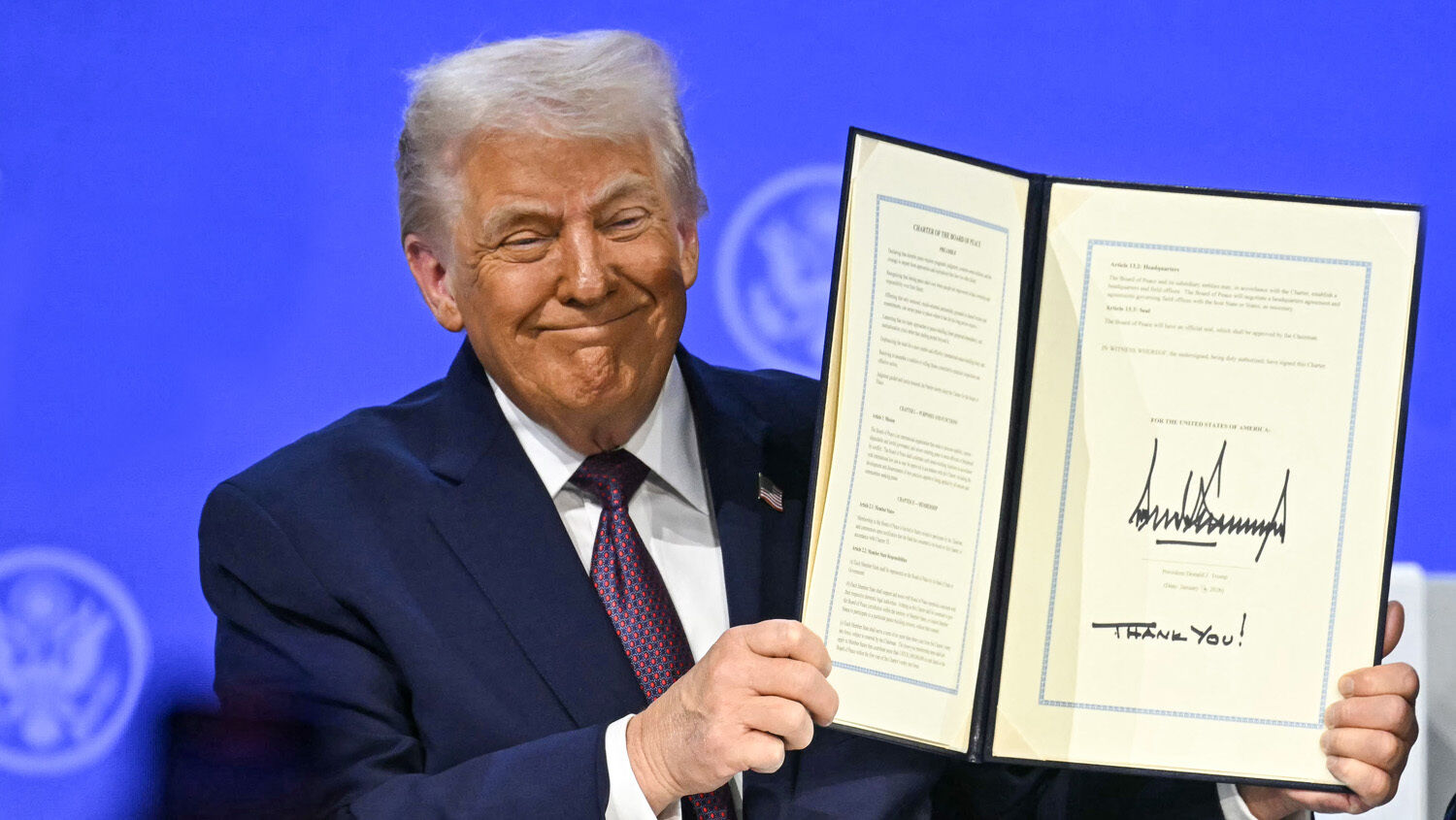
President Trump signed the board’s founding charter in Davos, Switzerland, on January 22, alongside representatives from 19 foreign countries. “This board has the chance to be one of the most consequential bodies ever created, and it’s my enormous honor to serve as its chairman,” he said. “Today, the first steps toward a brighter day for the Middle East and a much safer future for the world are unfolding right before your very eyes.”
Yet at the same time, European leaders were talking about using a “trade bazooka” against the United States and mustering a European Union army to defend Greenland from President Trump. They are not expecting peace with Donald Trump. Rather, they are preparing for trade war and worse with the U.S.
Two thirds of the countries who have joined the Board of Peace so far are authoritarian regimes. Denmark, France, Germany, Italy, Norway, Spain and Sweden have refused to join, while Canada has been barred from joining after Prime Minister Mark Carney insulted Trump. Few established First World democracies have backed Trump’s efforts, so the Board of Peace looks more like the Board of Autocrats.
During a debate at Davos, a moderator noted: “We’re talking about, Can Europe defend itself?, and something that is really interesting is we have not said the word Russia or Ukraine, I think, so far in this conversation.” Interesting observation. While President Trump is inviting Russian President Vladimir Putin and a host of other autocrats to his Board of Peace, Davos elites are discussing how Europe can defend itself from the U.S.
Does this sound like the prelude to a brighter day and a safer future?
When the late Herbert W. Armstrong attended the inaugural meeting of the United Nations in 1945, he contrasted the eloquent public speeches about peace with the bitter arguments occurring off the stage. Eight decades later, the arguing and threatening is there on stage. Men like Prime Minister Carney are talking about a new “era of great power rivalry” right out in the open for all ears.
When British Prime Minister Neville Chamberlain proclaimed “peace for our time” in 1938 after signing a pact allowing Germany to annex Czechoslovakia’s Sudetenland, people applauded. World War ii started only 11 months later. His pronouncement of peace turned out to be a sick joke. Will future historians look back on President Trump’s Davos speech the same way?
Isaiah 33:7 says, “Behold, their valiant ones shall cry without: the ambassadors of peace shall weep bitterly.” The ambassadors for peace certainly wept bitterly a year after Neville Chamberlain proclaimed “peace for our time” in 1938. They will weep bitterly again when the tensions evident at Davos erupt into open war.
After President Trump threatened to take Greenland “one way or the other,” Deutsche Bank warned that the U.S. remains critically dependent on foreign capital inflows; therefore Europe could retaliate by selling treasury bonds. Whether for this reason or another, or a combination, President Trump toned down his rhetoric and said he would settle for an updated defense agreement with Denmark. But this capitulation does not mean a brighter day is upon us.
“For when they shall say, Peace and safety; then sudden destruction cometh upon them, as travail upon a woman with child; and they shall not escape” (1 Thessalonians 5:3).
In the May-June 2025 Trumpet, my article “The Fatal Flaw in Trump’s Foreign Policy” highlighted the naivety of the Trump administration’s belief that “anything can be solved with dialogue.” The president has learned nothing from the failures of dialogue to bring peace to Gaza, Ukraine and other places that are suffering conflict. He feels he just needs to get all the world leaders together in a Board of Peace to talk things out.
This is a delusional take based on a shortsighted view of world history and human nature.
President Trump keeps referring to his Board of Peace as the “greatest and most prestigious board ever assembled,” but the League of Nations, established in 1920, and the United Nations, established in 1946, were also great and prestigious boards. What makes the Board of Peace different from these international efforts? The same selfish human nature that scuttled these peace boards is still present in the Board of Peace.
The only difference between 1946 and 2026 is that the world is more dangerous now than it has ever been. There are more than 12,000 nuclear warheads on Earth today, so that is no exaggeration. Burying our heads in the sand and talking about peace will not change this fact.
Hosea prophesied that the leaders of end-time Israel (which include America, Britain and Israel) would be “like a silly, senseless dove, crying to Egypt, flying to Assyria; but as they fly, I fling my net on them, and bring them down like a bird” (Hosea 7:11-12; Moffatt). This analogy well describes America’s naïve foreign policy.
President Trump is talking about “a brighter day” and a “safer future,” but God is preparing a net for the American people if they do not heed His warning message and look to the real Prince of Peace.


