

Papal Influence in Europe Intensifies
Looking northward from his balcony at the Vatican must spur some disheartening, even frustrating, thoughts in the mind of Pope Benedict xvi. A bevy of problems are erupting across virtually the entire continent of Europe. Millions of rioters fill the streets in France. Germany is trying to prevent the same. Islam‘s imprint is intensifying in more than a few European nations. National economies are ailing. Added to all this, the pope is acutely aware that for years Europe has been deteriorating spiritually. Large factions of European society are no longer governed by a lucid moral compass.
It’s abundantly clear: economically, politically, socially, morally, religiously—Europe lacks leadership.
As he surveys Europe’s ailing landscape today, the pope surely ponders the greatness of the Continent’s history, when it was heavily influenced and even dominated by the Roman Catholic Church. As the pontiff contrasts today’s Europe with the Europe of yesteryear, a solution to the Continent’s ailing condition must ring clear in his mind: Europe needs a dominant Vatican.
The restoration of Europe to its Catholic roots lies at the top of the pope’s to-do list. No issue is more important. Read his books; read the lines and between the lines of his speeches; watch where he travels, look who he talks to—Pope Benedict xvi is on a quest to restore Europe to its Christian roots.
This isn’t something he is trying to play down or hide: Pope Benedict xvi has clearly and publicly delineated that he wants the restoration of Europe to its Christian roots to be the defining theme of his papacy.
With this in mind, let’s assess two of the pope’s recent movements.
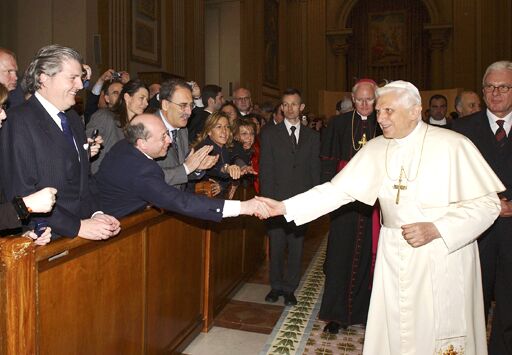
On March 30, the pope addressed some of Europe’s most prominent right-wing leaders at a conference in Rome that was sponsored by the EU’s largest and most influential conservative group, the European People’s Party. Comprised of 38 political parties from all over Europe, including several Christian Democrat parties, Benedict’s speech before the epp was more than a message to a group of Christian supporters; it was message to the entire leadership of the European Union.
And the media were there to make sure it was reported. The Financial Times reported that the pope had joined forces with leading European Union conservatives “to call for a restoration of Christian values at the heart of the EU” (March 30). The conference clearly furthered the courtship presently occurring between Europe’s conservative parties and the Vatican.
“It was a day on which European conservatism over future EU enlargement mixed with the Christian Democratic movement’s religious roots, symbolized by Pope Benedict xvi granting an audience to its members” (ibid.; emphasis added throughout). With such European heavyweights as German Chancellor Angela Merkel, Italian Prime Minister Silvio Berlusconi and European Commission President Jose Manuel Barroso in attendance, the summit in Rome was not only a “reminder that the center-right dominates EU agenda,” but that it also has the support of the Vatican.
The pope reminded eep attendees that Europe’s Catholic leaders have the right to become involved in public policy debates “in order to educate people’s consciences and uphold justice” (Catholic News Service, March 30). According to Pope Benedict, Europe’s Catholic leaders should have a voice in European politics, and those voices must be amplified.
Added to this, the pope told the conservative politicians, “Your support for Christian heritage … can contribute significantly to the defeat of a culture that is now fairly widespread in Europe, which relegates [religion] to the private and subjective sphere …” (Reuters, March 30). Put simply, Pope Benedict wants Europe’s leaders to play a greater role in purging European society of moral relativism. Christian values should once again become the moral standard underpinning European society.
Benedict left no ambiguity as to which Christian values he was specifically referring to. “Pope Benedict said certain principles ‘are not negotiable‘; they include the protection of human life from conception until natural death, the family based on the marriage of a man and a woman, and the right of parents to determine how their children will be educated” (Catholic News Service, op. cit.).
Both abortion and homosexuality are widely accepted in Europe. The fact that what the pope advocates grinds against the grain of what many Europeans believe didn’t phase him. In the eyes of the Vatican, such issues are “not negotiable.”
Pope Benedict is reviving the Euro-Vatican relationship in two ways. Firstly, as we observed through his efforts with the European People’s Party, he is positioning the Vatican to regain influence over the machinations of European politics. Secondly, he is revamping the Vatican’s image in the eyes of Europeans at the grass-roots level. This trend is especially evident in Benedict’s home country—Germany.
Germany’s Deutsche Welle recently wrote an article about this trend. “The election of a German pope has revived the once flagging fortunes of the Roman Catholic Church in Germany, bringing people back to the fold and inspiring the affection of younger worshipers …” (April 2). Catholicism is once again being embraced in Germany.
Even beyond Catholic circles, the pope has been good for religion in Germany. “While 59 percent of Catholics believe his election has boosted the Catholic Church in Germany, 54 percent of agnostics and 52 percent of Protestants share the same view …” (ibid.). Catholic or not, many German people are proud of the German presence in the Vatican. Young or old, millions of Germans are embracing Pope Benedict xvi and the Vatican.
With Europe spinning further out of control and Islamic influence reaching new heights, millions of Europeans are increasingly searching for stability and a sense of constancy. European nations have risen and fallen, but the Vatican has always been the one constant of Europe.
Over the next few months and years, watch for Europe’s populations and leaders alike to embrace the leadership, influence and constancy of the Vatican. Pope Benedict xvi will stabilize Europe.
When he visited Cologne last year for the World Youth Day festival, 1 million young people from across Europe took part in the closing mass. On the same trip, when the pontiff traveled down the Rhine, thousands of young people waded into the chilly waters to catch a glimpse of their new hero. The pope is scheduled to visit Bavaria again in August of this year; organizers of the trip are confident of a similar reception.
Europeans, especially Germans, are increasingly looking to Pope Benedict xvi and the Vatican for leadership and guidance. This trend will intensify in Europe.
It’s not a challenge to see that Europe is buckling under severe internal and external pressures. Oil-rich Iran and the Islamic Middle East are behaving arrogantly to the south. To its east, energy-rich Russia is cozying up with China and Japan. Internally, the Continent is politically divided, socially and economically unstable and suffering a severe identity crisis.
There is a massive and highly dangerous void in European leadership. No one is taking a definitive stand against Islam and the anti-religious sentiment pervading European society. No one is providing long-term solutions to the volatile problems besetting the Continent. No one is standing up to protect European identity. No one is leading Europe!
Not yet, anyway.
For years, the Trumpet has discussed how the Vatican, in cahoots with Germany, will stand up and take charge of a united federal European superpower. Europe will, thanks to the leadership of the Vatican and Germany, overcome its many problems and ailments. It will unite!
Pope Benedict xvi is acutely aware of the state of Europe today, and he is already working to restore the Continent from its ailing condition. The pontiff has wasted little time in reaffirming the Vatican’s influence in European politics and society. The Trumpet will continue to track Germany and the Vatican’s mounting influence over Europe.


