

U.S.-South American Relations Poisoned
In the latest development in the battle over the future of the Free Trade Area of the Americas (ftaa), Mexico and Venezuela have recalled their ambassadors. Continuing with his tradition of name calling, Venezuelan President Hugo Chavez referred to Mexican President Vicente Fox as a “puppy” of the United States and warned him: “Don’t mess with me, sir, because you’ll get stung.” No wonder President Fox, while promising to try to keep the debate with the Venezuelan leader impersonal, added that “we can’t allow people to offend our country” (Associated Press, November 14).
These latest comments are the follow-up to the Summit of the Americas on November 4-5 in Argentina where Fox backed the U.S. proposal for the formation of the ftaa and Chavez declared it dead, saying, “All of us here have brought an undertaker’s shovel, because here in Mar del Plata is the tomb of the ftaa” (Seattle Times, November 5).
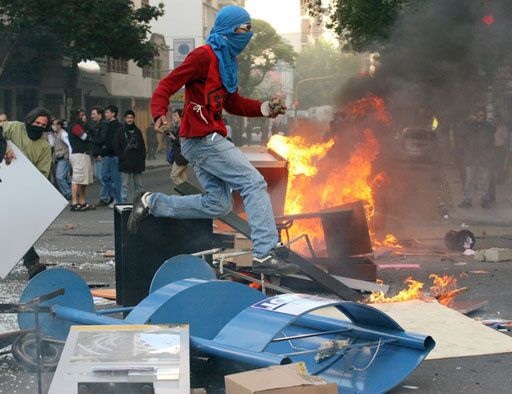
President Chavez isn’t alone in his opposition of the ftaa though. Over 30,000 protestors showed up in Argentina. By the end of the first day, initially peaceful marches had turned violent with a group of about 200 trying to break through the security cordon around the hotel where the heads of state—including U.S. President George Bush—were staying. Some threw rocks with slingshots; others burned American flags. Ever the diplomat, President Chavez held an anti-Bush rally. Police were forced to use tear gas to break up the crowd and arrested over 60 people.
The violence wasn’t limited to Mar del Plata where the summit was held. A U.S. Citibank was attacked in Rosario. In Uruguay, “hooded protesters chanting anti-Bush slogans attacked bank buildings and shops, and shattered windows” (ibid.). While some called President Bush a fascist and terrorist, others praised Fidel Castro and Hugo Chavez.
Anti-U.S. sentiment in Latin America is widespread. In October, a Republican senator from Florida, Mel Martinez, warned that Latin America risks sliding into a “populist Chavismo, anti-American sentiment” if the U.S. doesn’t take a more comprehensive, active approach in the region (Miami Herald, October 1). Now, the entire world can see how correct that warning was.
The New York Times has called George W. Bush “the most unpopular president ever among Latin Americans” (November 2). No doubt, but the issue here is not politics: it’s economics. When President Chavez sold off U.S. Treasury bonds in October, he turned to Europe with that wealth, a trend that will certainly continue throughout Latin America as time progresses.
Bible prophecy tells us the United States will be edged out of Latin America in favor of Europe economically. The U.S.-backed ftaa appears to be going nowhere while the Latin American trade group Mercosur is growing stronger—both Mexico and Venezuela have agreed to become full members of Mercosur. The U.S. failure to gain support in Latin America will drive Mercosur more firmly toward Europe.


