

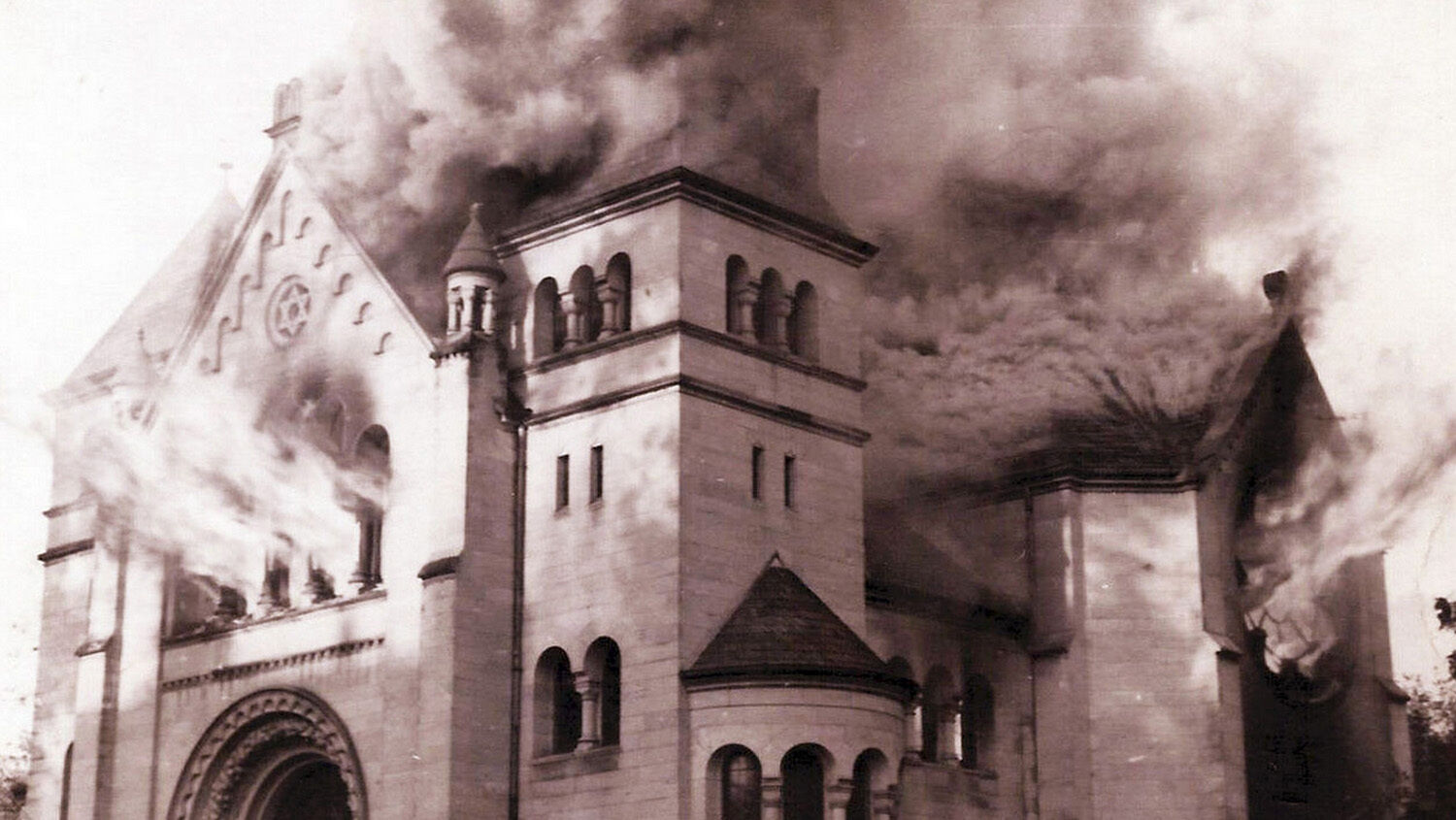
America’s Kristallnacht Moment
The New York Times’s big headline on Nov. 10, 1938, read of a party takeover in the United States Congress interfering with the president’s agenda. Other stories on page A1 read: “Taxpayers Revolt” and “Congress Changes Are Country-Wide.” The headlines could have easily read similarly in papers covering this month’s midterms. A casual reader in old isolationist America could have missed one relatively small section headlining a serious international crisis: “Berlin Raids Reply to Death of Envoy.”
This headline covered Germany’s organized pogrom against Jews the night before. The night of November 9, the Nazis torched over 1,400 synagogues, vandalized thousands of Jewish businesses, and imprisoned about 26,000 Jews in concentration camps. Today, we call this event Kristallnacht, “the Night of the Broken Glass,” a watershed milestone leading up to Adolf Hitler’s murder of 6 million Jews in the Holocaust.
This November 9, the 88th anniversary of Kristallnacht, it is worth pausing to reflect how the lessons of that important night apply to the situation of the world’s Jews today.
Blaming the Jews
There may have been no nationwide election in recent memory like this one where Israel’s relationship with the United States was such a defining and polarizing aspect of the campaigns—with Israel ending up the loser. Michigan candidate for Senate Abdul El-Sayed won essentially with a “one-horse trick campaign”: claiming America’s economic woes were entirely Israel’s fault because Israel was hijacking U.S. resources to commit “genocide” in Gaza. So much of El-Sayed’s anti-Semitic views—including his refusal in front of cameras to state Israel has a right to exist—has been publicly known for months, yet he still won. This suggests millions of Americans sympathize with these views. Or at least, they don’t think they’re anything serious or dangerous.
Other winning Democrats may not have been as overt in anti-Israel messaging as El-Sayed, but most still gained power through the same general campaign. This view hasn’t been restricted to the left. Anti-Semitic right-wing provocateur Tucker Carlson had one sentence in his newsletter on Election Day: “As you head to the polls, just remember … Your gas Israeli expensive.” After the election, Vice President JD Vance quoted a pollster that one of the main reasons the Republicans lost was because voters want to “change our relationship with Israel.”
Wanting a reset with a country isn’t synonymous with a hate crime. But consider everything that Israel, and even the Jewish people at large, has faced from America and elsewhere in recent years: torching the governor’s mansion in Pennsylvania, a pogrom in Amsterdam, making up criteria to indict Israel’s leader for genocide, constant hounding and intimidation of Jews in public for sometimes little more than wearing a kippah. And all of this is because Israel is exercising its right to defend itself from openly genocidal zealots who brag about murdering children and using their own people as human shields.
It’s one thing to want to critically examine one international relationship among many. It is quite another to overwhelmingly agree that the Jewish state, when it is at its most vulnerable, is the cause of the world’s problems. As Richard Palmer wrote for the September 2019 Trumpet: “Criticism of Israel is not inherently anti-Semitic—but such obsession is. There is no evidence to suggest that Israel is the most problematic country on the planet …. The Jewish state is being singled out because it is Jewish. That is textbook anti-Semitism.”
What does this have to do with Kristallnacht?
Parallels
After news reached the West of the scale of Germany’s pogrom, many were appalled. But many also didn’t care enough to do much about it. Two weeks after Kristallnacht, a Gallup poll suggested 94 percent of Americans disapproved of the Nazis’ actions. Yet in the same poll, 72 percent of respondents said the U.S. should not “allow a larger number of Jewish exiles from Germany to come to the United States to live.” A survey earlier that year suggested 54 percent of Americans believed “the persecution of Jews in Europe has been partly their own fault.”
“The Great Depression was in its eighth year when the U.S. economy bottomed out again in 1937, the year before Kristallnacht,” Gallup wrote in 2018. “Unemployment spiked to 20 percent in 1938, and nearly half of Americans believed the United States had not yet hit the low point of the Depression. The notion that ‘those refugees’ would take ‘our’ jobs prevailed across much of America …. Even as late as the spring of 1939, with war pressures building in Europe, Americans were more likely to say economic issues were the most important problem facing the U.S. than they were to mention war.”
This wasn’t only an American problem. “The martyrdom of Jews in the 1940s would strip anti-Semitism [in Britain] of its respectability,” wrote William Manchester in The Last Lion, “but in the 1930s, it was a quite ordinary thing to see restaurants, hotels, clubs, beaches and residential neighborhoods barred to people with what were delicately called ‘dietary requirements.’ … Contempt for [Jews] was not considered bad form. They were widely regarded as unlovable, alien, loud-mouthed, ‘flashy’ people who enriched themselves at the expense of Gentiles.”
As appalled as many in the West were by what Nazi Germany was doing, they reasoned: Not my problem. But in taking that attitude, they were contributing to the problem.
Plenty of voters may have been appalled by the last few years of anti-Semitic attacks while simultaneously supporting candidates blaming the death of the American paycheck on Israeli machinations. In detaching themselves from the wider trend, they are making the same mistake that Americans did 90 years ago.
“You may think resentment toward Jews is not a major problem,” Palmer wrote. “It makes them uncomfortable, but after all, no one is building gas chambers. But what did the world look like before they built the gas chambers? It looked a lot like it does today.”
Where to Now?
Solomon wrote in Proverbs 22:3: “A prudent man sees danger and hides himself; but the simple go on, and suffer for it” (Revised Standard Version). Ominous signs worldwide point to very serious danger. Many, if not most, are not taking it seriously.
The Bible prophesies of an unparalleled cataclysm of cataclysms, inspired by the devil, that will affect the whole world. (Our literature has more information on this.) This will happen primarily through the actions of a coming resurrection of Nazi Europe. While the entire world will suffer, one of the main targets of this coming empire’s wrath, as during World War ii, will be the Jewish people. The world’s current climate against the Jews, as it was right before World War ii, is a sign of coming danger.
“When a race receives honor as God has honored the Jews,” Trumpet editor in chief Gerald Flurry writes in The Key of David, “Satan hates them for that. He inspired enemies to rise up and strip them of all dignity! The Nazis often shaved their heads, took their clothes, beat them, and used them for medical experiments. God says it will be far worse the next time around. Do you believe God?”
“The Jews say, ‘Never again!’” Mr. Flurry continues. “Sadly, we have to tell them they are dead wrong. It is going to happen again, and it’s going to make the Holocaust look like a dress rehearsal. The Jews suffered horribly in World War ii. That history is a stark warning of what is about to come upon them!”
Anti-Semitism’s worldwide explosion is nothing to shrug off as unimportant. The public needs to know how serious the times are and what is prophesied to take place very soon. It also needs to learn how the Jewish people factor into God’s plan and why the world is so rabidly hostile toward them. Chapter 9 of The Key of David answers these questions while placing them in the context of God’s plan for all mankind.


