

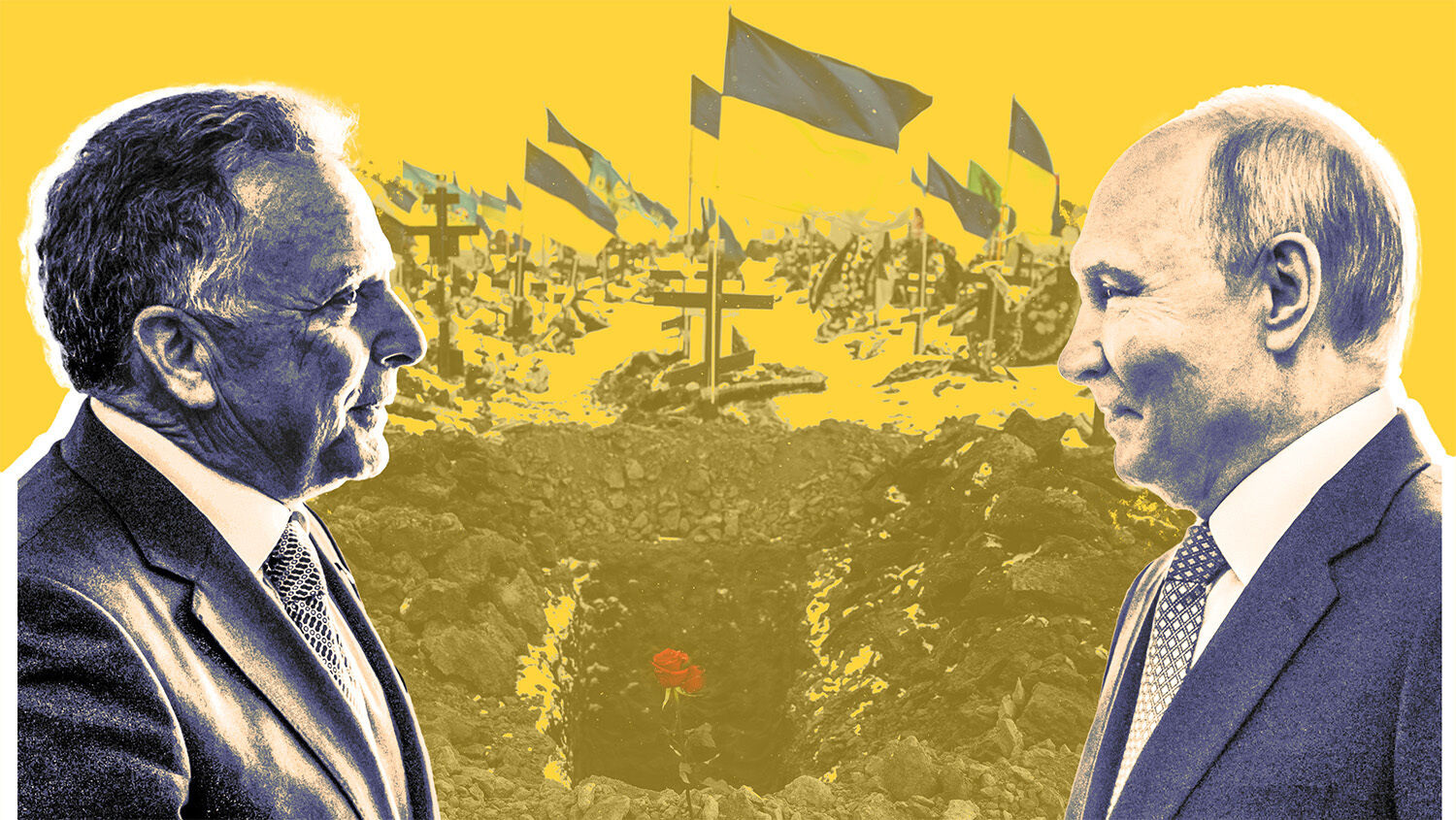
Witkoff: Putin a ‘Humanitarian’
What do you call a man who murders his country’s journalists, imprisons those who criticize him, enriches himself obscenely from his people’s labor, tortures prisoners, facilitates attacks against American forces, launches wars of aggression, lays waste to cities and towns in neighboring countries, terrorizes civilians, rains down missiles on schools and apartment buildings, forcibly uproots families from their homes, and abducts tens of thousands of children?
For United States President Donald Trump’s special envoy Steve Witkoff, the answer is “humanitarian.”
During a meeting with Russian President Vladimir Putin in St. Petersburg yesterday, Witkoff said: “You talk so much about my president, President Trump, being a humanitarian. You are a humanitarian also, sir, and I salute that, I commend you, and I thank you again.”
The remarks came after Putin agreed to release Stephen Hubbard, a 74-year-old American who had spent more than four years in Russian custody on unproven mercenary charges the U.S. government deemed wrongful.
His release is, of course, a tremendous relief for Hubbard and his family. But a true humanitarian would never collect American hostages to use as bargaining chips in the first place. Nor would he subject them to years of brutal torture in captivity for the crime of being American, as Hubbard was. And he would release the other eight or more American hostages still wrongfully detained, languishing in Russian prisons and likely enduring unspeakable torture.
Witkoff’s remarks drew sharp criticism from many, including Republicans who have been appalled by the Trump administration’s deference to Putin.
“Vladimir Putin is not our friend, and he is certainly no humanitarian,” Republican Sen. Joni Ernst of Iowa posted on X. “His relentless attacks on innocent civilians in Ukraine show his total disregard for human life. Appeasement won’t end this war. Pressure will.”
“No. Putin is a stone-cold killer,” Republican Sen. John Cornyn of Texas posted on X in response to a video of Witkoff’s words to Putin.
“Look up the definition of ‘humanitarian,’” North Carolina Republican Sen. Thom Tillis wrote. “What an embarrassing and outrageous thing to say. You should go back to Ukraine and ask the families of the children Putin has kidnapped and murdered whether they agree your friend Putin is a ‘humanitarian.’”
But the Trump administration appears undeterred by such criticism, determined to keep appeasing Putin, enacting anti-Western policies that strengthen him, and shielding him from accountability.
Desperate to find some rationale for Trump’s approach to Russia—which runs diametrically counter to the convictions of most Americans who elected him—some argue that he is pursuing a grand strategy to pry Russia away from China.
Such a maneuver would be the reverse of what U.S. President Richard Nixon and Secretary of State Henry Kissinger orchestrated between China and the Soviet Union in the 1970s. They normalized long frozen diplomatic relations with Chinese leaders, enabling them to pull China out of its alliance with the Soviet Union. Losing their ally forced the Soviets to make significant concessions and hastened the eventual collapse of the Soviet Union.
This time around, the strategy would be to draw Russia out of its alliance with China to weaken and isolate the Chinese Communist Party that Nixon and Kissinger inadvertently placed on the superpower path all those years ago.
Whether or not this is the true aim of the Trump administration’s simping for Putin and enacting Kremlin-friendly policies remains to be seen. But we can be certain that such a strategy would not work.
Russia and China today have a far stronger bond than the brittle relationship Nixon and Kissinger exploited. The two have forged a strategic alignment driven by a shared determination to challenge U.S. dominance and cemented by their mutual dependence on trade: China needs oil and gas supplies; Russia has them in abundance.
But the strongest reason any “reverse Kissinger” strategy won’t work is Bible prophecy.
To understand the Bible’s prophecies about the Russia-China axis and why fawning over its antihumanitarian leaders will neither placate them nor drive them apart, order your free copy of Russia and China in Prophecy.


