

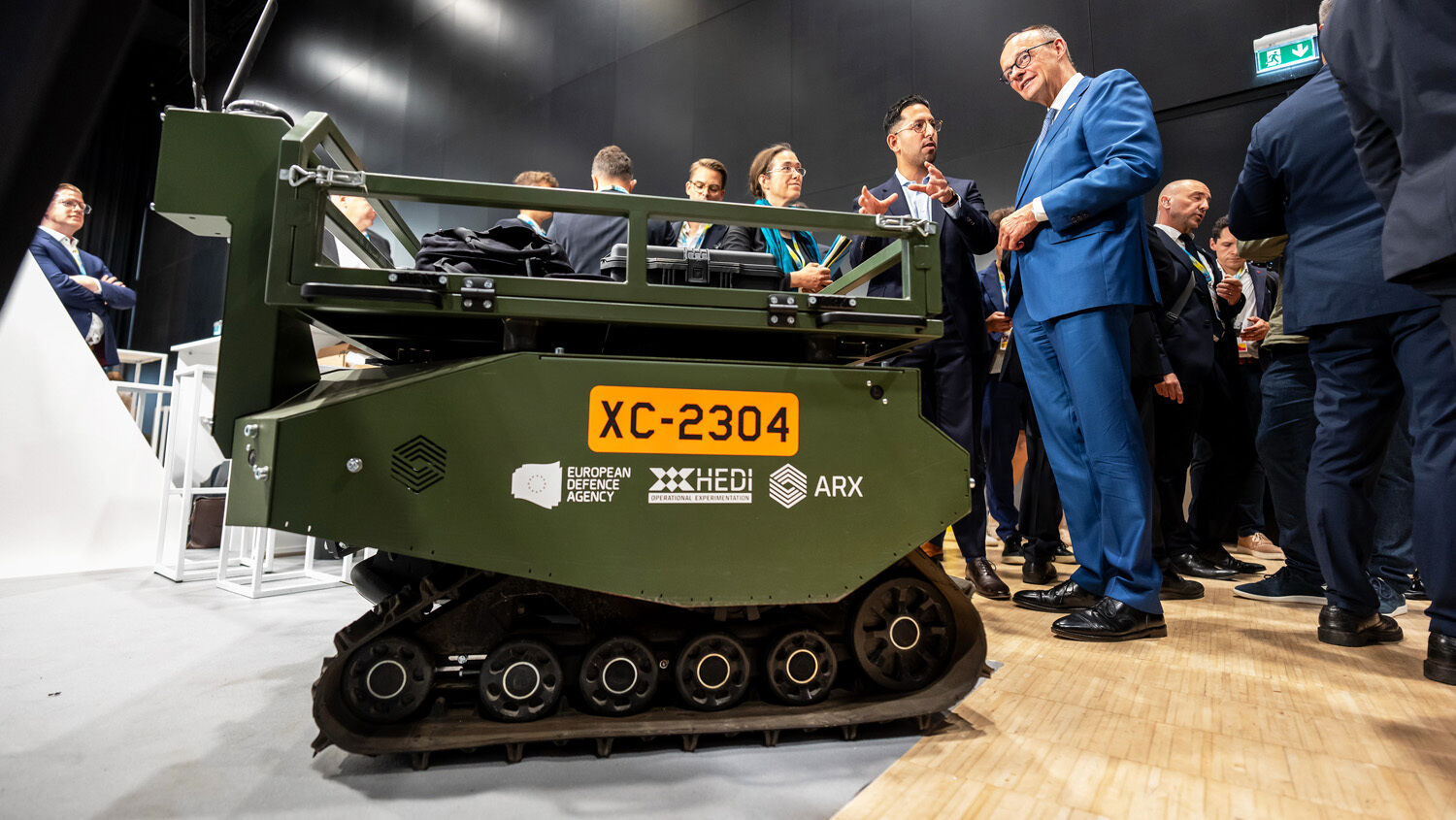
The Future of Germany’s Military Is Robotic
Following the transformation of the skies over Ukraine by drones, robots are beginning to change the nature of the battlefield on the ground. Germany is both a benefactor and a beneficiary.
During a state visit from German Chancellor Friedrich Merz to Ukraine on October 4, German start-up arx Robotics signed an agreement to mass-produce unmanned vehicles in collaboration with its Ukrainian partner, Roboneers.
“We have a contract to deliver several thousand robotic vehicles to the Ukrainian Army by the end of next year,” Marc Wietfeld, founder and ceo of arx Robotics, told Handelsblatt on October 13.
This is part of a wider trend of military cooperation, through which Germany is gaining military expertise.
In May, then Ukrainian Defense Minister Mykhailo Fedorov and his German counterpart Boris Pistorius signed a letter of intent to launch a joint initiative called Brave Germany, aimed at developing defense technologies and supporting innovative start-ups.
These start-ups are transforming the battlefield. Fedorov, who has since announced the launch of his own defense company, said in a social media post on September 26:
In 2022, we launched the Army of Drones. … Today, drones account for more than 95 percent of strikes. But technological warfare does not stand still. We need the next breakthrough. Our bet is on the robotization of warfare. The mission of the Army of Robots is to save lives.
German military start-up Helsing has helped transform Ukraine’s skies. arx Robotics is now on the path to do the same on the ground. The need is urgent. Handelsblatt reported:
On average, it takes three minutes for a soldier in the so-called “kill zone” on the Ukrainian front to be spotted and attacked by an enemy drone. It takes six minutes for a vehicle to be hit by a drone.
Ukraine has carried out more than 100,000 supply runs using remote-controlled vehicles this year. “Everything that was previously transported by humans in the kill zone will in future be done by robots,” Wietfeld said. Germany is the central contributor to the military transformation. Handelsblatt wrote:
arx Robotics, founded in 2021 by former Bundeswehr officers, has already delivered hundreds of “Gereon” robotic vehicles to Ukraine, making it the largest fleet of Western-made vehicles in the conflict. The compact tracked vehicle is electrically powered and can transport up to 500 kilograms of supplies, rescue the wounded, and carry weapons. The drone is remotely controlled via a controller but can also perform certain maneuvers semi-autonomously. Since September, the Gereon has also been manufactured at the Deutz plant in Ulm and delivered to Ukraine.
Another production facility is scheduled to open in northern Munich early next year. There, arx is converting a former trade fair center into its new corporate headquarters. In addition, new production facilities are being established in the United Kingdom and Poland. Another production site in Ukraine is planned for the joint venture with Roboneers. The “Rys Pro,” developed by Roboneers, is to be manufactured there. This platform is simpler than the Gereon and is intended to be produced in high volumes. All in all, arx has increased production 10-fold between 2025 and 2026. By 2028, production is set to quadruple once again. arx has not provided any details regarding revenue or potential future funding rounds.
Germany’s military investment isn’t altruistic: It is learning vital lessons and developing drones and robots for its own forces.
Christian Freuding, a lieutenant general in the Bundeswehr and inspector general of the German Army, previously served as the head of the Ukraine Situation Center at the Ministry of Defense. When asked if the Bundeswehr can keep pace with this technological development, he told Welt on October 7:
My impression is that we’re catching up at full speed right now. This year, as part of the Land Experimental Series, we’ve also made unmanned systems the focus of our research and experiments. The defense minister has decided that we will establish an independent uxs regiment—that is, an independent regiment equipped with unmanned systems within the Army. This will be implemented as early as next year and will achieve initial operational capability.
Of course, we will also draw on the experiences of our Ukrainian partners. We are in close contact with them. We will intensify this collaboration even further, and then I believe we will be well on our way to integrating these capabilities into our approach to land warfare.
When visiting the Bundeswehr’s Land Experimental Series, Pistorious said:
We are relying on high technology in procurement. We are watching very closely what is happening on the battlefield in Ukraine: control of data, networking and innovation cycles determine success or failure. Uncrewed systems are also playing an increasingly important role.
Few are paying attention to Germany’s military innovations; however, it is preparing for something big. A casual glance at Germany’s military reveals only a fraction of the truth.
Germany has the third-largest economy in the world and is the leader of the European Union, which greatly augments its strength. By itself, it is already the fourth-largest military spender in the world and has the industrial capacity to mass-produce drones and robots.
What it needs most to beat rivals is innovation. What better way to fast-track military innovation than on a live battlefield? So it is no surprise that Germany is Ukraine’s largest military backer on paper. But rather than supporting a Ukrainian win against Russia, it is using the battlefield for its own ambitions, as Trumpet editor in chief Gerald Flurry explained in “Germany Is Arming for World War III.”
The Bible reveals that Germany’s sudden military rise will surprise many. Revelation 13 prophesies: “And they worshipped the dragon which gave power unto the beast: and they worshipped the beast, saying, Who is like unto the beast? who is able to make war with him?” (verse 4). This is a prophecy about a coming militaristic empire headed by Germany. The rise of this empire will be sudden and unexpected, causing the world to “wonder” at its strength (verse 3).
Adolf Hitler’s Nazi regime developed many weapons that surprised the world; thankfully, some of the worst of them never made it onto the battlefield.
But as Mr. Flurry explained in his article, Germany is prophesied to be far more destructive in World War iii. This time, God will allow our world to experience almost total extinction. As Jesus Christ prophesied in Matthew 24:21-22, “For then shall be great tribulation, such as was not since the beginning of the world to this time, no, nor ever shall be. And except those days should be shortened, there should no flesh be saved: but for the elect’s sake those days shall be shortened.”
To understand how and why this prophecy will be fulfilled, read Mr. Flurry’s article “Germany Is Arming for World War III.”


