How Debt Destroyed the British Empire
How Debt Destroyed the British Empire

Why do superpowers fall? Over the past 500 years, six powers have successively dominated the global economy: Portugal, Spain, the Netherlands, France, Britain and the United States. None managed to hold onto that dominance for much more than a century. In every case, the high cost of maintaining global dominance eventually outgrew the economic foundation underpinning it.
Britain’s fall is the clearest version of this story and the most useful one for understanding where America stands today.
A century ago, the British Empire governed 23 percent of the world’s population, controlled 25 percent of the world’s land surface, held 40 percent of the world’s overseas investments, and financed 50 percent of the world’s trade. It was the world’s largest creditor nation, and sterling was the undisputed reserve currency (the currency foreign governments and central banks use to back their own money). The Royal Navy protected the world’s trade routes. Sterling sustained the fleet and the empire behind it.
What happened to this globe-girdling power? Today, Britain accounts for just 4 percent of official foreign-exchange reserves, handles roughly 3.5 percent of world exports, contributes only 3 percent of global gross domestic product, governs less than 1 percent of the world’s land, and is a net debtor to the rest of the world.
How did the world’s greatest empire fall from unchallenged hegemon to a country whose output per person now roughly equates to that of Mississippi, the poorest state in America?
This question is crucial because the United States is at risk of repeating Britain’s mistakes.
Rising Debts
Before World War i, Great Britain was not merely powerful. It was solvent.
In 1913, the British economy generated roughly £2.2 billion. The national debt stood at about £625 million, a debt-to-gdp ratio of roughly 29 percent. The budget was close to balanced. Tax receipts amounted to roughly 13 percent of national output. Britain could still afford its navy because interest payments consumed only about 12 percent of the central budget.
William Gladstone’s fiscal rules, combined with a century without a major war, gave Britain a firm financial foundation. Any holder of a Bank of England note could demand gold at a fixed price of £3.89 per troy ounce. Sterling was literally as good as gold, and half of the world’s trade was transacted in it.
Then German Kaiser Wilhelm ii invaded Belgium, and “the war to end all wars” was on.
Fighting the First World War cost the British Treasury about £7 billion, more than three times the entire 1913 economy. To pay for it, the government raised the standard income tax rate from 6 percent to 30 percent, sold off overseas assets accumulated over generations, and borrowed on a scale the Victorian state had never attempted. It also suspended the gold standard, cutting the monetary anchor that had made sterling as good as gold. The national debt rose from about £625 million to roughly £7.4 billion.
By 1919, wartime inflation had lifted Britain’s nominal gdp to about £5.3 billion, and the debt-to-gdp ratio stood near 140 percent. Taxes took about a fifth of national output. Debt interest, which had consumed about 12 percent of the central budget in 1913, now absorbed roughly a quarter of government tax receipts.
Prime Minister Lloyd George argued in a 1919 parliamentary debate that because Britain was obligated to pay war pensions and interest on its massive debt, it had no choice but to enact the most aggressive military cuts in British history. He slashed the defense budget from £770 million to £110 million, putting the country in a position where it spent twice as much servicing debt as defending its borders.
The strategy backfired: The economy shrank faster than the budget did. Between 1919 and 1923, Britain’s debt-to-gdp ratio climbed further still, from 140 percent to nearly 180 percent. As pressure mounted on the pound, international investors increasingly favored U.S. dollars over sterling.
Recognizing that sterling was in real danger of losing its place as the world’s reserve currency, Winston Churchill restored the gold standard after he became chancellor of the Exchequer in 1924, believing it necessary to keep the dollar from overtaking the pound. But he mismanaged the transition badly. By ignoring the inflation of the previous decade and restoring parity at the prewar rate of £3.89 per troy ounce, he severely overvalued the pound. British exports became prohibitively expensive on international markets, crushing key industries, driving up unemployment, and ultimately triggering the General Strike of 1926.
Britain had entered a trap: Servicing yesterday’s debts left no resources for tomorrow’s defense.
Power Transfer
In 1931, when the Great Depression forced a run on London’s gold reserves, Britain went off the gold standard for good. Unable to compete with the dollar at a fixed gold price, Britain turned inward, introducing protectionist tariffs, establishing Imperial Preference (a system of lower tariffs for trade within the empire), and forming the “sterling area,” a monetary bloc in which member countries anchored their currencies to the pound and held their reserves in London.
Under this system, if Australia sold wool to America for U.S. dollars, London confiscated those dollars and issued paper pounds in return, then used the seized dollars to buy American food and munitions. As the British economy struggled, it ran up debts to its own colonies, debts denominated in pounds that could be converted into neither gold nor dollars.
Perhaps this system could have survived if Britain had been given time to pay down its debts. Adolf Hitler’s 1939 invasion of Poland ended that possibility. Britain ran up astronomical debts to fight a second world war, and by the time it ended, its debt-to-gdp ratio had spiked to 260 percent. In 1944, most of the world agreed at Bretton Woods to conduct international trade in U.S. dollars.
The empire survived, but Britain had forfeited its role as the world’s reserve currency and was nearing bankruptcy.
Even with total economic mobilization, tax collections reached a record 35 percent of gdp, yet roughly 22 percent of that revenue had to go straight to creditors just to service interest on the debt. To keep the interest bill from overwhelming the state, London suppressed interest rates. But financial controls could not change the fundamental reality. Britain, so recently an economic superpower, was now unable to survive financially without aid from abroad.
The only path to solvency was a low-interest loan from America. The United States extended Britain a $3.75 billion line of credit at an ultra-low 2 percent interest rate, amortized over 50 annual installments. But the U.S. demanded concessions calculated to build a U.S.-led global trade order: Britain had to make sterling fully convertible into U.S. dollars, dismantle its protective Imperial Preference network, and formally accede to the newly created International Monetary Fund (imf).
The 1946 Anglo-American Loan Agreement saved Britain from bankruptcy, but at a steep cost. The greatest empire in world history now depended on the largesse of its former colony. Any military deployment could spark a run on sterling, trapping London and handing the U.S. a kill switch on British foreign policy. Britain still technically governed 20 percent of the world, but it could no longer act without Washington’s consent. The borrower served the lender.
Fallen Empire
This financial trap showed nowhere more clearly than in British India. By the end of World War ii, London owed India over £1.3 billion in war debt. Indian nationalists demanded immediate repayment to fund postwar development and famine relief. London did not have the money. Repaying those balances in hard currency would have triggered a run on the pound and collapsed what was left of the British banking system. Refusing to repay them risked riots that would have required deploying hundreds of thousands of British troops—troops the depleted Treasury could not afford to pay.
Faced with massive debt to India and no funds to suppress an uprising, the British government reached a sobering conclusion: The empire could no longer afford to keep its most prized possession. The British Empire left India in 1947, not because it wanted to go but because it could no longer afford to stay.
Without the Indian subcontinent, the Suez Canal alone held together what remained of the British Empire. When Egyptian President Gamal Abdel Nasser nationalized the Suez Canal Co. in July 1956, Prime Minister Anthony Eden viewed it as a direct threat to the empire’s survival. That November, Britain, France and Israel launched a secret, coordinated military strike to seize the canal zone. Britain had the ships to do this—but it lacked the funds.
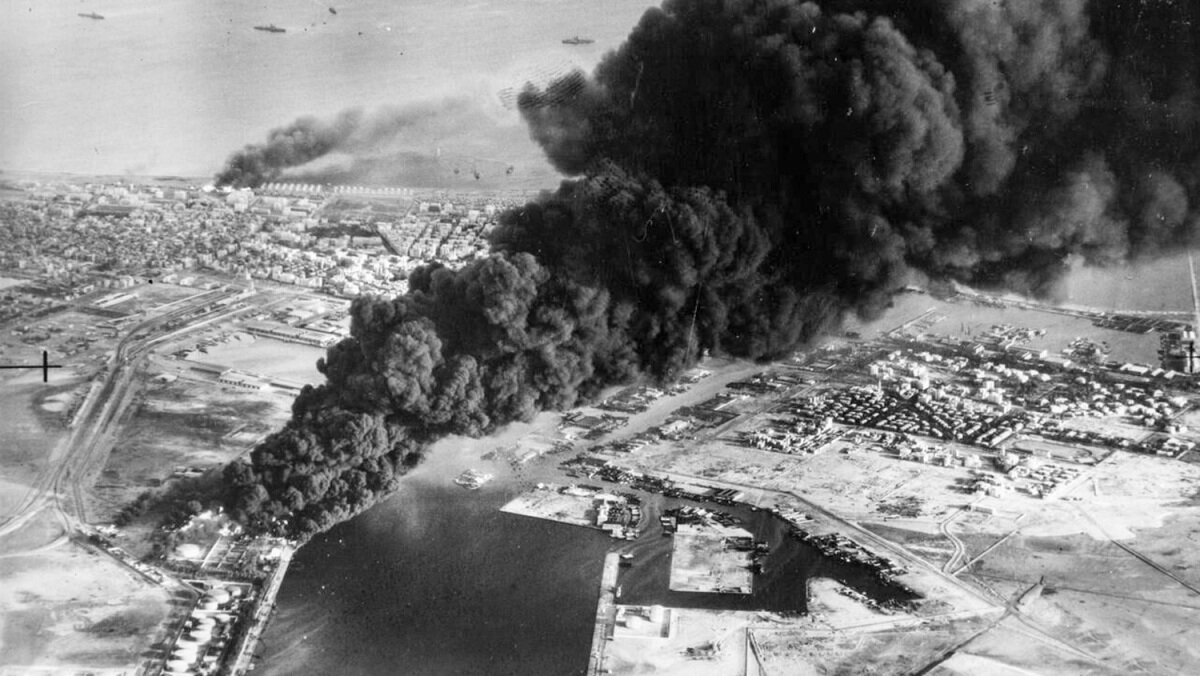
The invasion triggered a global panic, and international investors began aggressively dumping the pound. Britain needed emergency loans from the imf to stabilize its currency. But U.S. President Dwight D. Eisenhower, furious that Britain had launched an invasion without Washington’s knowledge during a delicate moment in the Cold War, blocked Britain’s access to imf loans and threatened to crash the pound by selling off America’s holdings of British government bonds.
The Suez debacle ended the illusion that Britain could act as an independent power. Remaining colonies did not all depart at once, but the episode signaled that London could no longer impose its will on them. From Ghana’s independence in 1957 through the mid-1960s, most of Britain’s African and other territories became independent. What remained were scattered islands and small outposts by the time the Colonial Office closed in August 1966.
Britain’s debt-to-gdp ratio fell from 260 percent to around 80 percent over the course of decolonization, but the country remained dependent on loans from the imf and the U.S. America overtook Britain as the world’s dominant power not through braver soldiers or a stronger military but through its role as the world’s creditor, backed by deeper gold reserves and manageable debts.
America’s Turn
In 1966, U.S. economic power rivaled that of the British Empire in its heyday. The American economy generated roughly $800 billion in gdp. The national debt stood at about $330 billion, a debt-to-gdp ratio of roughly 40 percent. The federal budget was close to balanced, and America could easily afford its military because net interest payments on the national debt consumed only about 7 percent of the central budget.
Yet six decades of war, welfare and waste have taken their toll. The U.S. abandoned what was left of the gold standard in 1971, and its debt-to-gdp ratio began rising soon after. Its debt has since climbed to a record $40 trillion, driving the U.S. debt-to-gdp ratio to a staggering 126 percent, nearly the same ratio the British Empire reached in the years right after World War i. Interest payments on the national debt now consume nearly 19 percent of federal revenue.
These statistics mean that President Donald Trump is now facing many of the same choices Lloyd George and Winston Churchill faced a century ago. The Penn Wharton Budget Model estimates that debt held by the public cannot rationally exceed about 210 percent of gdp, the point beyond which no tax on labor income, at any rate, could conceivably keep pace with the interest.
That figure excludes the trillions the government owes its own trust funds: Social Security, Medicare and others. Add them in, and the effective ceiling works out to roughly 260 percent of gdp, almost exactly the level Britain reached at the end of World War ii. On current trends, America could reach that 260 percent threshold sometime between 2045 and 2051, depending on how fast health-care costs continue to rise.
At that point, default appears inevitable. Either the Treasury stops paying bondholders or the government prints money to inflate the debt away. Both options carry serious costs.
Refusing to repay creditors would shut Washington out of bond markets entirely. Right now, the government spends $1.9 trillion more each year than it collects in taxes, and it borrows that difference. If it couldn’t borrow, it would have to make up that gap immediately through some mix of spending cuts and tax hikes. No country has ever cut spending or raised taxes that fast, that much, without triggering a recession.
Many experts think this recession could be worse than the Great Depression, which is why America probably won’t take the first option. Instead, the U.S. government will almost certainly print money to inflate the debt away over time, the same choice Britain made, again and again, for 50 years.
Britain’s strategy worked in the narrow sense that it never missed a bond payment. But the cost showed up elsewhere: The pound lost value every year, becoming a currency the world stopped trusting, and the government could no longer act without asking Washington’s permission first. Britain didn’t lose its empire in a single default. It lost it one devaluation at a time, as the world quietly moved its trust and its reserves to the dollar.
If America makes this same choice, its dominance will also gradually drain away.
Next Reserve
One key difference between Britain in 1926 and America in 2026 is that America isn’t facing competition from another currency the way Britain faced competition from the dollar. But that could soon change.
Today, the world’s second-most widely held reserve currency is the euro. The eurozone economy is only about half the size of the U.S. economy, but its debt-to-gdp ratio is much lower, and its gold reserves are meaningfully greater. The primary reason the euro isn’t a major competitor to the dollar is that it isn’t backed by a single central government, and investors are unsure how long the union will last.
The founders of the European Union always intended for the euro to be backed by a central government, but division between eurozone member states has prevented this from happening.
Dr. Otto von Habsburg discussed this with the late Herbert W. Armstrong in 1983. Both men agreed that it would likely take a massive crisis to force European integration. Dr. Habsburg suggested to Mr. Armstrong that it might take an aggressive foreign leader to frighten Europe into uniting. Mr. Armstrong forecast that a banking crisis could be just as geopolitically impactful.
Specifically, he warned that a massive banking crisis in America “could suddenly result in triggering European nations to unite as a new world power larger than either the Soviet Union or the U.S.”
Mr. Armstrong based this forecast on Bible prophecies in Daniel 2 and Revelation 17 about 10 nations in Europe giving their economic, military and political power over to “the beast.”
Economic trends are now proving Mr. Armstrong correct. Over the last four decades, European nations have created a unified currency that ranks second only to the dollar in global transactions, while U.S. fiscal liabilities continue to climb. If a U.S. bond crisis eventually prompts Europe to unite into a fiscal union, America will find itself in a very similar situation to interwar Britain. Any attempt to stabilize its currency will leave it unable to pay its astronomical debts, and any attempt to inflate these debts away will destroy its currency.
Either way, the result will be a new economic superpower to rule the world.