

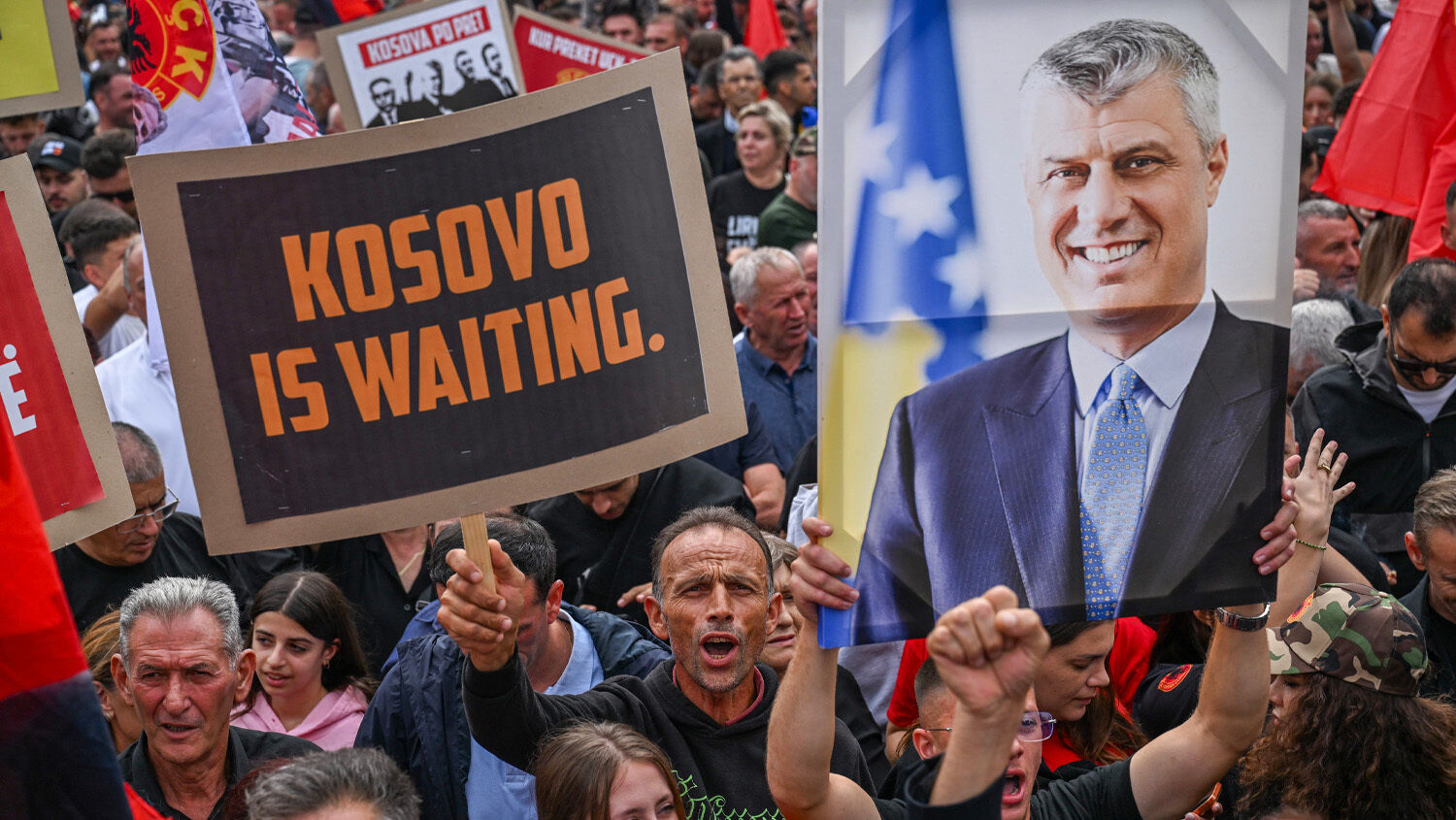
Hashim Thaçi and Kosovo’s Travesty of Justice
Former Kosovar President Hashim Thaçi was found guilty of war crimes on September 16. The Kosovo Specialist Chambers in the Hague sentenced Thaçi to 25 years in prison for murder, torture, cruel treatment and arbitrary detention. The charges relate to Thaçi’s role as a senior commander in the Kosovo Liberation Army (kla) during Kosovo’s 1998–1999 rebellion against Serbia. Also indicted were Thaçi’s kla comrades Jakup Krasniqi, Kadri Veseli and Rexhep Selimi.
Thaçi’s charges include “torture as a war crime” against “at least 303 people” and “murder as a war crime” against 96 people. A 2020 report details accusations such as mass prisoner executions, electrocutions and slave labor.
Thaçi also faces a separate trial on obstruction of justice that will begin later in September. Presiding judge Charles Smith iii said the trial occurred in a “climate of witness intimidation,” claiming some witnesses lied and others may have felt afraid for their safety.
Before the Kosovo War, the kla was a terrorist group, attacking police stations and refugee camps housing Serb populations fleeing the rest of Yugoslavia. Serbia’s crackdown in Kosovo, though heavy-handed, was prompted by the kla’s insurrection and targeting of civilians. The group successfully rebranded itself as an independence movement in 1998, even though its methods didn’t change. Many of its founders, emigres in Western countries, have been implicated in sordid activities.
The travesty in the court’s ruling is that it is happening in 2026.
The kla’s reputation isn’t a secret. In 1996, it attacked a refugee camp of Serbs fleeing Croatian persecution and sent an open letter to the bbc claiming responsibility. A nonviolent Kosovar group at first claimed the kla was actually a Serb front to smear the reputation of Kosovo Albanians.
Serbia’s 1998 counterattack was brutal and involved mass human rights violations, but it was responding to the activities of the kla. Despite both sides being culpable for similar crimes, Western public opinion and government policy were overwhelmingly anti-Serbian. German Defense Minister Rudolf Scharping and others insinuated Serbia was planning a Nazi-style genocide against Kosovo Albanians. Nothing of the sort was true. The kla’s thuggery and violation of Serbian sovereignty were overlooked.
In covering Thaçi’s verdict, cbc commented: “The judgment was a crushing blow for a man once embraced by Western leaders, who invited him to 1999 peace talks in France, and who was seen as a leader who could guide the country toward independence.” Former United States Secretary of State Madeleine Albright recounted her policy to Kosovo: “There was this young Kosovar guy, Hashim Thaçi, who was a kla fighter. We said to him, ‘You’re going to be the Gerry Adams [the former Sinn Féin leader in Ireland] of this operation. You’ll show that there’s a peaceful arm to the kla and you will be the hero.’” Thaçi’s response, according to Albright, was, “I’ll do everything you want.”
The truth is, everybody knew what the kla stood for. Yet no one in a position of power cared.
The Yugoslav crisis didn’t have to become a bloody mess. The decade-long bloodbath emerged largely because of external meddling—chiefly from Germany and the Vatican. Trumpet editor in chief Gerald Flurry linked German and Vatican recognition of Slovenia’s and Croatia’s independence in 1991—when the rest of the world was against such a move—to Yugoslavia’s dissolution. In his free booklet Germany’s Conquest of the Balkans, Mr. Flurry outlines how Germany started the Yugoslav crisis to remove a key rival to its domination of Europe.
Over a quarter of a century after the Kosovo War ended, Germany’s dominance over the Balkans is all but complete. Short of civil war restarting in Bosnia—which is a real possibility—no threat to German dominance will come from there again. Yugoslavia has disintegrated, and most of its old republics are either in the European Union or the North Atlantic Treaty Organization—solidly in Germany’s sphere of influence. Consequently, the kla’s reputation no longer has to be protected.
Mr. Flurry wrote:
Was the German-supported kla a band of freedom fighters, or were they terrorists? nato had serious problems controlling them.
The truth is, they were German-sponsored terrorists—used to achieve Germany’s fascist goals. The world quickly forgets the ugly truth about Germany’s aims. But the sledgehammer of events will jar our memory as never before.
The world may have moved on from the Yugoslav Wars, but that history is far more important to Europe’s current direction and even world security than most realize. Germany’s Conquest of the Balkans explains this in detail.


