

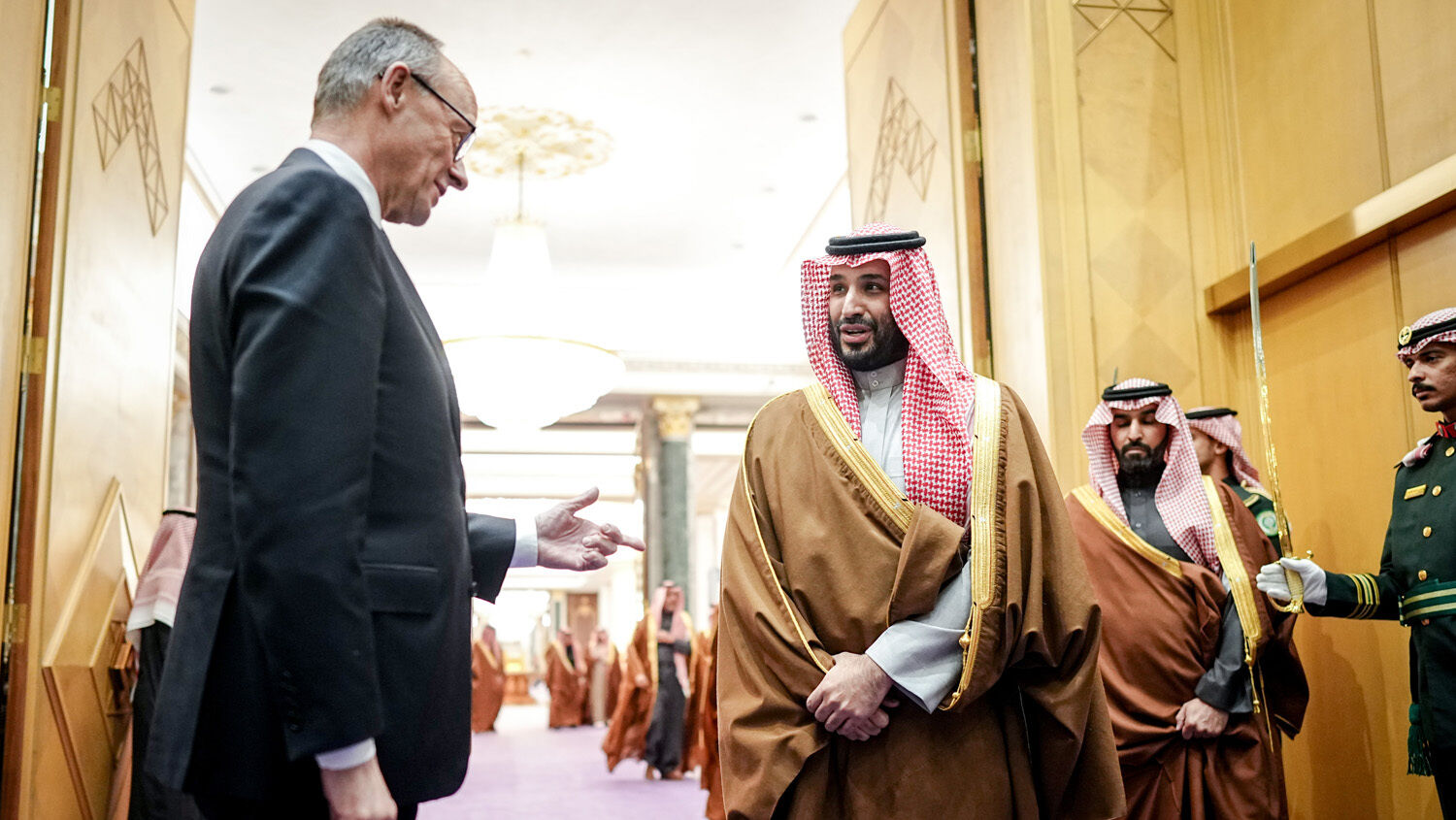
Let Down by America, Will Saudi Arabia Turn to Germany?
After Iran effectively closed the Strait of Hormuz earlier this year, Saudi Arabia relied on its East-West Pipeline to bypass the strait and transport oil to the Red Sea.
But on September 10, drones launched from Iraq struck the pipeline, forcing Saudi Arabia to shut it down temporarily. This threatens Saudi oil exports and, by extension, could threaten Europe’s energy supply. This comes on top of recent attacks by the Iran-backed Houthi terrorist group on Saudi Arabian military targets.
In both cases, the Saudi government can expect little help from the United States.
Reuters reported on September 14 that Saudi Crown Prince Mohammed bin Salman requested military assistance from U.S. President Donald Trump to help fight the Houthis. Instead of promising to strike the Houthis, the Trump administration allegedly only offered intelligence-sharing and targeting assistance. America’s response is absurdly insufficient, as the Daily Telegraph’s chief foreign affairs commentator David Blair remarked:
It’s a big escalation.
And historically, if a hostile armed group had seized control of the islands that command the Bab el-Mandeb strait, which is, after all, one of the great choke points of the world, and if simultaneously one of their allies had knocked out the Saudi East-West oil pipeline with the clear aim of paralyzing all Saudi oil exports, historically, that’s the sort of thing that America would have gone to war to prevent.
And it probably would have called upon its allies, and there would have been some kind of concerted military effort to break the stranglehold on the strait and rescue Saudi Arabia’s capacity to export oil. … Instead, Donald Trump is dragging his feet.
That weakness will aggravate the Saudis.
After all it was American strikes on Iran in February that caused the recent escalation and Saudi Arabia’s economic decline. Its economy contracted 4.7 percent year-on-year in 2026’s second quarter due to shortages in oil exports, tourism and other factors.
Saudi Arabia initially advised the U.S. against attacking Iran. The U.S. ignored that advice, which is its prerogative.
Instead of bringing stability to the region, the war has emboldened Iran and its allies to take the Middle East’s vital sea routes hostage—which endangers Saudi Arabia’s livelihood. In that context, Saudi Arabia’s request for military aid isn’t unreasonable.
America’s response shows that Saudi Arabia urgently needs a backup plan.
One powerful ally is just as concerned about the escalation as Saudi Arabia: Germany.
In July, German Chancellor Friedrich Merz said:
The federal government condemns in the strongest terms the Houthi attacks on Saudi ships in the Red Sea. These attacks must cease immediately. Any form of naval blockade is unacceptable.
These reckless attacks jeopardize freedom of navigation and threaten to further undermine regional stability. We stand in solidarity with Saudi Arabia and our partners in the region.
In many ways, Saudi Arabia’s peril is also Germany’s. German news outlet t-online explained: “The Houthis are attacking Saudi Arabia and, at the same time, threatening one of the world’s most important trade routes. The consequences extend far beyond the Gulf—all the way to the German economy.”
The article recounted the Houthis’ recent attacks on Saudi Arabian military targets and wrote:
[A]t the same time, the kingdom is fighting for something even more crucial to its power: its oil. Following drone attacks, the approximately 1,200-kilometer-long East-West Pipeline was shut down. At the same time, the Houthis in Yemen have captured the port city of Mocha and strategically important islands. Their advance thus extends to the Bab el-Mandeb strait, one of the most important trade routes between Asia and Europe. …
As a result, Germany faces a double price shock: from more expensive energy and more expensive trade routes.
Just before the U.S. attacked Iran, Merz visited the Gulf states, promising more extensive arms cooperation. He told journalists:
This is in our mutual interest because we want to ensure that the world becomes safer, and it will only become safer if we are able to defend ourselves.
After Germany simplified arms export licenses to the Gulf states in March, German Economics Minister Katherina Reiche said:
Iran’s indiscriminate attacks on the Gulf states have resulted in an urgent need for military equipment, particularly for air defense.
With the new, temporary license, we are adapting our arms export control procedures for the export of urgently needed arms to these countries to meet these new requirements.
Germany and the Gulf states are uniting in this crisis. But this is just the beginning of a much closer alliance. For decades Trumpet editor in chief Gerald Flurry has prophesied that Germany and Saudi Arabia will form a military alliance against Iran based on prophecies in Psalm 83 and Daniel 11.
After Iran attacked Israel with hundreds of drones, Welt wrote that as pressure on Israel increases, “it will also become clear whether any of Germany’s political capital remains in the Arab world that can help forge an alliance against Iran and stabilize the region.”
Mr. Flurry wrote at the time:
For longtime Trumpet readers, that is an extraordinary statement. Germany is working to forge an alliance of Arab nations against Iran. This is a development we have forecast for years based on Psalm 83. But as we will see, confronting Iran is only part of the alliance’s goal.
This German-led “alliance against Iran” is the very precursor to the Psalm 83 alliance! Though they don’t realize it, geopolitical commentators are talking about this prophecy!
Now that some Arab countries are coming under attack, the formation of this “alliance against Iran” will speed up. Mr. Flurry’s article “The Hidden Danger in Germany’s ‘Alliance Against Iran’” puts these events in the context of Bible prophecy.


