

Polish Your Language
Joe Biden and Donald Trump have said more obscenities than all presidents since 1931 combined—a lot more. Seventy-eight percent of presidential foul language has come from these two presidents.
Today, bad language is no big deal. It is easy to let society’s plummeting standards rub off. But what does the Bible say? Christ said in Matthew 12:36 that “every idle word that men shall speak, they shall give account thereof in the day of judgement.”
“Bad language” can be generally divided into two categories: profanity and obscenity. God’s word forbids both.
Profanity involves any language that blasphemes, insults or disrespects God, or otherwise puts God or the things of God in a negative context. This is so important that God codified it as the Third Commandment: “You shall not take the name of the Lord your God in vain, for the Lord will not hold him guiltless who takes His name in vain” (Exodus 20:7, New King James Version). The Amplified Bible renders this verse: “You shall not take the name of the Lord your God in vain [that is, irreverently, in false affirmations or in ways that impugn the character of God]; for the Lord will not hold guiltless nor leave unpunished the one who takes His name in vain [disregarding its reverence and its power].”
Many regularly use the names of God and Jesus Christ as expletives or as part of jokes. These are the clearest examples of violating this commandment. But it can also take the form of imputing bad character to God. For example, people often use as an expletive words relating to damnation, or God sending somebody or something to “hell.” God wills that all men be saved (1 Timothy 2:1-4) and has no pleasure in the death of the wicked (Ezekiel 33:11). As our booklet The Ten Commandments summarizes: “To call on God to damn someone is to ask God to do something He never desires to do.”
Using euphemisms, or substitutions meant to sound similar to profanity, also violates the Third Commandment.
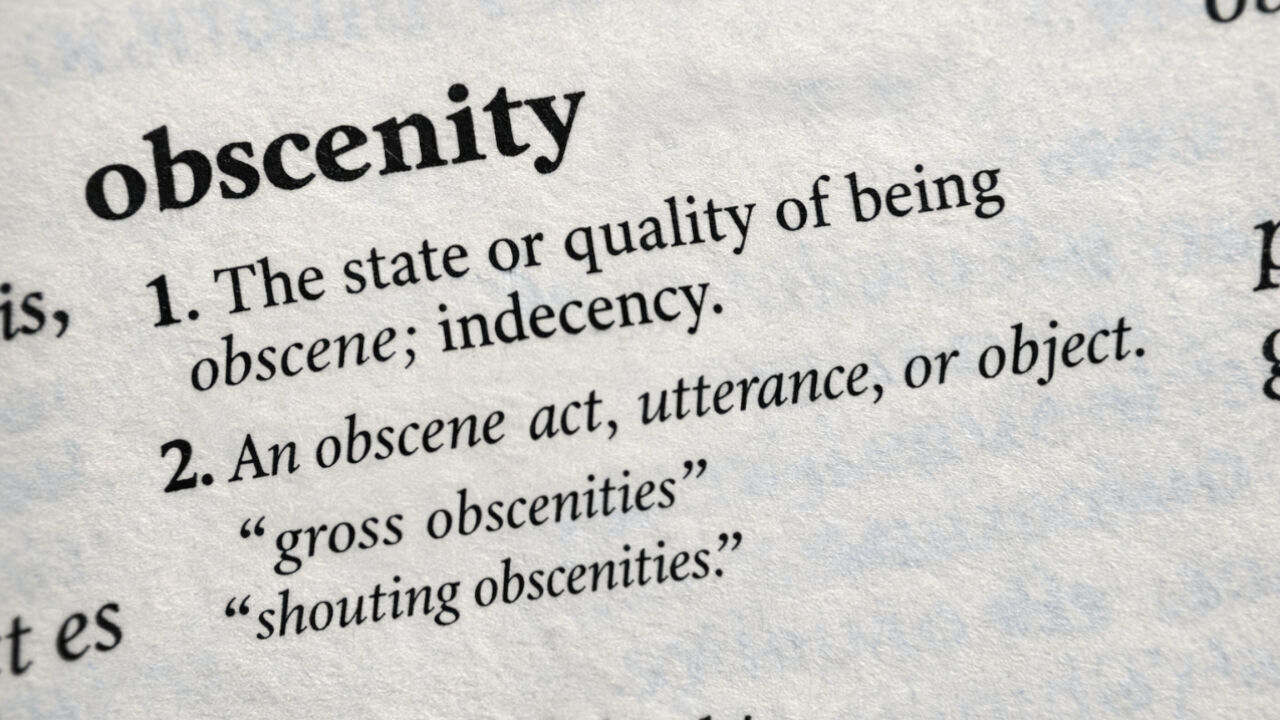
Obscenity refers to language that isn’t specifically taking God’s name in vain but is still crass or vulgar and considered unacceptable to public morality. The Apostle Paul commanded the early Church in Ephesians 4:29: “Let no corrupt communication proceed out of your mouth, but that which is good to the use of edifying ….” The Greek word rendered “communication” is logos, which literally means “word.” The word rendered “corrupt” is defined by Thayer’s Greek Lexicon as “rotten” and “of poor quality.” Paul further wrote in Ephesians 5:4 that “neither filthiness, nor foolish talking, nor coarse jesting” are fitting for Christians (nkjv).
Unfortunately, we live in a world where both profanity and obscenity are everywhere. It is a challenge to not let this world’s culture impact our thinking. Christ said in Matthew 12:34: “[H]ow can ye, being evil, speak good things? for out of the abundance of the heart the mouth speaketh.” What comes out of our mouth reflects the state of our thoughts: “For as he thinketh in his heart,” Proverbs 23:7 reads, “so is he ….”
Paul in another epistle gives the solution to profanity and obscenity: Purify our thinking. He wrote in Philippians 4:8: “[W]hatsoever things are true, whatsoever things are honest, whatsoever things are just, whatsoever things are pure, whatsoever things are lovely, whatsoever things are of good report; if there be any virtue, and if there be any praise, think on these things.”
Filter out entertainment content that normalizes foul language and replace it with positive alternatives. Be conscious of when you use it and stop yourself. Learn to regulate what goes on in your thoughts before it comes out of your mouth. This isn’t just to tick boxes in a divine checklist. Pure communication accomplishes what Paul said in Ephesians 4:29: edifying—building up—to a more wholesome state of being.


