

Germany and Russia, Friend or Foe?
Russia is about to invade another European country. Germany is secretly building nuclear weapons. Russia is using drones to target our infrastructure. Germany is helping Ukraine kill Russians.
These are the common narratives that German and Russia media channels propagate. The narrative leads to an arms race where each side is increasingly preparing for a confrontation. But at the same time Germany and Russia are still cooperating on various levels. What’s going on?
Fueling Fear
In May, Russian Ambassador to Berlin Sergey Nechayev told Izvestia that Germany is providing Ukraine with a large supply of long-range drones and financing the production of military-grade products in Ukraine. He said:
It is telling that, while denying accusations of turning Ukraine into a war zone, Germany is, by all accounts, on a course toward preparing for a military confrontation with Russia. This entails accelerated militarization, expansion of the armed forces, and increased pumping of budgetary and borrowed funds into the military sector.
It wouldn’t be the first time that Germany attempted an invasion of Russia.
In addition, Germany is conducting “active research and development work” with “a nuclear weapons focus,” according to Russia’s Foreign Intelligence Service on July 20. The report claimed that “the relevant ministries of one of the key nato states are expressing concern” as well. It pointed to Germany’s “revanchist sentiments” and Nazi efforts to create wunderwaffen (“wonder weapons”) and asked: “Has history still not taught us anything?!”
Adolf Hitler said before World War ii that if war came, “I should fall upon my enemy suddenly, like lighting striking out of the night.” Russian fears of a German strike aren’t unreasonable.
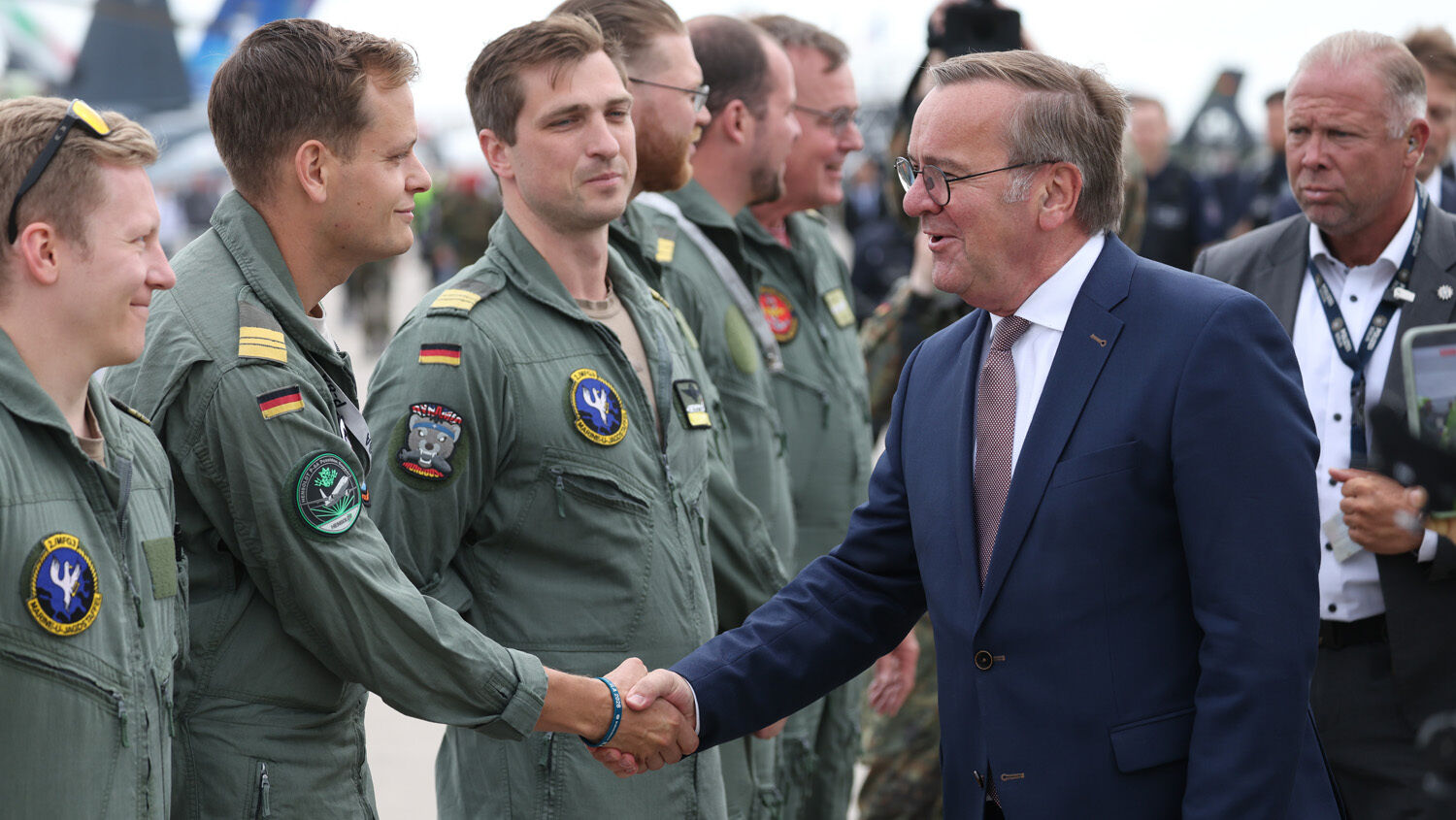
Meanwhile, Germany is stoking fears about Russia. In 2024, German Defense Minister Boris Pistorius said: “We must not believe that [Russian President Vladimir] Putin will stop at Ukraine’s borders if he gets that far. We must be kriegstüchtig [ready for war] by 2029. We must provide a deterrent to prevent things from escalating to the extreme.”
“We have to be prepared. … We must be ready to fight,” Lt. Gen. Christian Freuding, Germany’s army chief, told Politico at the ila Aerospace Show in Berlin in June. “2029 is not a German timeline. It’s nato-agreed intelligence. All 32 nato partners agree that Russia might have the capability to invade a nato partner country in 2029.”
Recent intelligence from the United States shows that Russia could attack a nato member as soon as this fall.
Germany’s Bild reported August 7: “U.S. and European leaders are increasingly seeing signs that Russia is testing nato’s resolve with test attacks. These include Russian cruise missiles that have struck Poland and drones that have repeatedly flown as far as Romania in recent weeks. … According to U.S. officials, Putin’s goal in attacking nato would be to divide the alliance. The fear is that a Putin who is backed into a corner could become even more dangerous.”
In other words, the more weapons Germany and others send to Ukraine, the more likely Putin is to escalate the war or start a second front. And many in Germany fear that U.S. President Donald Trump would not send troops to Europe’s aid.
Of course, Germany can point to Russia’s active war. But Russia can point to Germany’s expansion through the European Union, its participation in nato’s bombing of Yugoslavia, and its recent troop deployment to Lithuania.
It appears Germany and Russia are concerned about each other’s military ambitions. But this isn’t the full story.
Revealing Secret Talks
Germany’s Die Zeit and ard Kontraste exclusively revealed on July 16 that a secret meeting between former German and Russian officials took place July 12 to 14 in Azerbaijan. At a joint press conference with German Chancellor Friedrich Merz (July 21), Azerbaijani President Ilham Aliyev confirmed: “Our territory was used for such a meeting without our knowledge.”
There have been at least four meetings in Baku, Azerbaijan, and Abu Dhabi, United Arab Emirates, since the 2022 Russian invasion of Ukraine. In June, Russian President Vladimir Putin also held a private meeting with former German Chancellor Gerhard Schröder.
The German government denies any involvement in the meetings. But Germany and Russia have a history of secretly working together and Trumpet editor in chief Gerald Flurry has warned that they will again.
According to the investigative report from July 16, the director of the Institute of Europe was present. In a previous confidential report to the Kremlin, his institute suggested stoking “the fear among German citizens of a possible conflict between nato and the Russian Federation.”
Are the two nations exaggerating an imminent military confrontation to excuse their military buildup?
Why Keep Trading?
In his July 2022 article “Germany’s Secret Deal With Russia—Exposed,” Mr. Flurry highlighted how Germany hindered early weapons deliveries to Ukraine and prevented any meaningful sanctions against Russia. This gave the two nations time to reshape their alliance.
One example is Germany and the EU’s energy deals with Russia:
- Germany’s construction of the Nord Stream pipelines followed Russia’s invasion of Georgia in 2008 and Crimea in 2014.
- After Russia’s invasion of Ukraine, the EU—Germany in particular—increased imports of more expensive Russian liquefied natural gas.
- Oil that used to come from Russia was rerouted through India to Europe, which made it more expensive.
- Russian uranium imports increased 70 percent from 2023 to 2024.
- In July this year, Germany’s Environment Ministry for Lower Saxony approved a French-Russian project to produce nuclear fuel rods in Germany.
Despite recent sanctions, German exports to Russia have found clever reroutes:
- German exports to Kazakhstan increased from $1.65 billion in 2021 to $3.6 billion in 2023.
- German exports to Kyrgyzstan reached a high at $783 million in 2023, more than 13 times what it was the year prior to Russia’s invasion of Ukraine.
- The Brookings Institute wrote in 2024 that these transshipments “are large enough to substantially offset the drop in Germany’s direct exports to Russia.”
- A German firm even set up a network to supply Russia’s nuclear weapons and submarine programs with Western dual-use technologies.
Why would two nations that fear an imminent military confrontation have mutually beneficial deals?
Mr. Flurry warned in 2018: “The fact that these two are working so closely together strongly indicates that they agree on a plan to destroy nato.”
What Bible Prophecy Reveals
History should teach us that German and Russian militaristic ambitions are a grave danger to our world. These powers are prophesied to cause great havoc on our earth before clashing with each other.
Mr. Flurry explained:
These two nations are working to empower themselves and each other at the expense of Europe and the U.S.-led world order. Both want to tear down that order and build themselves into great empires! Those empires will inevitably clash, but for now it is in both Germany’s and Russia’s interest to weaken everyone else and strengthen themselves and each other. With this in mind, Germany’s duplicitous behavior is easy to understand.
It is easy to see why Russia wants to undermine nato, but few understand that nato has also prevented Germany’s military ambitions. Germany wants to dominate Europe militarily and U.S. presence prevents other European nations from fully trusting Germany.
By stoking fear of Russia, Germany is rallying Europe behind its plans. Revelation 17:12-13 reveal that “ten kings” will “give their power and strength unto the beast”—a German-led military empire.
However, Bible prophecy also reveals in Isaiah 23, Ezekiel 5 and 27 that Germany will be working together with Russia and China to economically weaken a common enemy: America.
While history warns of this possibility, Bible prophecy proves it. This economic siege will take place during the first year of the prophesied “great tribulation” (Matthew 24:21). Russia, Germany and their allies will take advantage of a weakened U.S., but Germany is prophesied to strike first—which will lead to a final clash between the German axis and the Russian axis. This clash will be so devastating that Christ warned that “except those days should be shortened, there should no flesh be saved: but for the elect’s sake those days shall be shortened” (verse 22).
It is critical to understand this complex relationship between Germany and Russia and know what it means prophetically. Start your study of this subject by reading “Germany’s Secret Deal With Russia—Exposed” and requesting a free copy of Russia and China in Prophecy.


