Why the Government Should Care About Teen Sex

Why the Government Should Care About Teen Sex
Good morning!
For 16 years and $100 million, the U.S. government tried to manage teenage sex with condom demonstrations, contraception counseling and comprehensive sex-ed curricula. The government’s own evaluations found it did not work.

Now it is taking a different approach: promoting … marriage.
- The health department canceled about $66 million in grants for the Teen Pregnancy Prevention Program, which started in 2010.
- Fact Forward, a South Carolina nonprofit, lost its $1.6 million grant effective immediately. The government said the curriculum “encourages, normalizes or promotes sexual activity for minors.”
Roughly $63 million in taxpayer dollars is being redirected toward a model built on fertility awareness, abstinence and marriage, underscoring the truth that marriage is where sex belongs.
- This should not be a remarkable thing for a government to say. But after decades of courts, schools and media treating sexual restraint as backward and marriage as optional, a federal program admitting otherwise is a welcome development.
Strong families are the bulwark of stable societies. Studies prove that intact marriages and happy homes foster human flourishing; improve happiness, health and prosperity; reduce criminality and government dependency; among many other benefits.
- A government that is interested in its people’s well-being will do all it can to promote solid marriages and families. Encouraging sexual restraint in teens is an indispensable part of that.
- A government interested instead in power benefits from dysfunctional, dependent people. It pushes policies that undermine families so their power devolves to government.
God’s government is one of the former. Living according to the Creator’s laws works. At man’s creation, God put marriage before sex: “Therefore shall a man leave his father and his mother, and shall cleave unto his wife” (Genesis 2:24). Every attempt to reorder that sequence has produced more heartbreak, more fatherless children, more dysfunction and confusion.
- Even the federal government now admits, 16 years and $100 million later, that the order was right all along: marriage first.
For God’s design for sex and marriage—and why every substitute for it fails—request your free copy of a truly life-changing book: The Missing Dimension in Sex.
Iran war update
- The United States launched strikes on Iran last night for the 13th consecutive night, damaging Iranian naval assets as well as targets further inland, including an Islamic Revolutionary Guard Corps base in the northern province of Gilan.
- The benchmark price for oil exceeded $100 a barrel yesterday, its highest in more than a month, after at least one Saudi oil tanker was struck Wednesday in attacks claimed by Houthis in Yemen. (The Houthis reported attacking a second ship that has not been verified.)
- Last night, U.S. President Donald Trump threatened that Iranian-linked damage to cargo ships would be compensated by Iranian funds held by the U.S.
Trump Links Saudi Nuke Deal With Abraham Accords
United States President Donald Trump claimed yesterday his nuclear deal with Saudi Arabia, already signed, is now contingent on Saudi Arabia joining the Abraham Accords and normalizing relations with Israel. He said:
The Civil Nuclear Deal (There will be no enrichment of material!) being made between the United States Department of Energy and Saudi Arabia, which pertains only to non-military use such as the ones that Iran and the [United Arab Emirates] (and others) already have, will be approved, but is totally subject to Saudi Arabia joining the very respectful and successful Abraham Accords.
Israeli Prime Minister Benjamin Netanyahu called the idea “a historic leap forward for peace in the Middle East.” The Saudi government has yet to comment.
This appears identical to a deal Trump’s predecessor, Joe Biden, offered the Saudis. (President Trump started the concept during his first term.) That deal was reportedly close to happening before Hamas perpetrated its Oct. 7, 2023, terror massacre.
- To avoid the appearance of siding with Israel over Palestinians, Saudi Arabia has since insisted it will open relations with Israel only if it makes irreversible concessions to the establishment of a Palestinian state.
- With the Palestinian issue now out of mind for many, Saudi Arabia may feel it can go for the terms of the original deal and make significant advances in nuclear technology.
When the original Abraham Accords were announced in 2020, most of the world saw them as a positive development. Trumpet editor in chief Gerald Flurry wrote that the agreements “have a deadly flaw”:
Biblical prophecy gives us deep insight into these agreements. It actually foretells that moderate Arabs will unite, somewhat like we are now seeing. But they are prophesied not to cooperate with the United States or Israel!
Psalm 83 is the prophecy he was referring to, which mentions “the Ishmaelites”—the modern peninsular Arabs—joining an alliance “that the name of Israel may be no more in remembrance” (verses 4, 6).
- Mr. Flurry made his comments regarding the smaller Arab states of Bahrain and the U.A.E. A country with the size and economy of Saudi Arabia—and a nuclear program—could further this prophecy’s momentum even more.
To learn more, read Mr. Flurry’s article “Deadly Flaw in Mideast Peace Deals.”
New Party to Unseat Erdoğan?
Özgür Özel, formerly the leader of Turkey’s Republican People’s Party, announced on July 21 that he has established a new political party: Yeni, meaning “new.” Ninety of the Republican People’s Party’s 135 members of parliament have defected to Yeni, making Özel leader of the opposition.
We opened up a new road because they blocked all the others. We are opening up that road now. Are you ready to march to power? We will march to power.
—Özgür Özel
Why now? Turkish President Recep Tayyip Erdoğan has harassed popular opposition figures through lawfare. His judicial system has imprisoned his previous main challenger, Istanbul Mayor Ekrem İmamoğlu, on a questionable conviction. In May, the courts stripped Özel of his leadership over the Republican People’s Party. Other prominent opposition figures have faced similar treatment.
- But whereas other figures like prominent mayors have faced arrest, Özel as a sitting member of parliament has legal immunity.
Where to now? Erdoğan has led Turkey since 2003. He has survived previous serious crises. But Özel seems to be the candidate every anti-Erdoğan Turk is now coalescing around.
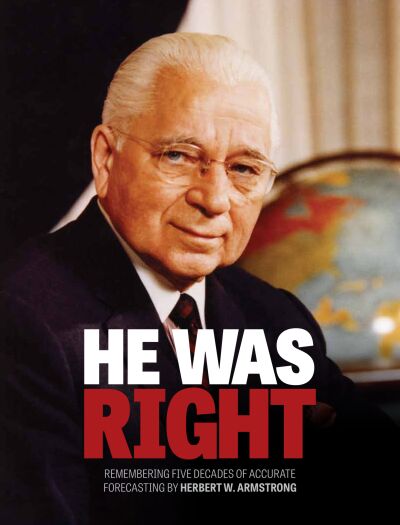
Prophecies in the Psalms, Obadiah and elsewhere show Turkey will serve a crucial geopolitical role in the years ahead. Because of this, the Trumpet watches events in Turkey closely. The chapter “Reviving the Ottoman Empire” in our free booklet He Was Right explains in detail.
Germany Approves Joint Nuclear Project Involving Russia
Germany’s Environment Ministry for Lower Saxony approved a French-Russian project on Wednesday to produce nuclear fuel rods in Germany.
- That’s even though the state’s environment minister, Christian Meyer, said that “dealings and close cooperation with [Russian President Vladimir] Putin’s nuclear agency are totally wrong.”
- He acknowledged, however, that there was “no legal possibility to reject” the application in the absence of sanctions on Russia’s Rosatom government nuclear energy agency.
The companies involved are tvel, a subsidiary of Rosatom and France’s Advanced Nuclear Fuels, a subsidiary of nuclear technology company Framatome.
- Germany used to have a deal with the Russians to get cheap gas. Now it is making nuclear energy deals with them—while they use all possible revenue to kill more people in Ukraine.
Why has Germany not sanctioned Russia’s Rosatom or nuclear energy imports from Russia?
Profit for Germany and Russia: Germany shut down its last nuclear power plants in 2023, but it still imports Russian uranium to resell it. Some Eastern European countries still have nuclear power plants designed in the Soviet era that rely on the fuel rods.
- In 2024, Germany imported 68.6 tons of uranium from Russia, a 70 percent increase from 2023.
- The European Union’s enriched uranium imports from Russia increased eight-fold to $186 million from January to the end of April, compared to the same period last year, according to Eurostat data released June 15.
Bigger context: This isn’t the only example of the EU and Germany continuing to work with Russia.
- The EU also increased its liquefied natural gas imports from Russia in the first six months of this year by 18 percent compared to last year.
- While Germany has sanctioned various imports from Russia, it has always found other ways to keep the relationship going.
Why is Germany still working with Russia? Mr. Flurry explained in the July 2022 issue of the Philadelphia Trumpet:
These two nations are working to empower themselves and each other at the expense of Europe and the U.S.-led world order. Both want to tear down that order and build themselves into great empires! Those empires will inevitably clash, but for now it is in both Germany’s and Russia’s interest to weaken everyone else and strengthen themselves and each other. With this in mind, Germany’s duplicitous behavior is easy to understand.
Learn more by reading “Germany’s Secret Deal With Russia—Exposed.”
IN OTHER NEWS
The significance of Trump’s “new tariffs”: After his initial tariff system was struck down by the Supreme Court on February 20, President Donald Trump immediately imposed a 10 percent global tariff under Section 122 of the 1974 Trade Act, which can last 150 days before requiring congressional approval. This was the first time a president has done so. The instant these tariffs expired today, they were replaced by a new set of tariffs, under Section 301 of the same act. These impose a 10 percent tariff on countries that have taken action against imports produced by forced labor, and a 12.5 percent tariff on countries that have not. Many news outlets are headlining and criticizing the “new Trump tariffs.” The real story is that the tariffs have remained basically the same; they just have a different justification.
Tension snapping in Somalia? Pro-government forces clashed with opposition forces in Somalia’s Puntland state on Monday. Somali government’s historic weakness allowed Puntland and other states to act essentially autonomously for years. Somalia’s government is now growing in power and asserting more control over state governments. The conflicts many feared would follow such a rise may be on the horizon. In early June, Somalia’s ambassador to Ethiopia said the government would re-subjugate the country’s breakaway regions. A few days later, the Somali government unilaterally appointed a military commander over a division based in Puntland and sparked a military standoff. On Monday, Puntland forces attacked a pro-government convoy near its capital, capturing vehicles and troops. Analysts fear this is just the beginning. Bible prophecy shows this region is one we should watch closely.