
Follow the Money
Follow the Money

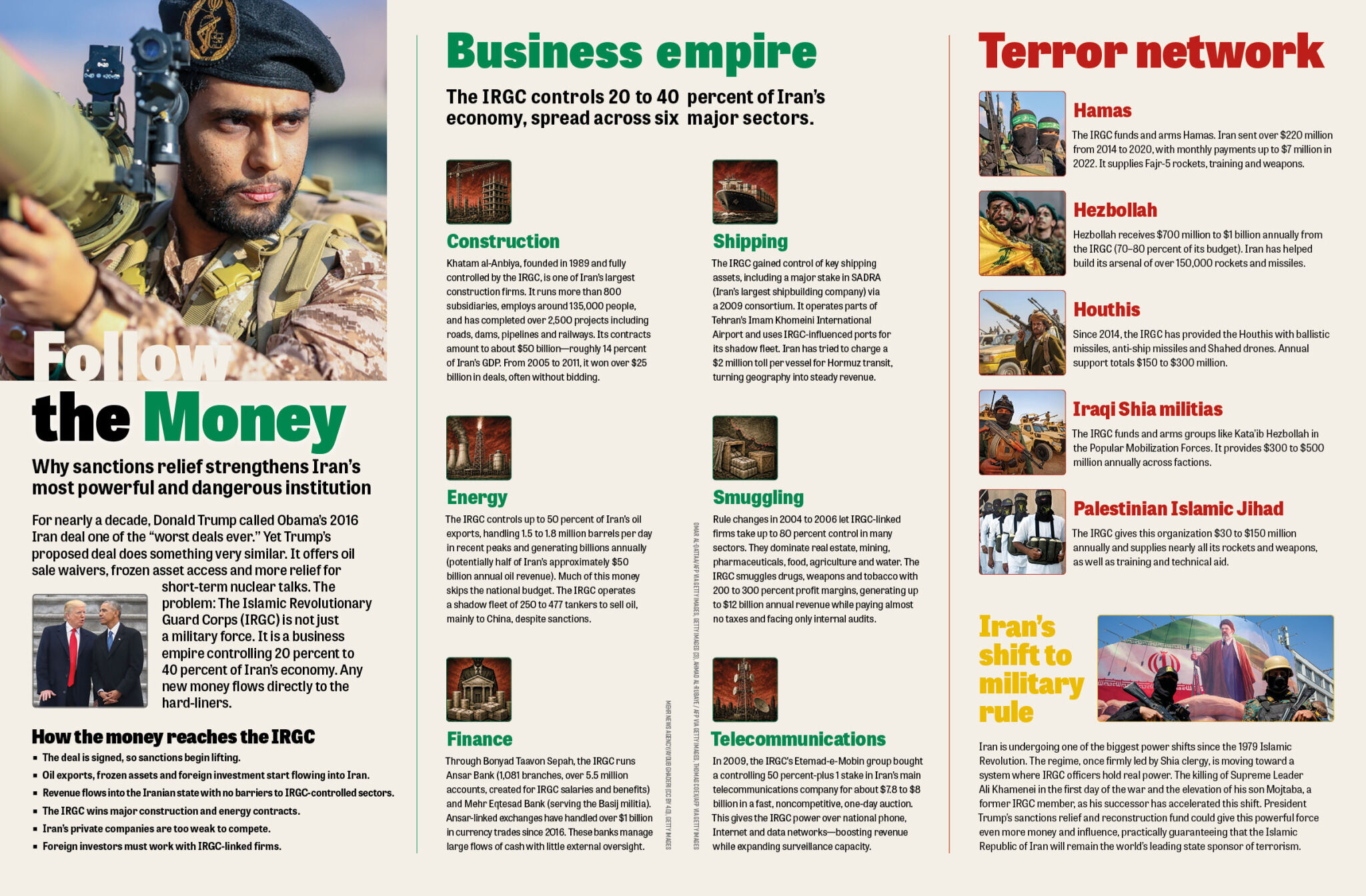
For nearly a decade, Donald Trump called Obama’s 2016 Iran deal one of the “worst deals ever.” Yet Trump’s proposed deal does something very similar. It offers oil sale waivers, frozen asset access and more relief for short-term nuclear talks. The problem: The Islamic Revolutionary Guard Corps (IRGC) is not just a military force. It is a business empire controlling 20 percent to 40 percent of Iran’s economy. Any new money flows directly to the hard-liners.
How the money reaches the IRGC
- The deal is signed, so sanctions begin lifting.
- Oil exports, frozen assets and foreign investment start flowing into Iran.
- Revenue flows into the Iranian state with no barriers to IRGC-controlled sectors.
- The IRGC wins major construction and energy contracts.
- Iran’s private companies are too weak to compete.
- Foreign investors must work with IRGC-linked firms.
Business empire
The IRGC controls 20 to 40 percent of Iran’s economy, spread across six major sectors.
Construction
Khatam al-Anbiya, founded in 1989 and fully controlled by the IRGC, is one of Iran’s largest construction firms. It runs more than 800 subsidiaries, employs around 135,000 people, and has completed over 2,500 projects including roads, dams, pipelines and railways. Its contracts amount to about $50 billion—roughly 14 percent of Iran’s GDP. From 2005 to 2011, it won over $25 billion in deals, often without bidding.
Energy
The IRGC controls up to 50 percent of Iran’s oil exports, handling 1.5 to 1.8 million barrels per day in recent peaks and generating billions annually (potentially half of Iran’s approximately $50 billion annual oil revenue). Much of this money skips the national budget. The IRGC operates a shadow fleet of 250 to 477 tankers to sell oil, mainly to China, despite sanctions.
Finance
Through Bonyad Taavon Sepah, the IRGC runs Ansar Bank (1,081 branches, over 5.5 million accounts, created for IRGC salaries and benefits) and Mehr Eqtesad Bank (serving the Basij militia). Ansar-linked exchanges have handled over $1 billion in currency trades since 2016. These banks manage large flows of cash with little external oversight.
Shipping
The IRGC gained control of key shipping assets, including a major stake in SADRA (Iran’s largest shipbuilding company) via a 2009 consortium. It operates parts of Tehran’s Imam Khomeini International Airport and uses IRGC-influenced ports for its shadow fleet. Iran has tried to charge a $2 million toll per vessel for Hormuz transit, turning geography into steady revenue.
Smuggling
Rule changes in 2004 to 2006 let IRGC-linked firms take up to 80 percent control in many sectors. They dominate real estate, mining, pharmaceuticals, food, agriculture and water. The IRGC smuggles drugs, weapons and tobacco with 200 to 300 percent profit margins, generating up to $12 billion annual revenue while paying almost no taxes and facing only internal audits.
Telecommunications
In 2009, the IRGC’s Etemad-e-Mobin group bought a controlling 50 percent-plus 1 stake in Iran’s main telecommunications company for about $7.8 to $8 billion in a fast, noncompetitive, one-day auction. This gives the IRGC power over national phone, Internet and data networks—boosting revenue while expanding surveillance capacity.
Terror network
Hamas
The IRGC funds and arms Hamas. Iran sent over $220 million from 2014 to 2020, with monthly payments up to $7 million in 2022. It supplies Fajr-5 rockets, training and weapons.
Hezbollah
Hezbollah receives $700 million to $1 billion annually from the IRGC (70–80 percent of its budget). Iran has helped build its arsenal of over 150,000 rockets and missiles.
Houthis
Since 2014, the IRGC has provided the Houthis with ballistic missiles, anti-ship missiles and Shahed drones. Annual support totals $150 to $300 million.
Iraqi Shia militias
The IRGC funds and arms groups like Kata’ib Hezbollah in the Popular Mobilization Forces. It provides $300 to $500 million annually across factions.
Palestinian Islamic Jihad
The IRGC gives this organization $30 to $150 million annually and supplies nearly all its rockets and weapons, as well as training and technical aid.
Iran’s shift to military rule
Iran is undergoing one of the biggest power shifts since the 1979 Islamic Revolution. The regime, once firmly led by Shia clergy, is moving toward a system where IRGC officers hold real power. The killing of Supreme Leader Ali Khamenei in the first day of the war and the elevation of his son Mojtaba, a former IRGC member, as his successor has accelerated this shift. President Trump’s sanctions relief and reconstruction fund could give this powerful force even more money and influence, practically guaranteeing that the Islamic Republic of Iran will remain the world’s leading state sponsor of terrorism.


