
Surrender to Iran
Surrender to Iran
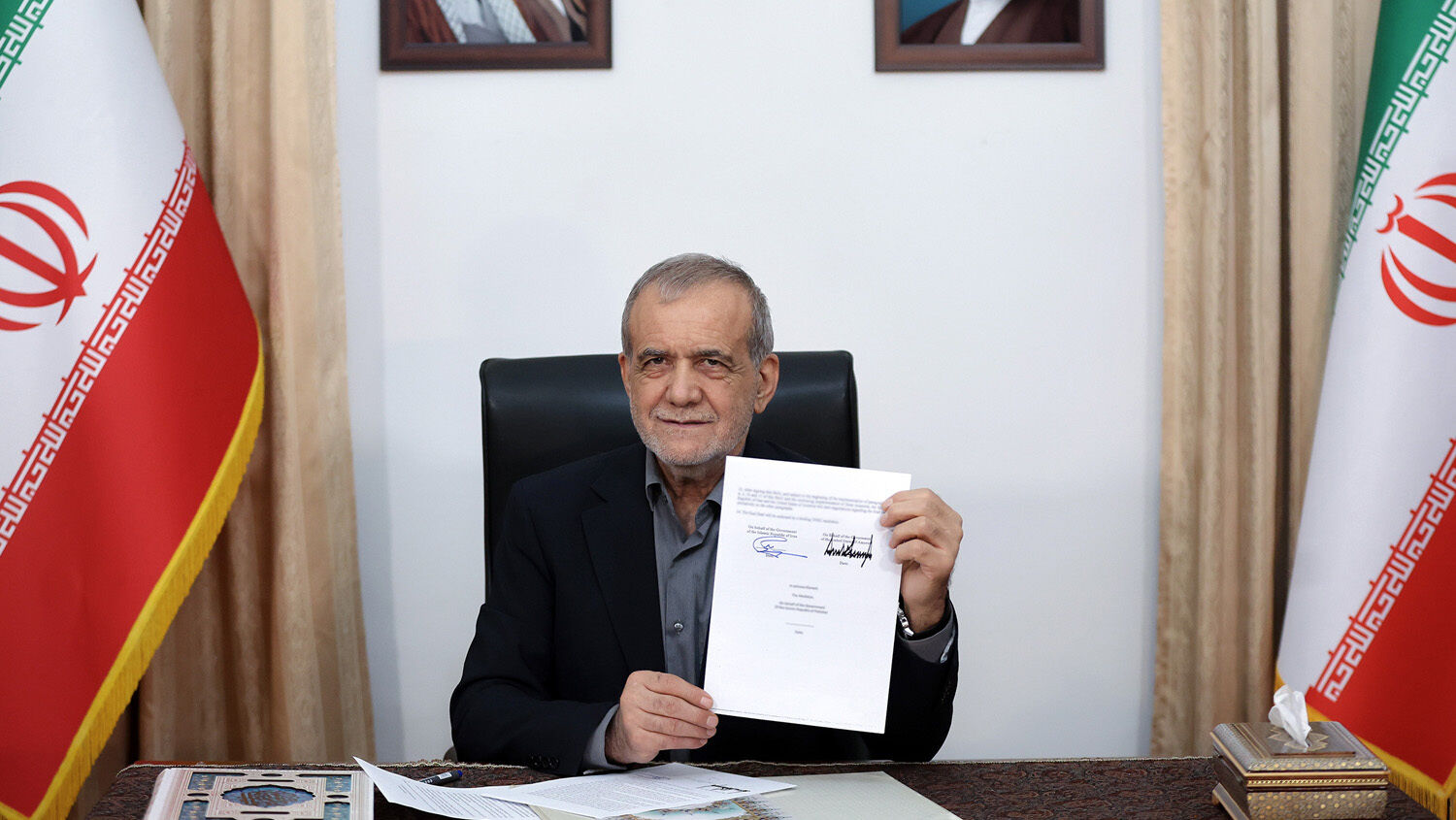
President Trump signed his deal with Iran yesterday, a 14-point Memorandum of Understanding aimed at ending the four-month conflict. Iranian President Masoud Pezeshkian separately signed the agreement in Tehran.
The White House calls it a triumph. In reality, it’s a surrender.

Consider what is being conceded:
- Iran keeps effective control over shipping through the Strait of Hormuz.
- Iran’s ballistic missile program goes unrestrained.
- America commits to ending all sanctions. Frozen Iranian assets, more than $100 billion, are released.
- Funding for terrorist proxies continues unrestricted.
- Hezbollah survives, untouched, regardless of what it does to Israeli citizens in the north.
- The U.S. and its regional partners pledge to bankroll a $300 billion “reconstruction” fund—for the very regime that has been launching missiles at American and Israeli targets.
Meanwhile, Iran’s only real commitment is to reaffirm, again, that it does not want a nuclear weapon. This is the same assurance it gave in 2015, under the Obama deal my father called “the worst foreign-policy blunder in American history”—the same deal Trump called “the worst deal ever negotiated” and a “disaster,” and that he withdrew from when he became president.
- President Trump described Iran’s new leadership this way: “We’re dealing with people that I think are very rational people. … They’re not radicalized.”
America snatches defeat from the jaws of victory, yet again.
- When Trump started his second term, Israel was on the verge of finishing Hamas. America stopped it.
- Israel has been making progress against Hezbollah. America is preventing that too.
- Now Iran itself—weakened, exposed, its military reportedly devastated—is being handed a lifeline.
“Trump has chosen this moment, when the Iranian regime was weakening by the day, to take his knee off its windpipe by lifting the U.S. blockade of Iranian ships.”
—Melanie Phillips
Why does this keep happening? Because of a delusion at the heart of Western foreign policy: the belief that any conflict can be solved through negotiation—no matter who sits across the table or what they have sworn to do to you.
- Vice President JD Vance has defended the agreement by attacking its critics, accusing them of demanding unrealistic “unconditional surrender” and an endless war. But unconditional surrender was the stated goal at the start of this conflict. Now Trump and Vance are capitulating and calling it peace.
The Bible has a name for this kind of agreement. Speaking of the peace deals nations would attempt involving the Jewish state in the end time, God says in Jeremiah 30:12-13: “Thy bruise is incurable, and thy wound is grievous. There is none to plead thy cause, that thou mayest be bound up: thou hast no healing medicines.”
- A negotiated peace with an enemy that has made no concession about its vow to destroy you is not a peace pact. It is a wound.
- It is a symptom of something much deeper: the spiritual sickness described in Leviticus 26 and Deuteronomy 28, where God warns that a nation that forsakes Him will lose its strength before its enemies.
America has surrendered to the world’s chief sponsor of terrorism. It is now allowing the regime to keep operating, enabling it to assert greater control over global oil supplies than before the war, and paying it a third of a trillion dollars to walk away.
The U.S.-Size Void in NATO Will Be Filled by Germany
European nato members are committed to filling the void left by the United States’ withdrawal of some of its forces, nato Secretary General Mark Rutte said yesterday.
- A full review of which assets Europe can replace on its own is expected before the nato summit that begins July 7.
In practice, this will mean that Germany, the Continent’s largest military spender, will fill the void. On the same day, Germany signed a defense pact with Poland, reaffirming that it would assist Poland in the event of an attack.
But some fear Germany’s rising dominance. On Tuesday, in “The New German Military Question,” the Financial Times paraphrased German political scientist and historian Liana Fix as warning that Germany “could become Europe’s next hegemon—beware the perils of German power.”
- Europe has little choice but to rely on Germany to defend it from Russia. Germany currently has the third-largest military in Europe (excluding Russia), is rapidly addressing its readiness issues, and has stationed 5,000 troops in Lithuania to deter Russia.
- Germany has, by far, the largest military budget in Europe, spending $114 billion last year, $25 billion more than the runner-up, Britain. That budget is projected to grow to $185 billion by 2029.
Fears are justified. Bible prophecy warns that Germany will use its imminent military dominance not just for defense against Russia but for its own ambitions, which include conquering the nato superpower it’s replacing.
America at 250: Identity Crisis
A profound identity crisis has gripped the United States. A prri American Identity Survey released yesterday shows that U.S. citizens are less proud of their country, less religiously unified and less likely to believe the American dream still works.
- The poll of 5,469 adults living in all 50 states found that only 51 percent are extremely or very proud of being American, down from 82 percent in 2013.
A deep partisan divide in the nation is apparent in the poll results:
- Republicans are overwhelmingly extremely or very proud to be American (83 percent), compared with fewer than half of independents (43 percent) and fewer than one third of Democrats (31 percent).
- Most Republicans believe being born in America, believing in God and being Christian are important to being “truly American.”
- Only 42 percent of Democrats said being born in America was important to national identity, only 41 percent said believing in God was important, and only 29 percent said being Christian was important.
One reason people are losing faith in America is they don’t know where American virtues come from.
- A separate poll from the Pell Center published yesterday found that 85 percent of respondents agreed with the statement “The United States was built on the idea that everyone is born with rights to life, liberty and the pursuit of happiness.” Yet only 15 percent agreed that “The United States was built on the character of the Anglo-Saxon people, their distinct love of liberty and their sense of glory, destiny and pride.”
- The fact that so few agreed with the second statement reveals a profound ignorance about American culture, heritage, history and virtue.
The idea that everyone is born with unalienable rights to life, liberty and the pursuit of happiness was articulated by Anglo-Saxon philosopher John Locke.
- He argued that because the Bible teaches all men are made in God’s image, they logically possess rights to life, liberty and property as gifts from their Creator.
- Locke did not reach these conclusions in isolation. Raised in a Puritan family and shaped by Protestant thought, he critiqued the Roman Catholic Church’s approach to government by appealing to principles rooted in Mosaic law and natural law reasoning.
If modern Americans lose the Anglo-Saxon culture that embraced the biblical truth that all men are born with unalienable rights to life, liberty and the pursuit of happiness, they lose the principles and purpose for which their country exists.
- God spread the idea of unalienable rights across the globe by using “the Anglo-Saxon people, their distinct love of liberty and their sense of glory, destiny and pride.”
Learn more about America’s most important history in “Rediscovering Our Anglo-Saxon Heritage” in the special America 250 July issue of the Philadelphia Trumpet.
IN OTHER NEWS
‘Gallant Boar 2026’: Poland, Lithuania and France are conducting military exercises from June 16 to 26 involving about 10,000 personnel. The drills will focus on defending Poland’s Suwałki Gap, a 40-mile-wide area bordering Lithuania and separating Russia’s heavily militarized Kaliningrad exclave from its close ally, Belarus. In the event of a conflict between Russia and nato, the narrow strip will likely become a key battleground.
Finland OKs nuclear weapons: Finnish lawmakers voted yesterday to remove a ban that denied allies the ability to station nuclear weapons on Finnish soil. “The weapons would only be allowed into Finnish territory to defend the country or to enable nato’s defense operations and cooperation,” Defense Minister Antti Hakkanen said. This comes as France has signed agreements to defend other nato allies with its nuclear arsenal.
Russia and Iran will integrate banking systems: Russia and Iran expect to fully connect their banking payment networks within two months, Iran’s central bank chief announced during a visit to Moscow on Tuesday. The move is part of a broader effort to reduce reliance on the U.S. dollar and shield their economies from Western sanctions. While it won’t dethrone the dollar on its own, the integration represents yet another crack in the foundations of the dollar-centric global financial system that has underpinned American power for decades.
A new report into Muslim rape gangs published by British M.P. Rupert Lowe has shone a spotlight on one of Britain’s most disgusting crime waves. The report highlights a genuine problem that politicians refuse to address, though flaws in its research will make it easier for them to ignore. The report states that 250,000 young white girls were attacked by these gangs but offers limited evidence to support such a shockingly high figure. Footnotes often point to smaller blogs and lead to a fruitless search for original sources. But this is actually a symptom of the same problem: Government departments and major news organizations have more resources for a more comprehensive report, yet have refused for years to compile one. Britain’s embrace of mass migration and multiculturalism has caused tremendous destruction that authorities refuse to look at.
The Philadelphia Trumpet is a monthly newsmagazine. Unlike any other publication currently in circulation, it doesn’t just report the news—it explains why the news happens. It goes beyond analyzing current events, and dares to forecast what will happen in the months and years ahead. Articles address the meaning behind geopolitical shifts, economic trends and social conditions, showing where all these events are heading. How? The Trumpet uses the Holy Bible as its foundational resource: It is able to see sharply into the future, because it brings focus to information about world events through the dual lenses of biblical history and prophecy.


